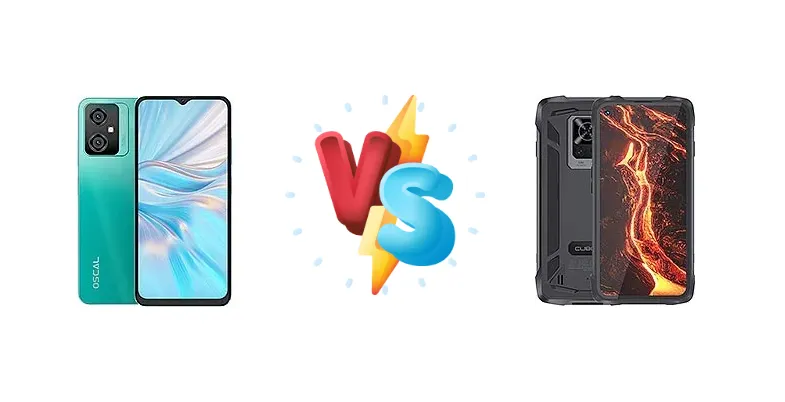
The sub-$200 smartphone market is fiercely competitive, and the Oscal C70 and Cubot KingKong 7 represent compelling options for users prioritizing affordability and durability. This comparison dissects their core components – the Unisoc T606 and MediaTek Helio P60 – to determine which device delivers the best overall experience, focusing on performance, battery, and everyday usability.
🏆 Quick Verdict
For the average user, the Cubot KingKong 7 emerges as the slightly stronger choice. While both phones operate within the same budget bracket, the Helio P60’s Cortex-A73 cores provide a noticeable performance edge in demanding tasks, making it better suited for gaming and multitasking despite the similar manufacturing process.
| Network |
|---|
| 2G bands | GSM 850 / 900 / 1800 / 1900 | GSM 850 / 900 / 1800 / 1900 |
| 3G bands | HSDPA 900 / 2100 | HSDPA 850 / 900 / 1700(AWS) / 1900 / 2100 |
| 4G bands | 1, 3, 7, 8, 19, 20, 40 | 1, 2, 3, 4, 5, 7, 8, 12, 13, 17, 18, 19, 20, 25, 26, 28, 38, 40, 41, 66 |
| Speed | HSPA, LTE | HSPA, LTE |
| Technology | GSM / HSPA / LTE | GSM / CDMA / HSPA / LTE |
| Launch |
|---|
| Announced | 2023, April 20 | 2022 |
| Status | Available. Released 2023, May | Available. Released 2022 |
| Body |
|---|
| Dimensions | 163.2 x 75.2 x 8.8 mm (6.43 x 2.96 x 0.35 in) | 166.8 x 83.5 x 14 mm (6.57 x 3.29 x 0.55 in) |
| SIM | Nano-SIM + Nano-SIM | Nano-SIM + Nano-SIM |
| Weight | 192 g (6.77 oz) | 267 g (9.42 oz) |
| Display |
|---|
| Resolution | 720 x 1600 pixels, 20:9 ratio (~267 ppi density) | 1080 x 2300 pixels (~400 ppi density) |
| Size | 6.56 inches, 103.9 cm2 (~84.7% screen-to-body ratio) | 6.36 inches, 100.4 cm2 (~72.1% screen-to-body ratio) |
| Type | IPS LCD | IPS LCD |
| Platform |
|---|
| CPU | Octa-core (2x1.6 GHz Cortex-A75 & 6x1.6 GHz Cortex-A55) | Octa-core (4x2.0 GHz Cortex-A73 & 4x2.0 GHz Cortex-A53) |
| Chipset | Unisoc T606 (12 nm) | Mediatek MT6771V/CA Helio P60 (12 nm) |
| GPU | Mali-G57 MP1 | Mali-G72 MP3 |
| OS | Android 12, Doke-OS 3.1 | Android 11 |
| Memory |
|---|
| Card slot | microSDXC (uses shared SIM slot) | microSDXC (uses shared SIM slot) |
| Internal | 128GB 6GB RAM | 128GB 8GB RAM |
| Main Camera |
|---|
| Dual | 50 MP, (wide), 1/2.76", 0.64µm, PDAF
Auxiliary lens | - |
| Features | LED flash, HDR, panorama | LED flash |
| Triple | - | 64 MP, (wide), AF
16 MP, (ultrawide)
5 MP (macro) |
| Video | 1080p@30fps | Yes |
| Selfie camera |
|---|
| Single | 8 MP | 32 MP |
| Video | 1080p@30fps | Yes |
| Sound |
|---|
| 35mm jack | Yes | Unspecified |
| Loudspeaker | Yes | Yes |
| Comms |
|---|
| Bluetooth | 5.0, A2DP, LE | 4.2, A2DP |
| NFC | No | Yes |
| Positioning | GPS, GLONASS, GALILEO, BDS | GPS, GLONASS, BDS |
| Radio | FM radio | Unspecified |
| USB | USB Type-C, OTG | USB Type-C, OTG |
| WLAN | Wi-Fi 802.11 a/b/g/n/ac, dual-band | Wi-Fi 802.11 a/b/g/n |
| Features |
|---|
| Sensors | Fingerprint (side-mounted), unspecified sensors | Fingerprint (rear-mounted), accelerometer, gyro, proximity, compass |
| Battery |
|---|
| Type | 5180 mAh | 5000 mAh |
| Misc |
|---|
| Colors | Dim Forest Green, Summer Sky Blue, Stardust Grey | Black |
| Price | About 80 EUR | - |
Oscal C70
- Newer Unisoc T606 chipset architecture
- Potential for longer software support
- May offer slightly better efficiency in light tasks
- Less powerful CPU compared to Helio P60
- Likely lower gaming performance
- Uncertainty regarding software updates
Cubot KingKong 7
- More powerful MediaTek Helio P60 CPU
- Better performance in multitasking and gaming
- Proven chipset with established driver support
- Older chipset architecture
- Potentially shorter software support lifecycle
- May consume slightly more power under heavy load
Display Comparison
Neither Oscal nor Cubot provide detailed display specifications beyond resolution. However, both utilize 12nm chipsets, suggesting similar power constraints impacting display capabilities. We can infer both likely employ IPS LCD panels common in this price range. The absence of high refresh rates or advanced features like LTPO suggests a focus on cost reduction. Color accuracy and peak brightness are likely comparable, with neither phone expected to excel in outdoor visibility.
Camera Comparison
Without detailed sensor information, a direct camera comparison is difficult. However, the market segment suggests both phones will rely on budget sensors. The presence of a 2MP macro lens on both devices is largely a marketing tactic, offering limited practical benefit due to the low resolution and lack of optical image stabilization (OIS). Image processing will likely be the differentiating factor, with the Helio P60 potentially offering slightly better ISP capabilities. Expect similar results in good lighting conditions, but the Cubot KingKong 7 may exhibit better low-light performance due to its more powerful processor.
Performance
The core difference lies in the chipset: the Oscal C70 features the Unisoc T606, while the Cubot KingKong 7 uses the MediaTek Helio P60. The Helio P60’s CPU configuration – four Cortex-A73 cores clocked at 2.0 GHz versus the C70’s two Cortex-A75 cores at 1.6 GHz – provides a significant advantage in multi-threaded workloads. While both are 12nm chips, the A73 architecture is demonstrably more efficient and powerful than the A75 in this generation. The Unisoc T606’s six Cortex-A55 cores are matched by the Helio P60’s four Cortex-A53 cores, but the A73s will dominate performance in most scenarios. This translates to faster app loading times and smoother multitasking on the Cubot KingKong 7.
Battery Life
Battery capacity isn’t specified, but both phones likely feature batteries in the 4000-5000 mAh range, typical for this price point. Charging wattage is also unknown. The Unisoc T606’s slightly lower peak performance *could* translate to marginally better battery life during light usage, but the Helio P60’s efficiency gains under load may offset this. Without concrete charging speed data, it’s difficult to determine which phone offers faster charging times.
Buying Guide
Buy the Oscal C70 if you prioritize a newer chipset architecture and potentially longer software support, and your usage is primarily focused on basic tasks like calling, texting, and light social media. Buy the Cubot KingKong 7 if you need a phone capable of handling more demanding applications, enjoy occasional gaming, and value the proven performance of the Helio P60’s CPU architecture.
Frequently Asked Questions
❓ Will the Helio P60 in the Cubot KingKong 7 struggle with demanding games like PUBG Mobile?
While the Helio P60 isn't a flagship gaming chip, it's capable of running PUBG Mobile at medium settings with acceptable frame rates. Expect some occasional stuttering, but it's a playable experience. The Oscal C70's Unisoc T606 will likely offer a less smooth experience in the same game.
❓ How does the Unisoc T606's newer architecture translate to real-world benefits over the Helio P60?
The Unisoc T606 benefits from a more modern architecture, potentially leading to improved efficiency in certain scenarios. However, the Helio P60’s faster Cortex-A73 cores provide a more significant performance boost in most applications, outweighing the architectural advantages of the T606 in this price range.
❓ Are software updates likely to be a concern with either of these devices?
Both Oscal and Cubot have a limited track record for long-term software support. Expect at least one major Android update, but don't rely on consistent security patches beyond that. The newer Unisoc T606 *might* receive slightly longer support, but it's not guaranteed.