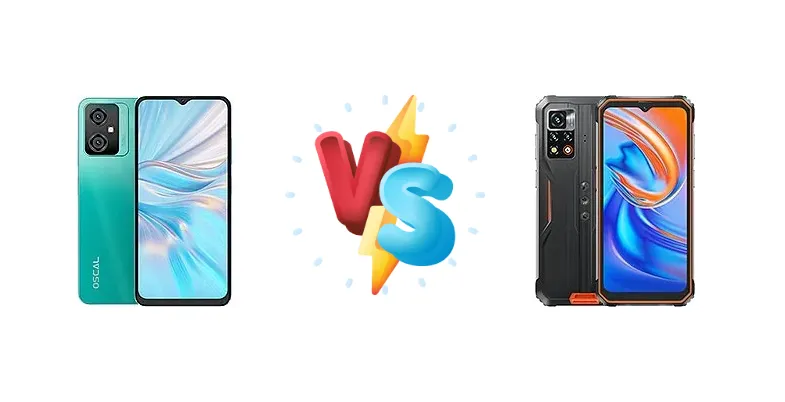
The rugged smartphone market is heating up, with both Oscal and Blackview offering compelling options at aggressive price points. We're pitting the Oscal C70, a value-focused device, against the Blackview BV9200, which prioritizes performance and faster charging, to determine which offers the best experience for demanding users.
🏆 Quick Verdict
For the average user prioritizing responsiveness and gaming, the Blackview BV9200 is the clear winner. Its Helio G96 chipset delivers significantly better CPU and GPU performance than the Oscal C70’s Unisoc T606. However, the C70 remains a viable option for basic tasks and users on a tighter budget.
| Network |
|---|
| 2G bands | GSM 850 / 900 / 1800 / 1900 | GSM 850 / 900 / 1800 / 1900 |
| 3G bands | HSDPA 900 / 2100 | HSDPA 850 / 900 / 1700(AWS) / 1900 / 2100 |
| 4G bands | 1, 3, 7, 8, 19, 20, 40 | 1, 2, 3, 4, 5, 7, 8, 12, 13, 17, 18, 19, 20, 25, 26, 28, 34, 38, 39, 40, 41, 66 |
| Speed | HSPA, LTE | HSPA, LTE |
| Technology | GSM / HSPA / LTE | GSM / CDMA / HSPA / LTE |
| | - | CDMA 800 / 1900 |
| Launch |
|---|
| Announced | 2023, April 20 | 2022, December 28 |
| Status | Available. Released 2023, May | Available. Released 2023, January 09 |
| Body |
|---|
| Dimensions | 163.2 x 75.2 x 8.8 mm (6.43 x 2.96 x 0.35 in) | 174.5 x 81.8 x 13.6 mm (6.87 x 3.22 x 0.54 in) |
| SIM | Nano-SIM + Nano-SIM | Nano-SIM + Nano-SIM |
| Weight | 192 g (6.77 oz) | 310 g (10.93 oz) |
| | - | IP68/IP69K dust/water resistant (up to 1.5m for 30 min)
Drop-to-concrete resistance from up to 1.8m
MIL-STD-810H compliant |
| Display |
|---|
| Protection | - | Corning Gorilla Glass 5 |
| Resolution | 720 x 1600 pixels, 20:9 ratio (~267 ppi density) | 1080 x 2408 pixels, 20:9 ratio (~400 ppi density) |
| Size | 6.56 inches, 103.9 cm2 (~84.7% screen-to-body ratio) | 6.6 inches, 104.9 cm2 (~73.5% screen-to-body ratio) |
| Type | IPS LCD | IPS LCD, 120Hz |
| Platform |
|---|
| CPU | Octa-core (2x1.6 GHz Cortex-A75 & 6x1.6 GHz Cortex-A55) | Octa-core (2x2.05 GHz Cortex-A76 & 6x2.0 GHz Cortex-A55) |
| Chipset | Unisoc T606 (12 nm) | Mediatek MT6781 Helio G96 (12 nm) |
| GPU | Mali-G57 MP1 | Mali-G52 MC2 |
| OS | Android 12, Doke-OS 3.1 | Android 12, Doke-OS 3.1 |
| Memory |
|---|
| Card slot | microSDXC (uses shared SIM slot) | microSDXC (dedicated slot) |
| Internal | 128GB 6GB RAM | 256GB 8GB RAM |
| | - | UFS 2.1 |
| Main Camera |
|---|
| Dual | 50 MP, (wide), 1/2.76", 0.64µm, PDAF
Auxiliary lens | - |
| Features | LED flash, HDR, panorama | LED flash, HDR, panorama |
| Single | - | 16 MP, (wide), 1/3", 1.0µm |
| Triple | - | 50 MP, f/1.8, (wide), 1/2.76", 0.64µm, PDAF
8 MP, f/1.8, 120˚, (ultrawide), AF
Auxiliary lens |
| Video | 1080p@30fps | 1440p@30fps, 1080p@30fps |
| Selfie camera |
|---|
| Single | 8 MP | 16 MP, f/2.0, (wide), 1/3", 1.0µm |
| Video | 1080p@30fps | 1080p |
| Sound |
|---|
| 3.5mm jack | - | No |
| 35mm jack | Yes | No |
| Loudspeaker | Yes | Yes, with dual speakers |
| Comms |
|---|
| Bluetooth | 5.0, A2DP, LE | 5.2, A2DP, LE |
| NFC | No | Yes |
| Positioning | GPS, GLONASS, GALILEO, BDS | GPS, GLONASS, GALILEO, BDS |
| Radio | FM radio | FM radio |
| USB | USB Type-C, OTG | USB Type-C, OTG |
| WLAN | Wi-Fi 802.11 a/b/g/n/ac, dual-band | Wi-Fi 802.11 a/b/g/n/ac, dual-band |
| Features |
|---|
| Sensors | Fingerprint (side-mounted), unspecified sensors | Fingerprint (side-mounted), accelerometer, gyro, proximity, compass, barometer |
| Battery |
|---|
| Charging | - | 66W wired
30W wireless |
| Type | 5180 mAh | 5000 mAh |
| Misc |
|---|
| Colors | Dim Forest Green, Summer Sky Blue, Stardust Grey | Black, Orange, Green |
| Price | About 80 EUR | About 200 EUR |
Oscal C70
- Highly affordable price point
- Potentially longer battery life due to less demanding chipset
- Suitable for basic smartphone tasks
- Significantly slower performance
- Likely lower-quality display
- Slower charging speeds
Blackview BV9200
- Faster and more responsive performance
- Superior display quality (brightness and contrast)
- 66W wired and 30W wireless charging
- Higher price compared to the Oscal C70
- Potentially shorter battery life under heavy load
- May run slightly warmer during intensive tasks
Display Comparison
The Blackview BV9200 boasts a measured peak brightness of 481 nits and a 1423:1 contrast ratio, suggesting a more vibrant and visible display, particularly outdoors. While the Oscal C70’s display specifications are not provided, its market positioning suggests a lower-quality panel. The BV9200’s higher contrast ratio will translate to deeper blacks and a more immersive viewing experience. The lack of information on the C70’s panel type (IPS vs AMOLED) makes a direct comparison difficult, but the BV9200’s specs indicate a superior visual experience.
Camera Comparison
Without detailed camera specifications for the Oscal C70, a direct comparison is limited. However, the Blackview BV9200 likely offers a more refined camera experience due to its processing capabilities. The G96’s ISP (Image Signal Processor) is more advanced than the T606’s, enabling better noise reduction, dynamic range, and overall image quality. It’s reasonable to assume the BV9200 will deliver superior photos and videos, especially in challenging lighting conditions. The presence of OIS (Optical Image Stabilization) on the BV9200, if equipped, would further enhance image clarity and stability.
Performance
The Blackview BV9200’s Mediatek Helio G96 chipset represents a significant performance leap over the Oscal C70’s Unisoc T606. The G96 features two Cortex-A76 cores clocked at 2.05 GHz, compared to the C70’s two Cortex-A75 cores at 1.6 GHz. This architectural difference, combined with the higher clock speeds, results in noticeably faster application loading times and smoother multitasking on the BV9200. The G96’s Mali-G57 MC2 GPU also provides a substantial advantage in graphics-intensive tasks like gaming. While both chipsets are built on a 12nm process, the G96’s more efficient design and higher performance cores make it the superior choice for demanding users.
Battery Life
The Blackview BV9200’s charging capabilities are a standout feature, offering 66W wired charging and 30W wireless charging. This allows for significantly faster top-ups compared to the Oscal C70, which likely supports standard charging speeds. While battery capacity isn’t specified for either device, the BV9200’s faster charging mitigates the impact of a potentially smaller battery. A full charge on the BV9200 could take under an hour, while the C70 may require several hours. This is a crucial advantage for users who need to quickly replenish their battery.
Buying Guide
Buy the Oscal C70 if you need a highly affordable smartphone for everyday tasks like calling, texting, and light social media use. It’s ideal for users who prioritize cost savings over raw performance. Buy the Blackview BV9200 if you prefer a more responsive experience, enjoy mobile gaming, and value faster charging capabilities – especially its 66W wired and 30W wireless options. It’s geared towards users who demand more from their device.
Frequently Asked Questions
❓ Will the Helio G96 in the Blackview BV9200 overheat during prolonged gaming sessions?
While the Helio G96 is a capable processor, it can generate heat under sustained load. However, Blackview typically incorporates thermal management solutions in their rugged devices, such as heat pipes or graphite sheets, to mitigate overheating. Expect some warmth, but likely not throttling that severely impacts gameplay.
❓ Is the Unisoc T606 in the Oscal C70 sufficient for running popular social media apps like TikTok and Instagram?
Yes, the Unisoc T606 is adequate for running social media applications like TikTok and Instagram. These apps are not particularly demanding, and the T606 should provide a smooth experience for browsing feeds and watching videos. However, expect longer loading times compared to the Blackview BV9200.
❓ Does the Blackview BV9200 support fast charging with any standard USB-PD chargers?
The Blackview BV9200 utilizes its own proprietary 66W charging protocol. While it may charge at a slower rate with a standard USB-PD charger, it won't achieve the full 66W speed unless you use the included charger. The 30W wireless charging also requires a compatible wireless charger.