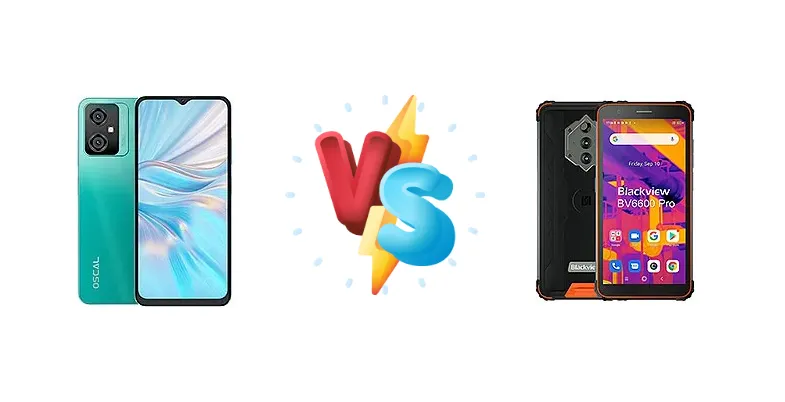
The sub-$200 smartphone market is fiercely competitive, and both the Oscal C70 and Blackview BV6600 Pro aim to deliver a blend of durability and functionality. While both fall into the rugged phone category, they diverge significantly in their core processing power. This comparison dissects those differences, focusing on how the Unisoc T606 in the C70 stacks up against the MediaTek Helio P35 in the BV6600 Pro, and who benefits most from each device's strengths.
🏆 Quick Verdict
For the average user prioritizing responsiveness and future-proofing, the Oscal C70 emerges as the better choice. Its Unisoc T606 chipset, utilizing newer Cortex-A75 cores, offers a noticeable performance advantage over the aging Helio P35 in the Blackview BV6600 Pro, despite the latter's 18W charging.
| Network |
|---|
| 2G bands | GSM 850 / 900 / 1800 / 1900 | GSM 850 / 900 / 1800 / 1900 |
| 3G bands | HSDPA 900 / 2100 | HSDPA 850 / 900 / 1700(AWS) / 1900 / 2100 |
| 4G bands | 1, 3, 7, 8, 19, 20, 40 | 1, 2, 3, 4, 5, 7, 8, 12, 13, 17, 19, 18, 20, 28, 25, 26, 38, 40, 41, 66 |
| Speed | HSPA, LTE | HSPA, LTE |
| Technology | GSM / HSPA / LTE | GSM / CDMA / HSPA / CDMA2000 / LTE |
| | - | CDMA2000 1x |
| Launch |
|---|
| Announced | 2023, April 20 | 2021, September 28 |
| Status | Available. Released 2023, May | Available. Released 2021, October |
| Body |
|---|
| Dimensions | 163.2 x 75.2 x 8.8 mm (6.43 x 2.96 x 0.35 in) | 159 x 79.4 x 18 mm (6.26 x 3.13 x 0.71 in) |
| SIM | Nano-SIM + Nano-SIM | Nano-SIM + Nano-SIM |
| Weight | 192 g (6.77 oz) | 325 g (11.46 oz) |
| | - | IP68/IP69K dust/water resistant (up to 1.5m for 30 min)
Drop-to-concrete resistance from up to 1.5m
MIL-STD-810G compliant |
| Display |
|---|
| Protection | - | Dragontrail Glass |
| Resolution | 720 x 1600 pixels, 20:9 ratio (~267 ppi density) | 720 x 1440 pixels, 18:9 ratio (~282 ppi density) |
| Size | 6.56 inches, 103.9 cm2 (~84.7% screen-to-body ratio) | 5.7 inches, 83.8 cm2 (~66.4% screen-to-body ratio) |
| Type | IPS LCD | IPS LCD |
| Platform |
|---|
| CPU | Octa-core (2x1.6 GHz Cortex-A75 & 6x1.6 GHz Cortex-A55) | Octa-core (4x2.35 GHz Cortex-A53 & 4x1.8 GHz Cortex-A53) |
| Chipset | Unisoc T606 (12 nm) | Mediatek MT6765V/CA Helio P35 (12 nm) |
| GPU | Mali-G57 MP1 | PowerVR GE8320 |
| OS | Android 12, Doke-OS 3.1 | Android 11 |
| Memory |
|---|
| Card slot | microSDXC (uses shared SIM slot) | microSDXC |
| Internal | 128GB 6GB RAM | 64GB 4GB RAM |
| | - | eMMC |
| Main Camera |
|---|
| Dual | 50 MP, (wide), 1/2.76", 0.64µm, PDAF
Auxiliary lens | - |
| Features | LED flash, HDR, panorama | Thermal imaging, LED flash |
| Single | - | 8 MP, f/2.0, (wide) |
| Triple | - | 16 MP, f/2.0, (wide), PDAF
5 MP, thermal assisted camera
FLIR thermal camera (Lepton module) |
| Video | 1080p@30fps | 1080p@30fps |
| Selfie camera |
|---|
| Single | 8 MP | 8 MP, f/2.0, (wide) |
| Video | 1080p@30fps | 1080p@30fps |
| Sound |
|---|
| 3.5mm jack | - | No |
| 35mm jack | Yes | No |
| Loudspeaker | Yes | Yes |
| Comms |
|---|
| Bluetooth | 5.0, A2DP, LE | 5.0, A2DP, LE |
| NFC | No | Yes |
| Positioning | GPS, GLONASS, GALILEO, BDS | GPS, GLONASS, GALILEO, BDS |
| Radio | FM radio | FM radio |
| USB | USB Type-C, OTG | USB Type-C 2.0, OTG |
| WLAN | Wi-Fi 802.11 a/b/g/n/ac, dual-band | Wi-Fi 802.11 a/b/g/n/ac |
| Features |
|---|
| Sensors | Fingerprint (side-mounted), unspecified sensors | Fingerprint (side-mounted), accelerometer, gyro, proximity, compass |
| Battery |
|---|
| Charging | - | 18W wired |
| Type | 5180 mAh | 8580 mAh |
| Misc |
|---|
| Colors | Dim Forest Green, Summer Sky Blue, Stardust Grey | Black, Orange, Green |
| Price | About 80 EUR | About 260 EUR |
Oscal C70
- More modern and efficient Unisoc T606 chipset
- Potentially smoother user experience due to A75 cores
- Likely better long-term software support (Unisoc is gaining traction)
- Charging speed not specified, potentially slower than Blackview
- Camera performance is unknown, relying on software optimization
Blackview BV6600 Pro
- 18W wired charging for faster top-ups
- Proven rugged design and build quality (Blackview's expertise)
- Established brand reputation in the rugged phone market
- Aging MediaTek Helio P35 chipset
- Less responsive performance for demanding tasks
- Potentially limited software updates
Display Comparison
Neither Oscal nor Blackview provide detailed display specifications in the provided data. However, given the price point, both likely utilize IPS LCD panels. The real differentiator will be resolution and brightness, which are unknown. The absence of information regarding refresh rates suggests both are likely capped at 60Hz. Bezels are expected to be substantial on both devices, typical of this market segment. Color accuracy is unlikely to be a priority, with both likely targeting the sRGB color space rather than wider gamuts.
Camera Comparison
Without sensor details, a direct camera comparison is difficult. However, the market trend suggests both phones will feature a primary sensor, likely around 13-20MP, accompanied by auxiliary lenses of questionable utility (often 2MP macro or depth sensors). Image processing will be a key differentiator. Blackview has a history of aggressive image sharpening, while Oscal’s approach is less known. The Helio P35’s ISP (Image Signal Processor) is older, potentially limiting its ability to handle dynamic range and noise reduction as effectively as a more modern ISP paired with the T606. Users should expect acceptable results in good lighting conditions, but both will struggle in low light.
Performance
The core difference lies in the chipsets. The Oscal C70’s Unisoc T606 features two Cortex-A75 cores clocked at 1.6 GHz, paired with six Cortex-A55 cores, also at 1.6 GHz. This architecture is significantly more modern than the Blackview BV6600 Pro’s MediaTek Helio P35, which uses four Cortex-A53 cores at 2.35 GHz and another four at 1.8 GHz. While the P35 boasts higher clock speeds on its A53 cores, the A75 cores in the T606 offer substantially better single-core performance, translating to snappier app launches and a more responsive UI. The T606’s architecture is better suited for handling modern applications and multitasking. The Helio P35, while capable, will show its age with heavier workloads. RAM configurations are not specified, but adequate RAM (4GB or more) is crucial for both to avoid performance bottlenecks.
Battery Life
Battery capacity is not specified for the Oscal C70, but given the rugged phone segment, it's likely in the 5000-6000 mAh range, similar to the Blackview BV6600 Pro. The BV6600 Pro’s 18W wired charging is a slight advantage, potentially reducing 0-100% charge times. However, the T606’s more efficient architecture in the Oscal C70 could offset this difference, providing comparable real-world battery life despite potentially having a similar capacity. The efficiency gains of the T606 will be most noticeable during sustained usage, such as video playback or gaming.
Buying Guide
Buy the Oscal C70 if you need a phone for everyday tasks, light gaming, and appreciate a more fluid user experience. Its newer chipset provides a smoother experience for multitasking and app loading. Buy the Blackview BV6600 Pro if you prioritize a proven rugged design and slightly faster charging, and your usage is limited to basic communication and very light app use. The P35 is adequate for these tasks, but will struggle with demanding applications.
Frequently Asked Questions
❓ Will the Unisoc T606 in the Oscal C70 handle popular games like PUBG Mobile?
The Unisoc T606 can run PUBG Mobile, but expect to play at lower graphics settings (Balanced or Low) to maintain a stable frame rate. The Helio P35 in the Blackview BV6600 Pro will struggle even at the lowest settings, experiencing significant lag and frame drops.
❓ Is the Blackview BV6600 Pro's 18W charging significantly faster in real-world use?
While 18W is faster than standard charging, the actual time saved depends on the battery capacity of both phones. The Oscal C70’s more efficient chipset might minimize the difference, especially if it has a comparable battery size. Expect a full charge in around 2.5-3.5 hours for both devices.
❓ How durable is the Blackview BV6600 Pro compared to typical smartphones?
The Blackview BV6600 Pro is built to withstand drops, dust, and water immersion, typically meeting IP68 or IP69K standards. This means it's significantly more durable than standard smartphones, making it ideal for outdoor workers or those prone to accidents. Oscal C70 also claims ruggedness, but Blackview has a longer track record in this area.