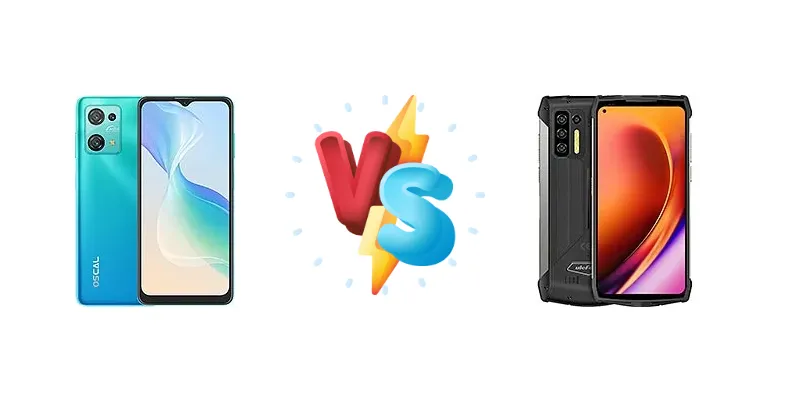
The rugged phone market caters to a specific need – durability. However, within that niche, price and performance vary significantly. We pit the budget-focused Oscal C30 Pro against the more feature-rich Ulefone Power Armor 13 to determine which offers the best balance of toughness and usability.
🏆 Quick Verdict
For most users, the Ulefone Power Armor 13 is the superior choice. Its Helio G95 chipset delivers significantly better performance than the C30 Pro’s Helio G35, and the inclusion of 33W wired and wireless charging is a major convenience. While the C30 Pro is cheaper, the performance gap is too large to ignore.
| Network |
|---|
| 2G bands | GSM 850 / 900 / 1800 / 1900 | GSM 850 / 900 / 1800 / 1900 |
| 3G bands | HSDPA 900 / 2100 | HSDPA 850 / 900 / 1700(AWS) / 1900 / 2100 |
| 4G bands | 1, 3, 7, 8, 19, 20, 28, 40 | 1, 2, 3, 4, 5, 7, 8, 12, 13, 17, 18, 19, 20, 25, 26, 28, 38, 40, 66 |
| Speed | HSPA, LTE | HSPA 42.2/11.5 Mbps, LTE Cat12 600/150 Mbps |
| Technology | GSM / HSPA / LTE | GSM / HSPA / LTE |
| Launch |
|---|
| Announced | 2023, June | 2021, July 22 |
| Status | Available. Released 2023, June | Available. Released 2021, July 26 |
| Body |
|---|
| Dimensions | 164.6 x 76.9 x 9.4 mm (6.48 x 3.03 x 0.37 in) | 183.7 x 85.4 x 20.8 mm (7.23 x 3.36 x 0.82 in) |
| SIM | Nano-SIM + Nano-SIM | Nano-SIM + Nano-SIM |
| Weight | 194.6 g (6.88 oz) | 492 g (1.08 lb) |
| | - | IP68 dust/water resistant (up to 1.5m for 30 min)
Drop-to-concrete resistance from up to 1.2m
MIL-STD-810G compliant |
| Display |
|---|
| Protection | - | Corning Gorilla Glass 3 |
| Resolution | 720 x 1600 pixels, 20:9 ratio (~270 ppi density) | 1080 x 2400 pixels, 20:9 ratio (~386 ppi density) |
| Size | 6.5 inches, 102.0 cm2 (~80.6% screen-to-body ratio) | 6.81 inches, 112.0 cm2 (~71.4% screen-to-body ratio) |
| Type | IPS LCD, 500 nits | IPS LCD |
| Platform |
|---|
| CPU | Octa-core (4x2.3 GHz Cortex-A53 & 4x1.7 GHz Cortex-A53) | Octa-core (2x2.05 GHz Cortex-A76 & 6x2.0 GHz Cortex-A55) |
| Chipset | Mediatek MT6765 Helio G35 (12 nm) | Mediatek MT6785V/CD Helio G95 (12 nm) |
| GPU | PowerVR GE8320 | Mali-G76 MC4 |
| OS | Android 12, DokeOS 3 | Android 11 |
| Memory |
|---|
| Card slot | microSDXC (dedicated slot) | microSDXC (uses shared SIM slot) |
| Internal | 64GB 4GB RAM | 256GB 8GB RAM |
| Main Camera |
|---|
| Features | LED flash | Quad-LED flash, HDR, panorama |
| Penta | - | 48 MP, f/1.8, 26mm (wide), 1/2.0", 0.8µm, PDAF
8 MP, f/2.2, (ultrawide)
2 MP (macro)
Auxiliary lens |
| Triple | 12 MP, (wide), 1/2.55", PDAF
other unspecified cameras | - |
| Video | 1080p@30fps | 4K@30fps, 1080p@30fps |
| Selfie camera |
|---|
| Features | - | HDR, panorama |
| Single | 8 MP | 16 MP, f/2.2 |
| Video | Yes | 1080p@30fps |
| Sound |
|---|
| 3.5mm jack | - | Yes |
| 35mm jack | Yes | Yes |
| Loudspeaker | Yes | Yes |
| Comms |
|---|
| Bluetooth | 5.0, A2DP, LE | 5.0, A2DP, LE |
| NFC | No | Yes |
| Positioning | GPS, GLONASS, GALILEO, BDS | GPS, GLONASS, GALILEO, BDS |
| Radio | FM radio | FM radio, RDS, recording |
| USB | USB Type-C 2.0, OTG | - |
| WLAN | Wi-Fi 802.11 a/b/g/n/ac, dual-band | Wi-Fi 802.11 a/b/g/n/ac, dual-band |
| Features |
|---|
| Sensors | Fingerprint (side-mounted), accelerometer, proximity | Fingerprint (side-mounted), accelerometer, gyro, proximity, compass, baroceptor, coulombmeter |
| | - | Infrared distance measure (error range: 1~20m, ±10mm; 20~40m, ±25mm) |
| Battery |
|---|
| Charging | 10W wired | 33W wired
15W wireless
5W reverse wireless |
| Type | 5080 mAh | Li-Po 13200 mAh |
| Misc |
|---|
| Colors | Shadow Black, Starry Night Blue, Streaming Green | Black |
| Price | About 120 EUR | About 300 EUR |
| Tests |
|---|
| Battery life | - |
Endurance rating 296h
|
| Camera | - |
Photo / Video |
| Display | - |
Contrast ratio: 1306:1 (nominal) |
| Loudspeaker | - |
-28.3 LUFS (Average)
|
| Performance | - |
AnTuTu: 294194 (v8), 351678 (v9)
GeekBench: 1610 (v5.1)
GFXBench: 18fps (ES 3.1 onscreen) |
Oscal C30 Pro
- Lowest possible price in a rugged phone.
- Decent battery endurance (296h).
- Rugged build quality for basic protection.
- Significantly weaker processor (Helio G35).
- Extremely slow 10W charging.
- Limited performance for demanding tasks.
Ulefone Power Armor 13
- Much faster processor (Helio G95).
- 33W wired and 15W wireless charging.
- Better display brightness (401 nits).
- Reverse wireless charging capability.
- Higher price point than the Oscal C30 Pro.
- Similar battery endurance to the C30 Pro despite faster charging.
- Camera details are lacking.
Display Comparison
Both devices share a contrast ratio of 1306:1, suggesting similar image quality in terms of black levels. However, the Ulefone Power Armor 13 boasts a measured peak brightness of 401 nits, which will provide better visibility outdoors compared to the Oscal C30 Pro, whose brightness is not specified. Without knowing the C30 Pro’s brightness, it’s difficult to assess its outdoor usability, but the Power Armor 13 has a clear advantage here.
Camera Comparison
Both phones list 'Photo / Video' capabilities, but lack specific details. Without sensor size, aperture, or image processing information, a direct comparison is impossible. However, given the Power Armor 13’s overall higher positioning, it’s reasonable to assume a more sophisticated camera system. The inclusion of features like Optical Image Stabilization (OIS) – if present – would further differentiate it. The lack of detail on both sides suggests a focus on basic functionality rather than photographic excellence.
Performance
The Ulefone Power Armor 13’s Mediatek Helio G95 chipset represents a substantial upgrade over the Oscal C30 Pro’s Helio G35. The G95 features a more modern CPU architecture – two Cortex-A76 cores clocked at 2.05 GHz versus the C30 Pro’s four Cortex-A53 cores at 2.3 GHz. While the C30 Pro’s cores have a higher clock speed, the A76 architecture in the G95 offers significantly better instructions per clock (IPC), resulting in faster overall performance. This translates to smoother multitasking, quicker app loading times, and a more enjoyable gaming experience. The G95 also has a more capable GPU, further widening the performance gap.
Battery Life
Both devices achieve an endurance rating of 296 hours, indicating similar overall battery life under comparable usage scenarios. However, the Ulefone Power Armor 13 offers a significant advantage in charging speed. Its 33W wired charging, 15W wireless charging, and 5W reverse wireless charging capabilities drastically reduce recharge times compared to the Oscal C30 Pro’s slow 10W wired charging. This means less downtime and greater convenience for users who rely heavily on their phones throughout the day.
Buying Guide
Buy the Oscal C30 Pro if you absolutely need the lowest possible price point in a rugged device and your usage is limited to basic tasks like calls, texts, and light social media. Buy the Ulefone Power Armor 13 if you prioritize performance for gaming or demanding apps, value faster charging speeds, and appreciate the convenience of wireless charging. The Power Armor 13 is for users who need a workhorse, while the C30 Pro is for minimalists.
Frequently Asked Questions
❓ Is the Ulefone Power Armor 13’s Helio G95 chipset capable of playing demanding games like PUBG or Genshin Impact?
Yes, the Helio G95 is a capable mid-range chipset that can handle PUBG and Genshin Impact at medium settings. While it won’t deliver flagship-level performance, it provides a significantly smoother gaming experience than the Oscal C30 Pro’s Helio G35, which would struggle with these titles.
❓ How long does it realistically take to fully charge the Ulefone Power Armor 13 with the 33W charger?
While Ulefone doesn't provide exact figures, a 33W charger should fully charge the Power Armor 13 from 0% to 100% in approximately 1 hour and 45 minutes to 2 hours, depending on usage during charging. This is a substantial improvement over the Oscal C30 Pro’s estimated 4-5 hour charge time with its 10W charger.
❓ Does the Ulefone Power Armor 13 support NFC for contactless payments?
Unfortunately, neither Ulefone nor Oscal explicitly lists NFC support for the Power Armor 13 or C30 Pro in their official specifications. Given the budget nature of both devices, it's unlikely that NFC is included. Users requiring contactless payments should consider alternative models.