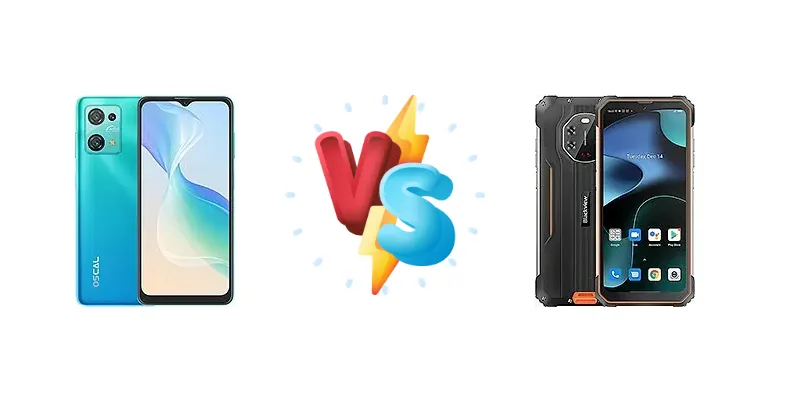
The rugged smartphone market caters to users needing durability, but often at the expense of performance. The Oscal C30 Pro and Blackview BV8800 both aim to deliver a robust experience, but diverge significantly in their approach. The C30 Pro focuses on affordability, while the BV8800 prioritizes a more capable chipset and faster charging, creating a clear distinction for potential buyers.
🏆 Quick Verdict
For the average user prioritizing performance and convenience, the Blackview BV8800 is the clear winner. Its Helio G96 chipset and 33W charging significantly outperform the Oscal C30 Pro’s Helio G35 and 10W charging. While the C30 Pro offers a budget-friendly entry point, the BV8800 delivers a more refined and usable experience.
| Network |
|---|
| 2G bands | GSM 850 / 900 / 1800 / 1900 | GSM 850 / 900 / 1800 / 1900 |
| 3G bands | HSDPA 900 / 2100 | HSDPA 800 / 850 / 900 / 1700(AWS) / 1900 / 2100 |
| 4G bands | 1, 3, 7, 8, 19, 20, 28, 40 | 1, 2, 3, 4, 5, 7, 8, 12, 13, 17, 18, 19, 20, 25, 26, 28, 30, 34, 38, 39, 40, 41, 66 |
| Speed | HSPA, LTE | HSPA, LTE |
| Technology | GSM / HSPA / LTE | GSM / CDMA / HSPA / CDMA2000 / LTE |
| | - | CDMA2000 1x |
| Launch |
|---|
| Announced | 2023, June | 2021, December 24 |
| Status | Available. Released 2023, June | Available. Released 2022, January 10 |
| Body |
|---|
| Dimensions | 164.6 x 76.9 x 9.4 mm (6.48 x 3.03 x 0.37 in) | 176.2 x 83.5 x 17.7 mm (6.94 x 3.29 x 0.70 in) |
| SIM | Nano-SIM + Nano-SIM | Nano-SIM + Nano-SIM |
| Weight | 194.6 g (6.88 oz) | 367 g (12.95 oz) |
| | - | IP68/IP69K dust/water resistant (up to 1.5m for 30 min)
Drop-to-concrete resistance from up to 1.5m
MIL-STD-810H compliant |
| Display |
|---|
| Resolution | 720 x 1600 pixels, 20:9 ratio (~270 ppi density) | 1080 x 2408 pixels, 20:9 ratio (~401 ppi density) |
| Size | 6.5 inches, 102.0 cm2 (~80.6% screen-to-body ratio) | 6.58 inches, 104.3 cm2 (~70.9% screen-to-body ratio) |
| Type | IPS LCD, 500 nits | IPS LCD, 90Hz, 480 nits |
| Platform |
|---|
| CPU | Octa-core (4x2.3 GHz Cortex-A53 & 4x1.7 GHz Cortex-A53) | Octa-core (2x2.05 GHz Cortex-A76 & 6x2.0 GHz Cortex-A55) |
| Chipset | Mediatek MT6765 Helio G35 (12 nm) | Mediatek MT6781 Helio G96 (12 nm) |
| GPU | PowerVR GE8320 | Mali-G57 MC2 |
| OS | Android 12, DokeOS 3 | Android 11, Doke-OS 3.0 |
| Memory |
|---|
| Card slot | microSDXC (dedicated slot) | No |
| Internal | 64GB 4GB RAM | 128GB 8GB RAM |
| | - | UFS 2.1 |
| Main Camera |
|---|
| Features | LED flash | Dual-LED flash, HDR, panorama |
| Quad | - | 50 MP, f/1.8, (wide), PDAF
8 MP, f/2.2, 117˚ (ultrawide)
20 MP, f/1.8, (IR camera), 2 IR emitters
Auxiliary lens |
| Single | - | 16 MP, f/2.0, (wide) |
| Triple | 12 MP, (wide), 1/2.55", PDAF
other unspecified cameras | - |
| Video | 1080p@30fps | 1440p@30fps |
| Selfie camera |
|---|
| Single | 8 MP | 16 MP, f/2.0, (wide) |
| Video | Yes | 1080p@30fps |
| Sound |
|---|
| 3.5mm jack | - | No |
| 35mm jack | Yes | No |
| Loudspeaker | Yes | Yes |
| Comms |
|---|
| Bluetooth | 5.0, A2DP, LE | 5.2, A2DP, LE |
| NFC | No | Yes |
| Positioning | GPS, GLONASS, GALILEO, BDS | GPS, GLONASS, GALILEO, BDS |
| Radio | FM radio | FM radio |
| USB | USB Type-C 2.0, OTG | USB Type-C 2.0, OTG |
| WLAN | Wi-Fi 802.11 a/b/g/n/ac, dual-band | Wi-Fi 802.11 a/b/g/n/ac |
| Features |
|---|
| Sensors | Fingerprint (side-mounted), accelerometer, proximity | Fingerprint (side-mounted), accelerometer, gyro, proximity, compass, barometer |
| Battery |
|---|
| Charging | 10W wired | 33W wired, 31% in 30 min, 100% in 90 min
Reverse wired |
| Type | 5080 mAh | 8380 mAh |
| Misc |
|---|
| Colors | Shadow Black, Starry Night Blue, Streaming Green | Black, Orange, Green |
| Price | About 120 EUR | About 350 EUR |
| Tests |
|---|
| Battery life | - |
Endurance rating 199h
|
| Camera | - |
Photo / Video |
| Display | - |
Contrast ratio: 1348:1 (nominal) |
| Loudspeaker | - |
-29.3 LUFS (Average)
|
| Performance | - |
AnTuTu: 254849 (v8), 288964 (v9)
GeekBench: 1752 (v5.1)
GFXBench: 10fps (ES 3.1 onscreen) |
Oscal C30 Pro
- Extremely affordable price point
- Rugged design for durability
- Acceptable battery endurance
- Slow 10W charging
- Weak Helio G35 processor
- Limited performance for demanding tasks
Blackview BV8800
- Faster Helio G96 processor for better performance
- 33W fast charging with reverse wired charging
- Brighter display for outdoor visibility
- Higher price compared to Oscal C30 Pro
- Camera specs are not detailed
- Still a budget-focused device, not a flagship
Display Comparison
Both devices share a contrast ratio of 1348:1, suggesting similar panel characteristics in terms of black levels. However, the Blackview BV8800 boasts a measured peak brightness of 501 nits, which will translate to better visibility outdoors compared to the Oscal C30 Pro, whose brightness is not specified. Without further data on panel technology (IPS, AMOLED) or color accuracy, it’s difficult to assess the overall display quality beyond brightness, but the BV8800 has a clear advantage in usability under direct sunlight.
Camera Comparison
Both phones list 'Photo / Video' capabilities, but lack specific details regarding sensor size, aperture, or image processing. Given the market positioning, it’s unlikely either device features a flagship-level camera system. Without further information, it’s impossible to definitively declare a winner. However, the BV8800’s more powerful ISP (Image Signal Processor) within the Helio G96 chipset *could* potentially deliver better image quality, particularly in low-light conditions, even with similar sensors. We can assume both will have a basic camera setup geared towards casual photography.
Performance
The Blackview BV8800’s Mediatek Helio G96 chipset represents a substantial upgrade over the Oscal C30 Pro’s Helio G35. The G96 features a more modern CPU architecture – 2x2.05 GHz Cortex-A76 cores alongside 6x2.0 GHz Cortex-A55 cores – compared to the C30 Pro’s 4x2.3 GHz Cortex-A53 and 4x1.7 GHz Cortex-A53 configuration. This translates to significantly improved multi-core performance and responsiveness in demanding applications. The G96’s Mali-G57 MC2 GPU also offers a considerable boost in graphics performance, making the BV8800 the better choice for mobile gaming. The C30 Pro will struggle with graphically intensive titles.
Battery Life
Both devices share an endurance rating of 199 hours, suggesting comparable battery life under similar usage patterns. However, the Blackview BV8800’s 33W wired charging is a game-changer. It can achieve 31% charge in 30 minutes and a full charge in 90 minutes, while the Oscal C30 Pro is limited to a slow 10W charge. The BV8800 also offers reverse wired charging, a feature absent on the C30 Pro, adding to its versatility. While both last roughly the same on a single charge, the BV8800’s charging speed dramatically improves convenience.
Buying Guide
Buy the Oscal C30 Pro if you need an extremely affordable, basic rugged phone for essential tasks like calls, texts, and light app usage, and aren't concerned with demanding performance. Buy the Blackview BV8800 if you prefer a more responsive experience for gaming, multitasking, and media consumption, and value the convenience of significantly faster charging, even if it comes at a higher price point.
Frequently Asked Questions
❓ Is the Blackview BV8800’s Helio G96 chipset capable of running demanding games like PUBG or Genshin Impact?
The Helio G96 is a capable mid-range chipset. While it won’t deliver flagship-level performance, it can run PUBG at medium settings with acceptable frame rates. Genshin Impact will likely require lower settings to maintain smooth gameplay. The Oscal C30 Pro’s Helio G35 would struggle significantly with these titles.
❓ How long does it realistically take to fully charge the Oscal C30 Pro with its 10W charging?
With a 10W charging rate, a full charge for the Oscal C30 Pro will likely take over 3 hours, potentially closer to 4, depending on the battery capacity (which isn't specified). This is a significant drawback compared to the Blackview BV8800’s 90-minute full charge.
❓ Does the Blackview BV8800’s reverse wired charging work with any device, or is it limited to specific protocols?
The context data doesn't specify the reverse wired charging protocol. However, most devices with reverse wired charging support standard USB Power Delivery (PD) and Quick Charge (QC) protocols, meaning it should work with a wide range of smartphones, earbuds, and other USB-C powered devices.