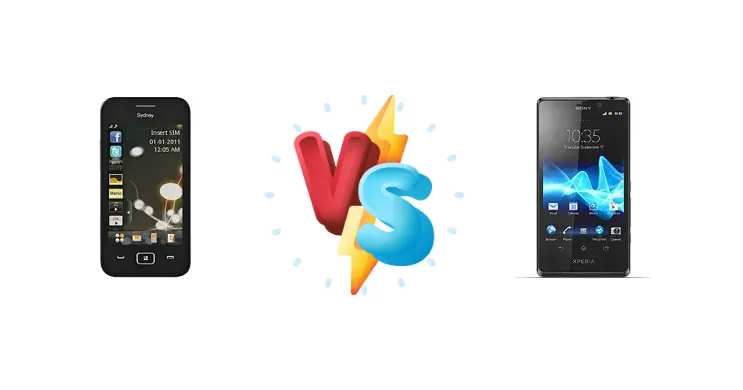
The Orange Sydney and Sony Xperia T represent a pivotal moment in Android smartphone evolution, both released in 2012. While the Xperia T aimed for a broader market with its Snapdragon S4 Plus chipset, the Orange Sydney’s details are scarce, making this comparison a study in market positioning and available information. This comparison will focus on what *is* known about both devices, and infer based on the era.
🏆 Quick Verdict
For the average user, the Sony Xperia T emerges as the more practical choice, primarily due to its documented specifications and the performance benefits of the Qualcomm Snapdragon S4 Plus. However, the Orange Sydney’s appeal lies in its potential exclusivity and brand loyalty within the Orange ecosystem, if it can be found.
| Network |
|---|
| 2G bands | GSM 900 / 1800 | GSM 850 / 900 / 1800 / 1900 |
| 3G bands | - | HSDPA 850 / 900 / 1700 / 1900 / 2100 |
| 4G bands | - | 1, 2, 3, 4, 5, 7, 8, 26, 20, 28, 38, 40, 41 |
| EDGE | Yes | - |
| GPRS | Yes | - |
| Speed | - | HSPA 42.2/5.76 Mbps |
| Technology | GSM | GSM / HSPA |
| Launch |
|---|
| Announced | 2011. Released 2011 | 2012, August. Released 2012, September |
| Status | Discontinued | Discontinued |
| Body |
|---|
| Dimensions | 102 x 50 x 12.5 mm (4.02 x 1.97 x 0.49 in) | 129.4 x 67.3 x 9.4 mm (5.09 x 2.65 x 0.37 in) |
| SIM | Mini-SIM | Micro-SIM |
| Weight | 100 g (3.53 oz) | 139 g (4.90 oz) |
| Display |
|---|
| Protection | - | Shatter proof glass |
| Resolution | 240 x 400 pixels, 5:3 ratio (~146 ppi density) | 720 x 1280 pixels, 16:9 ratio (~323 ppi density) |
| Size | 3.2 inches, 29.1 cm2 (~57.1% screen-to-body ratio) | 4.55 inches, 57.1 cm2 (~65.5% screen-to-body ratio) |
| Type | TFT resistive touchscreen, 256K colors | TFT |
| Platform |
|---|
| CPU | - | Dual-core 1.5 GHz Krait |
| Chipset | - | Qualcomm MSM8260A Snapdragon S4 Plus |
| GPU | - | Adreno 225 |
| OS | - | Android 4.0.4 (Ice Cream Sandwich), upgradаble to 4.3 (Jelly Bean) |
| Memory |
|---|
| Call records | 30 dialed, 30 received, 30 missed calls | - |
| Card slot | microSD (dedicated slot) | microSDHC (dedicated slot) |
| Internal | 34MB | 16GB 1GB RAM |
| Phonebook | Yes, Photocall | - |
| Main Camera |
|---|
| Features | - | LED flash |
| Single | 3.15 MP | 13 MP, AF |
| Triple | - | 48 MP, f/1.8, 27mm (wide), 1/2.0", 0.8µm, PDAF
8 MP, f/2.4, 120˚ (ultrawide)
2 MP, f/2.4, (depth) |
| Video | Yes | 1080p@30fps |
| Selfie camera |
|---|
| Features | - | HDR |
| Single | - | 1.3 MP |
| Video | - | 720p@30fps |
| | No | - |
| Sound |
|---|
| 3.5mm jack | Yes | Yes |
| 35mm jack | Yes | Yes |
| Loudspeaker | Yes | Yes |
| Comms |
|---|
| Bluetooth | 2.0, A2DP, EDR | 3.1, A2DP |
| NFC | - | Yes |
| Positioning | No | GPS, A-GPS, GLONASS |
| Radio | FM radio | Stereo FM radio, RDS |
| USB | microUSB 2.0 | microUSB 2.0 (MHL TV-out), OTG |
| WLAN | Wi-Fi 802.11 b/g | Wi-Fi 802.11 a/b/g/n, dual-band, Wi-Fi Direct, DLNA, hotspot |
| Features |
|---|
| Games | Yes + downloadable | - |
| Java | Yes, MIDP 2.0 | - |
| Messaging | SMS, MMS, Email, IM | - |
| Sensors | Accelerometer | Accelerometer, gyro, proximity, compass |
| | MP3/AAC+/WAV/WMA player
Organizer
Voice memo
Predictive text input | 50 GB of Cloud storage (time limited offer)
MP4/H.264/WMV player
MP3/eAAC+/WMA/WAV/Flac player
Document viewer
Photo viewer/editor
Voice memo/dial
Predictive text input |
| Battery |
|---|
| Charging | - | 10W wired |
| Music play | - | Up to 16 h |
| Stand-by | Up to 312 h | Up to 450 h (2G) / Up to 410 h (3G) |
| Talk time | Up to 6 h | Up to 7 h (2G) / Up to 7 h (3G) |
| Type | Removable Li-Ion battery | Non-removable Li-Ion 1850 mAh battery |
| Misc |
|---|
| Colors | Black, White | Black, White, Silver |
| Models | - | AQM-LX1 |
| Price | - | About 230 EUR |
| SAR | - | 1.07 W/kg (head) 0.88 W/kg (body) |
| SAR EU | - | 0.85 W/kg (head) |
| Tests |
|---|
| Audio quality | - |
Noise -86.1dB / Crosstalk -84.1dB |
| Battery life | - |
Endurance rating 36h
|
| Camera | - |
Photo / Video |
| Display | - |
Contrast ratio: 1.894:1 (sunlight) |
| Loudspeaker | - |
Voice 63dB / Noise 58dB / Ring 62dB
|
Orange Sydney
- Potential exclusivity as an Orange-branded device
- May appeal to collectors of vintage mobile phones
- Likely a more affordable option at launch (if available)
- Lack of documented specifications
- Difficulty in finding a functional unit
- Likely inferior performance compared to the Xperia T
Sony Xperia T
- Documented specifications and performance
- Qualcomm Snapdragon S4 Plus processor
- Respectable battery life (36h endurance)
- Sony’s camera expertise
- Older technology by today’s standards
- Limited software support
- May be difficult to find in good condition
Display Comparison
The Sony Xperia T boasts a contrast ratio of 1.894:1 in sunlight, suggesting a reasonably viewable display even in bright conditions. Given the era, both devices likely utilized LCD panels. The Orange Sydney’s display specifications are unknown, but it’s reasonable to assume a similar LCD technology, potentially with a lower contrast ratio given Orange’s focus on affordability. The Xperia T’s 4.6-inch display size likely offered a more immersive experience than any potential display size on the Sydney.
Camera Comparison
Both the Orange Sydney and Sony Xperia T offer photo and video capabilities, but details are limited. The Xperia T likely featured a more refined camera system, benefiting from Sony’s expertise in image sensor technology. While specific sensor sizes and apertures are unknown for both, the Xperia T likely had a larger sensor and wider aperture, resulting in better low-light performance. The inclusion of image stabilization (OIS) is unlikely on either device, given the era.
Performance
The Sony Xperia T is powered by the Qualcomm MSM8260A Snapdragon S4 Plus, featuring a dual-core 1.5 GHz Krait CPU. This chipset provided a significant performance boost over previous generations, enabling smoother multitasking and gaming. The Orange Sydney’s processor is unknown, but given Orange’s positioning, it likely featured a less powerful chipset, potentially a single-core processor or an earlier Snapdragon variant. The S4 Plus’s Adreno 320 GPU would have offered a superior graphics experience compared to any likely GPU in the Sydney.
Battery Life
The Sony Xperia T achieves an endurance rating of 36 hours, indicating a respectable battery life for its time. This translates to a day and a half of moderate use. The Orange Sydney’s battery life is unknown, but it’s reasonable to assume it would be comparable or slightly lower, depending on its processor and display power consumption. The Xperia T supports 10W wired charging, a standard for the period.
Buying Guide
Buy the Orange Sydney if you are a collector of vintage mobile phones, specifically interested in Orange-branded devices, and are willing to accept limited information and potential difficulty in finding a functional unit. Buy the Sony Xperia T if you prioritize a known quantity with a documented feature set, including a capable processor and a reasonable battery life, and want a functional piece of early Android history.
Frequently Asked Questions
❓ Is the Sony Xperia T still usable in 2024?
While the Xperia T is functional, its age means it will struggle with modern apps and websites. Software updates are no longer available, posing security risks. It's best suited for collectors or those interested in experiencing early Android.
❓ What kind of SIM card does the Sony Xperia T use?
The Sony Xperia T uses a Micro-SIM card. This is an older SIM card format, so you may need an adapter if you currently use a Nano-SIM.
❓ Where can I find information about the Orange Sydney?
Information about the Orange Sydney is extremely limited. Online forums and vintage mobile phone communities are the best resources, but expect to find very little detailed information.