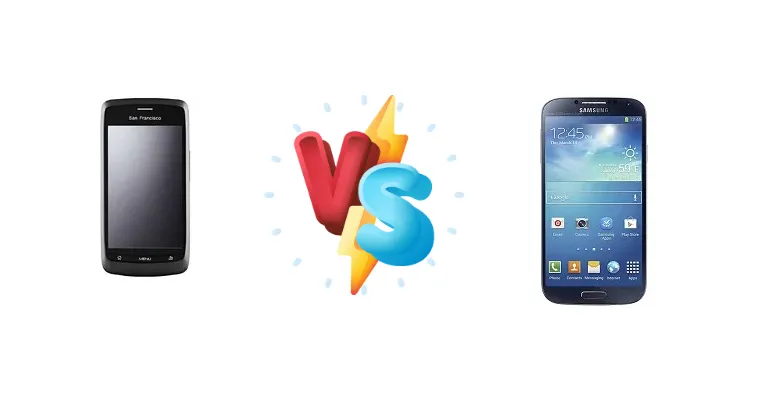
The Orange San Francisco and the Samsung Galaxy S4 represent distinct points in Android's evolution. The San Francisco, released in 2013, aimed for affordability and simplicity, while the Galaxy S4 was a full-fledged flagship boasting cutting-edge (for the time) features. This comparison dissects their core differences, revealing where each phone excels and who would benefit most from owning one today.
🏆 Quick Verdict
For the vast majority of users, the Samsung Galaxy S4 is the clear winner. Its Exynos 5410 Octa-core processor delivers significantly superior performance, and its feature set, including wireless charging, provides a more modern experience. The Orange San Francisco remains relevant only for those seeking a basic, ultra-affordable Android device.
| Network |
|---|
| 2G bands | GSM 900 / 1800 / 1900 | GSM 850 / 900 / 1800 / 1900 |
| 3G bands | HSDPA 900 / 2100 | HSDPA 850 / 900 / 1900 / 2100 |
| EDGE | - | Yes |
| GPRS | - | Yes |
| Speed | HSPA 7.2/5.76 Mbps | HSPA 42.2/5.76 Mbps |
| Technology | GSM / HSPA | GSM / HSPA |
| Launch |
|---|
| Announced | 2011, Q2. Released 2011, Q2 | 2013, March. Released 2013, April |
| Status | Discontinued | Discontinued |
| Body |
|---|
| Build | - | Glass front (Gorilla Glass 3), plastic back, plastic frame |
| Dimensions | 116 x 56.5 x 11.8 mm (4.57 x 2.22 x 0.46 in) | 136.6 x 69.8 x 7.9 mm (5.38 x 2.75 x 0.31 in) |
| SIM | Mini-SIM | Micro-SIM |
| Weight | 130 g (4.59 oz) | 130 g (4.59 oz) |
| Display |
|---|
| Protection | - | Corning Gorilla Glass 3 |
| Resolution | 480 x 800 pixels, 5:3 ratio (~267 ppi density) | 1080 x 1920 pixels, 16:9 ratio (~441 ppi density) |
| Size | 3.5 inches, 34.9 cm2 (~53.2% screen-to-body ratio) | 5.0 inches, 68.9 cm2 (~72.3% screen-to-body ratio) |
| Type | AMOLED, 256K colors | Super AMOLED |
| Platform |
|---|
| CPU | 600 MHz ARM 11 | Octa-core (4x1.6 GHz Cortex-A15 & 4x1.2 GHz Cortex-A7) |
| Chipset | Qualcomm MSM7227 Snapdragon S1 | Exynos 5410 Octa (28 nm) |
| GPU | Adreno 200 | PowerVR SGX544MP3 |
| OS | Android 2.1 (Eclair), upgradable to 2.2 (Froyo) | Android 4.2.2 (Jelly Bean), upgradable to 5.0.1 (Lollipop), TouchWiz UI |
| Memory |
|---|
| Call records | - | Yes |
| Card slot | microSDHC (dedicated slot) | microSDXC (dedicated slot) |
| Internal | 512MB RAM, 512MB | 16GB 2GB RAM, 32GB 2GB RAM, 64GB 2GB RAM |
| Phonebook | - | 2000 entries |
| | - | eMMC 5.0 |
| Main Camera |
|---|
| Features | - | LED flash, HDR |
| Single | 3.15 MP, AF | 13 MP, f/2.2, 31mm (standard), 1/3.1", 1.14µm, AF |
| Video | Yes | 1080p@30fps |
| Selfie camera |
|---|
| Features | - | Dual video call |
| Single | - | 2 MP, f/2.4, 31mm (standard) |
| Video | - | 1080p@30fps |
| | No | - |
| Sound |
|---|
| 3.5mm jack | Yes | Yes |
| 35mm jack | Yes | Yes |
| Loudspeaker | Yes | Yes |
| Comms |
|---|
| Bluetooth | 2.1, A2DP, EDR | 4.0, A2DP, EDR, LE, aptX |
| Infrared port | - | Yes |
| NFC | - | Yes |
| Positioning | GPS, A-GPS | GPS, GLONASS |
| Radio | Stereo FM radio, RDS | No |
| USB | microUSB 2.0 | microUSB 2.0 (MHL 2 TV-out), OTG |
| WLAN | Wi-Fi 802.11 b/g | Wi-Fi 802.11 a/b/g/n/ac, dual-band, Wi-Fi Direct, DLNA, hotspot |
| Features |
|---|
| Games | - | Downloadable |
| Java | - | Yes |
| Messaging | - | SMS(threaded view), MMS, Email, IM |
| Sensors | Accelerometer, proximity, compass | Accelerometer, gyro, proximity, compass, barometer, temperature, humidity, gesture |
| | MP4/H.264 player
MP3/WAV/eAAC+ player
Organizer
Voice memo
Predictive text input | ANT+
S-Voice natural language commands and dictation
Air gestures |
| Battery |
|---|
| Charging | - | Wireless (Qi) (market dependent) |
| Music play | - | Up to 62 h |
| Stand-by | Up to 216 h | Up to 370 h (3G) |
| Talk time | Up to 4 h | Up to 17 h (3G) |
| Type | Removable Li-Ion 1250 mAh battery | Li-Ion 2600 mAh, removable |
| Misc |
|---|
| Colors | Black | White Frost, Black Mist, Arctic Blue, Black Edition |
| Models | - | GT-I9500, SGH-I337M, SGH-M919, GT-I9507V, SHV-E330L, SPH-L720T, SHV-E300S, SHV-E300L, SHV-E300K, GT-I9507, SGH-M919N |
| Price | - | About 320 EUR |
| SAR | - | 0.85 W/kg (head) 1.55 W/kg (body) |
| SAR EU | - | 0.42 W/kg (head) 0.54 W/kg (body) |
| Tests |
|---|
| Audio quality | - |
Noise -95.9dB / Crosstalk -96.4dB |
| Battery life | - |
Endurance rating 65h
|
| Camera | - |
Photo / Video |
| Display | - |
Contrast ratio: Infinite (nominal) / 3.352:1 (sunlight) |
| Loudspeaker | - |
Voice 70dB / Noise 66dB / Ring 77dB
|
Orange San Francisco
- Extremely affordable
- Simple and easy to use
- Compact size
- Very slow processor
- Low-resolution display
- Limited features
Samsung I9500 Galaxy S4
- Powerful Octa-core processor
- High-quality display
- Wireless charging (market dependent)
- Older technology
- Battery life may be degraded due to age
- Larger size
Display Comparison
The Samsung Galaxy S4’s display, while lacking modern features like OLED or high refresh rates, boasts an 'infinite' (nominal) contrast ratio, indicating deep blacks and vibrant colors. The 3.352:1 sunlight contrast ratio suggests reasonable outdoor visibility. The Orange San Francisco’s display specifications are unavailable, but given its market positioning, it likely features a lower resolution and contrast ratio, resulting in a less visually appealing experience. The S4’s larger screen size and higher pixel density would provide a sharper and more immersive viewing experience.
Camera Comparison
Both devices offer photo and video capabilities, but the Samsung Galaxy S4 likely provides a superior imaging experience. While specific sensor details are missing for both, the S4’s higher-end positioning suggests a larger sensor and more advanced image processing. The San Francisco’s camera would likely produce lower-quality images, particularly in low-light conditions. The S4’s camera features, though dated by today’s standards, would offer more versatility and better overall image quality.
Performance
The performance gap between these devices is substantial. The Samsung Galaxy S4’s Exynos 5410 Octa-core processor, built on a 28nm process, features a big.LITTLE architecture with four 1.6 GHz Cortex-A15 cores for demanding tasks and four 1.2 GHz Cortex-A7 cores for efficiency. This contrasts sharply with the Orange San Francisco’s 600 MHz ARM 11 processor, which is significantly less powerful. The Exynos 5410 allows for smoother multitasking, faster app loading times, and the ability to handle more complex applications. The San Francisco would struggle with even moderately demanding tasks.
Battery Life
The Samsung Galaxy S4 achieves an endurance rating of 65 hours, indicating solid battery life. The 65-hour rating suggests efficient power management despite the powerful processor. The Orange San Francisco’s battery life is unknown, but its less demanding processor and likely smaller battery capacity could result in comparable, or even slightly better, endurance in very light usage scenarios. However, the S4’s wireless charging (Qi, market dependent) provides a convenient charging option not available on the San Francisco.
Buying Guide
Buy the Orange San Francisco if you need a functional, extremely budget-friendly Android device for basic tasks like calls, texts, and light web browsing. It's ideal for someone who prioritizes simplicity and minimal cost. Buy the Samsung I9500 Galaxy S4 if you prefer a more capable smartphone with a faster processor, a better display, and a more versatile camera. It's suited for users who want a smoother multitasking experience and access to a wider range of apps and features.
Frequently Asked Questions
❓ Does the Exynos 5410 in the Galaxy S4 suffer from significant thermal throttling under sustained load?
While the Exynos 5410 was a powerful processor for its time, it is known to exhibit some thermal throttling under prolonged, heavy workloads like gaming. However, for typical smartphone usage, throttling is unlikely to be a major issue. The big.LITTLE architecture helps mitigate this by switching to the more efficient Cortex-A7 cores during less demanding tasks.
❓ Is the Orange San Francisco still capable of running modern Android apps?
The Orange San Francisco’s 600 MHz ARM 11 processor and limited RAM make it highly unlikely to run modern Android apps effectively. Most apps require significantly more processing power and memory. While it may be possible to install older versions of some apps, the experience would likely be slow and unstable.
❓ How does the age of the Galaxy S4's battery impact its real-world performance?
Given the Galaxy S4's age, the battery has likely degraded significantly. Expect reduced capacity and shorter battery life compared to its original specifications. A battery replacement would be highly recommended to restore optimal performance.