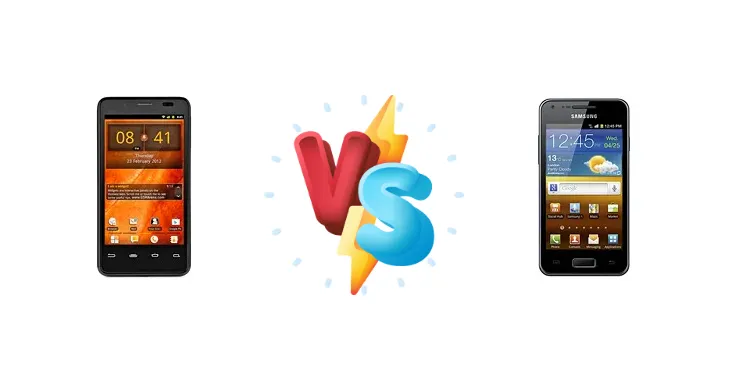
The Orange San Diego and Samsung Galaxy S Advance represent a fascinating crossroads in early Android development. Both devices aimed to deliver a smartphone experience to a wider audience, but they took fundamentally different approaches to processing power. The San Diego leveraged Intel's Atom architecture, while the Galaxy S Advance opted for Samsung's own NovaThor, based on ARM's Cortex-A9. This comparison dissects their strengths and weaknesses, revealing which phone offered the better experience in its time.
🏆 Quick Verdict
For the average user prioritizing responsiveness in basic tasks, the Samsung Galaxy S Advance emerges as the better choice. Its dual-core Cortex-A9 processor provides a smoother multitasking experience than the single-core Intel Atom Z2460 in the Orange San Diego, despite the lower clock speed. While the San Diego may have held theoretical advantages in single-threaded performance, the real-world benefits were often overshadowed by software optimization and the demands of the Android OS.
| Network |
|---|
| 2G bands | GSM 850 / 900 / 1800 / 1900 | GSM 850 / 900 / 1800 / 1900 |
| 3G bands | HSDPA 850 / 900 / 1900 / 2100 | HSDPA 850 / 900 / 1900 / 2100 |
| Speed | HSPA 21.1/5.76 Mbps | HSPA 14.4/5.76 Mbps |
| Technology | GSM / HSPA | GSM / HSPA |
| Launch |
|---|
| Announced | 2012, February. Released 2012, June | 2012, January. Released 2012, April |
| Status | Discontinued | Discontinued |
| Body |
|---|
| Dimensions | 123 x 63 x 10 mm (4.84 x 2.48 x 0.39 in) | 123.2 x 63 x 9.7 mm (4.85 x 2.48 x 0.38 in) |
| SIM | Micro-SIM | Mini-SIM |
| Weight | 117 g (4.13 oz) | 120 g (4.23 oz) |
| Display |
|---|
| Resolution | 600 x 1024 pixels, 16:9 ratio (~297 ppi density) | 480 x 800 pixels, 5:3 ratio (~233 ppi density) |
| Size | 4.0 inches, 45.0 cm2 (~58.1% screen-to-body ratio) | 4.0 inches, 45.5 cm2 (~58.7% screen-to-body ratio) |
| Type | TFT | Super AMOLED |
| Platform |
|---|
| CPU | 1.6 GHz | Dual-core 1.0 GHz Cortex-A9 |
| Chipset | Intel Atom Z2460 | NovaThor U8500 |
| GPU | PowerVR SGX540 | Mali-400 |
| OS | Android 2.3.7 (Gingerbread), upgradable to 4.0.4 (Ice Cream Sandwich) | Android 2.3.6 (Gingerbread), upgradable to 4.1.2 (Jelly Bean), TouchWiz UI 4 |
| Memory |
|---|
| Card slot | No | microSDHC (dedicated slot) |
| Internal | 16GB (12GB user available), 1GB RAM | 8GB 768MB RAM, 16GB 768MB RAM |
| Main Camera |
|---|
| Features | LED flash | LED flash |
| Single | 8 MP, AF | 5 MP, AF |
| Video | 1080p@30fps | 720p@30fps |
| Selfie camera |
|---|
| Single | Yes | 1.3 MP |
| Sound |
|---|
| 3.5mm jack | Yes | Yes |
| 35mm jack | Yes | Yes |
| Loudspeaker | Yes | Yes |
| Comms |
|---|
| Bluetooth | 2.1, A2DP | 3.0, A2DP, aptX |
| NFC | Yes | Optional |
| Positioning | GPS, A-GPS | GPS, A-GPS |
| Radio | No | Stereo FM radio, RDS |
| USB | microUSB 2.0 | microUSB 2.0 |
| WLAN | Wi-Fi 802.11 b/g/n, hotspot | Wi-Fi 802.11 a/b/g/n, dual-band, DLNA, hotspot |
| Features |
|---|
| Sensors | Accelerometer, proximity, compass | Accelerometer, gyro, proximity, compass |
| | HDMI port
MP4/H.264 player
MP3/WAV/eAAC+ player
Document viewer
Photo editor
Organizer
Voice memo/dial/commands
Predictive text input | - |
| Battery |
|---|
| Stand-by | Up to 336 h | Up to 570 h (2G) / Up to 550 h (3G) |
| Talk time | Up to 8 h | Up to 15 h (2G) / Up to 7 h 20 min (3G) |
| Type | Removable Li-Ion battery | Removable Li-Ion 1500 mAh battery |
| Misc |
|---|
| Colors | Black | Black, White |
| Models | - | GT-I9070 |
| Price | About 190 EUR | About 150 EUR |
| SAR | - | 0.37 W/kg (head) 0.98 W/kg (body) |
| SAR EU | - | 0.54 W/kg (head) |
| Tests |
|---|
| Audio quality | - |
Noise -88.6dB / Crosstalk -88.0dB |
| Camera | - |
Photo / Video |
| Display | - |
Contrast ratio: Infinite (nominal) |
| Loudspeaker | - |
Voice 74dB / Noise 66dB / Ring 75dB |
Orange San Diego
- Potentially higher single-core performance (theoretical)
- Intel x86 architecture for developers
- Early adopter of Intel's mobile platform
- Single-core processor limits multitasking
- x86 architecture faced software compatibility issues
- Likely higher power consumption
Samsung I9070 Galaxy S Advance
- Dual-core Cortex-A9 provides smoother multitasking
- More efficient ARM architecture for better battery life
- Mature software ecosystem and optimization
- Lower clock speed compared to the San Diego
- Less appealing to developers interested in x86
- Camera quality likely similar to the San Diego
Display Comparison
Both the Orange San Diego and Samsung Galaxy S Advance feature displays with an 'Infinite' (nominal) contrast ratio, a common marketing claim for the time that doesn't provide specific quantifiable data. Without knowing the panel technology (TFT, IPS, etc.) or resolution, it's difficult to assess image quality beyond this. Bezels were substantial on both devices, typical of the era. The lack of detailed display specifications makes a direct comparison impossible, but the Galaxy S Advance likely benefited from Samsung's in-house display expertise, potentially offering slightly better viewing angles and color reproduction.
Camera Comparison
Both devices offer basic 'Photo / Video' capabilities, but lack specific details regarding sensor size, aperture, or image processing. Given the era, image quality would have been limited by both hardware and software. The absence of details prevents a meaningful comparison. It's likely both cameras struggled in low-light conditions and produced images with limited dynamic range. The marketing focus wasn't on camera prowess for either device.
Performance
The core difference lies in the chipsets. The Orange San Diego's Intel Atom Z2460, clocked at 1.6 GHz, is a single-core processor based on the x86 architecture. The Samsung Galaxy S Advance boasts a NovaThor U8500, a dual-core 1.0 GHz Cortex-A9 processor. While the Atom has a higher clock speed, the Cortex-A9's dual-core design and ARM architecture are inherently more efficient for multitasking and handling the demands of Android. The Cortex-A9's architecture is designed for out-of-order execution, improving performance in many real-world scenarios. The San Diego's x86 architecture faced challenges with software compatibility and optimization at the time, potentially hindering its performance despite the higher clock speed. RAM specifications are missing for both devices, but it's reasonable to assume both had limited RAM (likely 512MB or 1GB), further emphasizing the importance of efficient processor architecture.
Battery Life
Battery capacity and charging wattage are not specified for either device. Without this information, it's impossible to assess battery life or charging times. However, the Intel Atom Z2460 was known for its relatively high power consumption compared to ARM-based processors. This suggests the Galaxy S Advance, with its more efficient Cortex-A9, likely offered better battery life under similar usage conditions. The power efficiency of the NovaThor U8500 would have been a significant advantage.
Buying Guide
Buy the Orange San Diego if you were a developer or enthusiast interested in experimenting with Intel's early foray into mobile processors and potentially optimizing software for the x86 architecture. Buy the Samsung I9070 Galaxy S Advance if you preferred a more polished, readily usable Android experience with better multitasking capabilities and a more mature software ecosystem. The Galaxy S Advance was the more practical choice for everyday users.
Frequently Asked Questions
❓ Did the Intel Atom Z2460 in the Orange San Diego suffer from significant thermal throttling under load?
Given the Atom Z2460's relatively high power consumption and the limited thermal design of smartphones at the time, it's highly probable that the Orange San Diego experienced thermal throttling during sustained demanding tasks. This would have resulted in reduced performance over time as the processor attempted to manage heat.
❓ Was the software on the Samsung Galaxy S Advance better optimized for the NovaThor U8500 compared to the Orange San Diego's Intel Atom?
Yes, the software ecosystem was significantly more mature and optimized for ARM-based processors like the NovaThor U8500. Samsung had extensive experience with ARM, allowing for better driver support and software compatibility. Intel's x86 architecture faced challenges with Android optimization during this period, leading to potential performance inconsistencies.
❓ Could you realistically play modern mobile games on either of these devices?
No. Both the Orange San Diego and Samsung Galaxy S Advance lack the processing power, RAM, and GPU capabilities to run modern mobile games. Even games available during their release period would likely experience significant lag and performance issues.