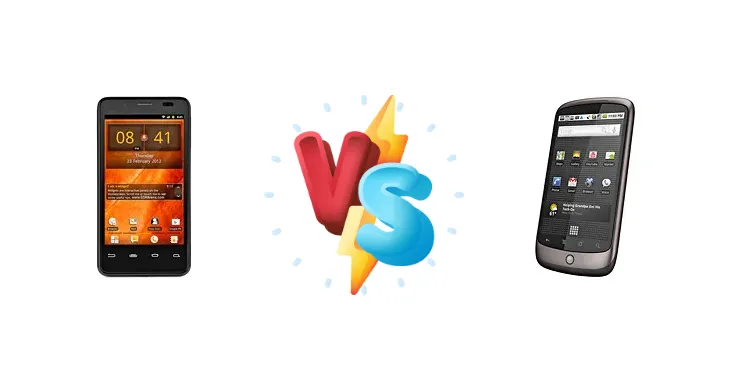
The Orange San Diego and the HTC Google Nexus One represent pivotal moments in Android's early evolution. The San Diego, powered by Intel's Atom Z2460, aimed to challenge the established ARM dominance, while the Nexus One, with Qualcomm's Snapdragon S1, embodied Google's vision for a refined, developer-focused experience. This comparison revisits these devices, analyzing their strengths and weaknesses through a modern lens.
🏆 Quick Verdict
For the average user seeking a functional, albeit dated, Android experience, the HTC Google Nexus One emerges as the slightly better choice. Its Snapdragon S1 chipset, despite being clocked lower at 1.0 GHz, offers a more responsive user experience than the Orange San Diego's Intel Atom Z2460, due to architectural advantages in application processing.
| Network |
|---|
| 2G bands | GSM 850 / 900 / 1800 / 1900 | GSM 850 / 900 / 1800 / 1900 |
| 3G bands | HSDPA 850 / 900 / 1900 / 2100 | HSDPA 900 / 1700 / 2100 |
| Speed | HSPA 21.1/5.76 Mbps | HSPA 7.2/2 Mbps |
| Technology | GSM / HSPA | GSM / HSPA |
| | - | HSDPA 850 / 1900 / 2100 - for AT&T, Rogers Wireless |
| Launch |
|---|
| Announced | 2012, February. Released 2012, June | 2010, January. Released 2010, January |
| Status | Discontinued | Discontinued |
| Body |
|---|
| Dimensions | 123 x 63 x 10 mm (4.84 x 2.48 x 0.39 in) | 119 x 59.8 x 11.5 mm (4.69 x 2.35 x 0.45 in) |
| SIM | Micro-SIM | Mini-SIM |
| Weight | 117 g (4.13 oz) | 130 g (4.59 oz) |
| | - | Trackball |
| Display |
|---|
| Resolution | 600 x 1024 pixels, 16:9 ratio (~297 ppi density) | 480 x 800 pixels, 5:3 ratio (~252 ppi density) |
| Size | 4.0 inches, 45.0 cm2 (~58.1% screen-to-body ratio) | 3.7 inches, 39.0 cm2 (~54.8% screen-to-body ratio) |
| Type | TFT | AMOLED |
| Platform |
|---|
| CPU | 1.6 GHz | 1.0 GHz Scorpion |
| Chipset | Intel Atom Z2460 | Qualcomm QSD8250 Snapdragon S1 |
| GPU | PowerVR SGX540 | Adreno 200 |
| OS | Android 2.3.7 (Gingerbread), upgradable to 4.0.4 (Ice Cream Sandwich) | Android 2.1 (Eclair), upgradable to 2.3.6 (Gingerbread) |
| Memory |
|---|
| Card slot | No | microSDHC (dedicated slot), 4 GB included |
| Internal | 16GB (12GB user available), 1GB RAM | 512MB RAM, 512MB |
| Main Camera |
|---|
| Features | LED flash | LED flash |
| Single | 8 MP, AF | 5 MP, AF |
| Video | 1080p@30fps | 480p@24fps |
| Selfie camera |
|---|
| Single | Yes | - |
| | - | No |
| Sound |
|---|
| 3.5mm jack | Yes | Yes |
| 35mm jack | Yes | Yes |
| Loudspeaker | Yes | Yes |
| Comms |
|---|
| Bluetooth | 2.1, A2DP | 2.1, A2DP |
| NFC | Yes | - |
| Positioning | GPS, A-GPS | GPS, A-GPS |
| Radio | No | Factory locked by default, can be enabled |
| USB | microUSB 2.0 | microUSB 2.0 |
| WLAN | Wi-Fi 802.11 b/g/n, hotspot | Wi-Fi 802.11 a/b/g |
| Features |
|---|
| Browser | - | HTML |
| Sensors | Accelerometer, proximity, compass | Accelerometer, proximity, compass |
| | HDMI port
MP4/H.264 player
MP3/WAV/eAAC+ player
Document viewer
Photo editor
Organizer
Voice memo/dial/commands
Predictive text input | Dedicated search key
MP3/eAAC+/WAV player
MP4/H.264 player
Voice memo
Predictive text input |
| Battery |
|---|
| Music play | - | Up to 20 hours |
| Stand-by | Up to 336 h | Up to 290 h (2G) / Up to 250 h (3G) |
| Talk time | Up to 8 h | Up to 10 hours (2G) / Up to 7 hours (3G) |
| Type | Removable Li-Ion battery | Removable Li-Ion 1400 mAh battery |
| Misc |
|---|
| Colors | Black | Brown (teflon coating) |
| Price | About 190 EUR | About 120 EUR |
| SAR | - | 0.37 W/kg (head) 0.74 W/kg (body) |
| Tests |
|---|
| Audio quality | - |
Noise -86.1dB / Crosstalk -85.2dB |
| Camera | - |
Photo |
| Loudspeaker | - |
Voice 69dB / Noise 66dB / Ring 79dB |
Orange San Diego
- Represents Intel's attempt to enter the mobile market.
- Higher CPU clock speed (on paper).
- Potentially interesting for collectors.
- Poor performance due to x86 emulation overhead.
- High power consumption leading to shorter battery life.
- Limited app compatibility.
HTC Google Nexus One
- Smoother and more responsive user experience.
- More power-efficient Snapdragon S1 chipset.
- Historically significant as the first Google phone.
- Lower CPU clock speed compared to the San Diego.
- Outdated software and limited app support.
- Camera quality is likely subpar by modern standards.
Display Comparison
Neither device boasts a particularly impressive display by today's standards. Specifics regarding panel technology (IPS, TFT) and resolution are missing, but both likely featured relatively low-resolution displays common for the era. The focus here isn't on visual fidelity, but rather on usability. The Nexus One's display, being part of a flagship device, likely benefited from slightly better color calibration and viewing angles, though concrete data is unavailable. Bezels were substantial on both devices, typical of 2010 designs.
Camera Comparison
Both devices feature a 'Photo' camera, a vague descriptor. Without megapixel counts or sensor details, a direct comparison is difficult. However, given the Nexus One's position as a flagship, it likely had a more refined camera system with better image processing. The Snapdragon S1's ISP (Image Signal Processor) would have contributed to better image quality compared to the Atom Z2460's limited multimedia capabilities. The San Diego's camera was likely a basic inclusion, while the Nexus One aimed for a more competitive camera experience.
Performance
The core difference lies in the chipsets. The Orange San Diego's 1.6 GHz Intel Atom Z2460, based on the x86 architecture, aimed to deliver desktop-class performance to mobile. However, its early implementation and the overhead of emulation for Android apps resulted in noticeable lag and slower application loading times. The HTC Google Nexus One's 1.0 GHz Qualcomm QSD8250 Snapdragon S1, utilizing the ARM architecture, was specifically designed for mobile and offered a more efficient and responsive experience. While clocked lower, the Snapdragon's architecture excelled at handling the tasks common on a smartphone, making it the superior performer in day-to-day use. The Snapdragon also benefited from a dedicated GPU, enhancing graphics performance.
Battery Life
Battery capacity details are unavailable for both devices. However, the Intel Atom Z2460 was known for its relatively high power consumption compared to ARM-based chips. This likely translated to shorter battery life for the Orange San Diego, even with a potentially larger battery. The Snapdragon S1, being more power-efficient, would have provided longer usage times on a single charge for the Nexus One. Charging speeds were slow by modern standards on both devices, relying on micro-USB connections.
Buying Guide
Buy the Orange San Diego if you're a collector interested in experiencing Intel's foray into the mobile space and are willing to accept performance limitations. Buy the HTC Google Nexus One if you prioritize a smoother, more usable Android experience, even with its age, and appreciate its historical significance as the first Google-branded phone.
Frequently Asked Questions
❓ Is the Intel Atom Z2460 in the Orange San Diego capable of running modern Android apps?
No. The Atom Z2460 is severely underpowered for modern Android applications and the architecture requires significant emulation, leading to extremely poor performance. It's limited to the Android version it originally shipped with and even then, performance will be sluggish.
❓ Does the HTC Google Nexus One support custom ROMs and updates?
Yes, the Nexus One has a vibrant custom ROM community. While official updates from Google ceased long ago, developers have maintained support through custom ROMs like LineageOS, allowing users to experience newer versions of Android, albeit with potential compatibility issues.
❓ Which phone is better for someone interested in Android development?
The HTC Google Nexus One is the better choice for Android development. It was designed with developers in mind and has a larger community providing support and resources. The San Diego's x86 architecture adds unnecessary complexity for Android development.
❓ What are the biggest limitations of the Snapdragon S1 in the Nexus One today?
The Snapdragon S1's limitations include its relatively slow CPU speed, limited RAM, and outdated GPU. This results in slow app loading times, laggy performance, and an inability to run graphically demanding games. However, it still provides a more usable experience than the Intel Atom-powered San Diego.