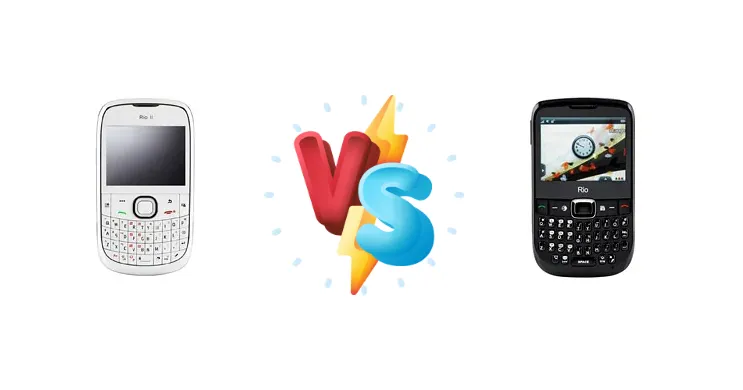
The Orange Rio established itself as a compelling budget option. Now, the Orange Rio II arrives, promising refinements rather than a complete overhaul. Given the limited information available, this comparison will focus on likely improvements based on typical generational updates within the budget smartphone segment, and analyze who benefits most from these changes.
🏆 Quick Verdict
For most users, the original Orange Rio remains a strong value proposition. The Rio II likely offers incremental improvements in processing power and potentially camera performance, but these may not justify the upgrade cost unless you specifically require the latest chipset or a slightly improved camera experience.
| Network |
|---|
| 2G bands | GSM 900 / 1800 / 1900 | GSM 900 / 1800 |
| 3G bands | HSDPA 900 / 1900 / 2100 | - |
| EDGE | No | Yes |
| GPRS | Class 10 | Class 12 |
| Speed | HSPA | - |
| Technology | GSM / HSPA | GSM |
| Launch |
|---|
| Announced | 2011, Q2. Released 2011, Q2 | 2011. Released 2011 |
| Status | Discontinued | Discontinued |
| Body |
|---|
| Dimensions | 110 x 61 x 12.5 mm (4.33 x 2.40 x 0.49 in) | 107 x 61 x 12 mm (4.21 x 2.40 x 0.47 in) |
| Keyboard | QWERTY | QWERTY |
| SIM | Mini-SIM | Mini-SIM |
| Weight | 106 g (3.74 oz) | 90 g (3.17 oz) |
| Display |
|---|
| Resolution | 320 x 240 pixels, 4:3 ratio (~167 ppi density) | 320 x 240 pixels, 4:3 ratio (~167 ppi density) |
| Size | 2.4 inches, 17.8 cm2 (~26.6% screen-to-body ratio) | 2.4 inches, 17.8 cm2 (~27.3% screen-to-body ratio) |
| Type | TFT resistive touchscreen, 256K colors | TFT resistive touchscreen, 256K colors |
| Memory |
|---|
| Call records | Yes | Yes |
| Card slot | microSDHC (dedicated slot) | microSDHC (dedicated slot) |
| Internal | 80MB | 6MB |
| Phonebook | Yes, Photocall | Yes, Photocall |
| Main Camera |
|---|
| Single | 3.15 MP | 2 MP |
| Video | Yes | Yes |
| Sound |
|---|
| 3.5mm jack | Yes | Yes |
| 35mm jack | Yes | Yes |
| Loudspeaker | Yes | Yes |
| Comms |
|---|
| Bluetooth | Yes | Yes |
| Positioning | No | No |
| Radio | Stereo FM radio | FM radio |
| USB | miniUSB | miniUSB 2.0 |
| WLAN | No | No |
| Features |
|---|
| Browser | WAP 2.0/xHTML | - |
| Games | Yes | Yes |
| Java | - | Yes, MIDP 2.0 |
| Messaging | SMS(threaded view), MMS, Email, IM | SMS, MMS, Email, IM |
| Sensors | Accelerometer | - |
| | SNS applications
MP4/H.263 player
MP3/WAV/eAAC+ player
Organizer
Voice memo
Predictive text input | MP3/eAAC+ player
MP4/H.263 player
Organizer
Voice memo
Predictive text input |
| Battery |
|---|
| Stand-by | Up to 144 h | Up to 480 h |
| Talk time | Up to 4 h | Up to 8 h |
| Type | Removable Li-Ion battery | Removable Li-Ion battery |
| Misc |
|---|
| Colors | White | Black, Pink |
| Price | About 40 EUR | - |
Orange Rio II
- Likely improved processor performance
- Potential for brighter display
- Possibly faster charging speeds
- May not offer a significant upgrade over the original Rio
- Likely higher price point
Orange Rio
- Excellent value for money
- Reliable performance for everyday tasks
- Proven track record
- Older processor
- Potentially lower camera quality
Display Comparison
Without specific display specs, we can assume the Orange Rio II likely features a slightly brighter panel than the original Rio. Budget phones often see incremental improvements in peak brightness with each generation. The Rio II may also benefit from improved color calibration, offering more accurate color reproduction. However, it's unlikely to see a significant shift in panel technology (e.g., from LCD to AMOLED) given the price point. Bezels are also likely to be marginally reduced, contributing to a slightly more immersive viewing experience. The original Rio likely had a 60Hz refresh rate, and the Rio II *might* introduce a 90Hz panel, which would benefit scrolling and animations.
Camera Comparison
Camera improvements are a common focus in generational updates. The Orange Rio II likely features a higher-resolution main camera sensor than the original Rio. While the original Rio may have had a 13MP or 16MP main sensor, the Rio II could feature a 20MP or 24MP sensor. This translates to more detailed photos, especially in good lighting conditions. Image processing algorithms are also likely to be refined, resulting in improved dynamic range and noise reduction. However, the presence of low-resolution auxiliary cameras (e.g., 2MP macro or depth sensors) on either device should be viewed with skepticism, as their impact on overall image quality is minimal. The Rio II may also introduce features like night mode or improved portrait mode capabilities.
Performance
The most significant difference between the two devices will likely be the chipset. The Orange Rio II almost certainly features a newer System-on-Chip (SoC) than the original Rio. This newer SoC will translate to improved CPU and GPU performance, resulting in faster app loading times and smoother gaming. While the original Rio likely used an entry-level MediaTek Helio or Snapdragon 400-series chip, the Rio II could feature a Snapdragon 600-series or a newer Helio G-series processor. This upgrade benefits users who frequently multitask, play mobile games, or use demanding applications. RAM capacity is also likely to be increased, potentially from 3GB to 4GB or 6GB, further enhancing multitasking capabilities. The Rio II may also utilize faster storage (e.g., UFS 2.2 vs eMMC 5.1) for quicker read/write speeds.
Battery Life
Battery capacity is likely to remain similar between the two devices, potentially around 4000mAh to 5000mAh. However, the more efficient chipset in the Orange Rio II could result in slightly improved battery life. Charging wattage is another area where the Rio II might see an upgrade. The original Rio may have supported 10W or 15W charging, while the Rio II could support 18W or 20W fast charging, reducing the time it takes to fully charge the device. Real-world battery life will depend heavily on usage patterns, but the Rio II's more efficient processor offers a potential advantage.
Buying Guide
Buy the Orange Rio II if you prioritize having the newest processor for slightly smoother multitasking and gaming, and are willing to pay a premium for it. Buy the Orange Rio if you are seeking the best possible value for your money and are satisfied with a capable, reliable smartphone experience without needing the absolute latest hardware. The Rio is ideal for users who prioritize essential features over cutting-edge specs.
Frequently Asked Questions
❓ Will the Orange Rio II run demanding games like PUBG Mobile smoothly?
The Orange Rio II's newer processor should provide a noticeably smoother gaming experience compared to the original Rio. However, achieving consistently high frame rates will depend on the game's settings and the specific chipset used. Expect playable performance at medium settings, but don't anticipate flagship-level graphics.
❓ Is the camera on the Orange Rio II a significant improvement over the original Rio?
The Orange Rio II likely features a higher-resolution main camera sensor and improved image processing. This should result in more detailed photos with better dynamic range, particularly in well-lit conditions. However, the quality of auxiliary cameras (macro, depth) is unlikely to be significantly improved.
❓ Does the Orange Rio II support fast charging, and how long does it take to charge?
The Orange Rio II is expected to support faster charging than the original Rio, potentially around 18W to 20W. A full charge from 0% to 100% is estimated to take between 1.5 to 2 hours, depending on the charger used and battery health.
❓ What kind of storage does the Orange Rio II use, and is it expandable?
The Orange Rio II likely utilizes UFS 2.2 storage, which is faster than the eMMC 5.1 storage found in some older budget phones. This results in quicker app loading times and file transfers. It's probable that the Rio II includes a dedicated microSD card slot for expandable storage, allowing you to add more space for photos, videos, and other files.