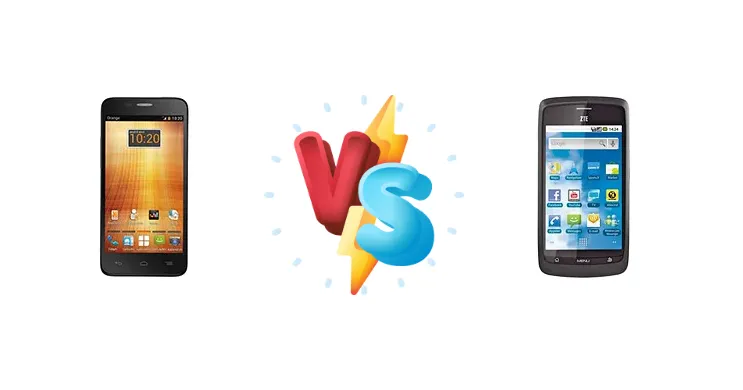
The Orange Hiro and ZTE Blade represent a bygone era of ultra-affordable Android smartphones. While modern budget options offer significantly more, these devices still appear in secondary markets. This comparison dissects their core hardware – the Mediatek MT6572 in the Hiro and the Qualcomm MSM7227 Snapdragon S1 in the Blade – to determine which provides a more usable experience in 2024.
🏆 Quick Verdict
For the average user, the Orange Hiro is the better choice. Its dual-core 1.3 GHz Cortex-A7 CPU, built on a 28nm process, offers a noticeable performance advantage over the ZTE Blade’s 600 MHz ARM 11. While neither phone is a powerhouse, the Hiro’s architecture translates to smoother multitasking and app loading.
| Network |
|---|
| 2G bands | GSM 850 / 900 / 1800 / 1900 | GSM 900 / 1800 / 1900 |
| 3G bands | HSDPA 2100 | HSDPA 900 / 2100 |
| Speed | HSPA | HSPA 7.2/5.76 Mbps |
| Technology | GSM / HSPA | GSM / HSPA |
| Launch |
|---|
| Announced | 2013, Q3. Released 2013, Q3 | 2010, October. Released 2010, November |
| Status | Discontinued | Discontinued |
| Body |
|---|
| Dimensions | 127.1 x 62 x 8 mm (5.00 x 2.44 x 0.31 in) | 116 x 56.5 x 11.8 mm (4.57 x 2.22 x 0.46 in) |
| SIM | Yes | Mini-SIM |
| Weight | 96 g (3.39 oz) | 110 g (3.88 oz) |
| Display |
|---|
| Resolution | 480 x 854 pixels, 16:9 ratio (~228 ppi density) | 480 x 800 pixels, 5:3 ratio (~267 ppi density) |
| Size | 4.3 inches, 51.0 cm2 (~64.7% screen-to-body ratio) | 3.5 inches, 34.9 cm2 (~53.2% screen-to-body ratio) |
| Type | IPS LCD | AMOLED or LCD, 256K colors |
| Platform |
|---|
| CPU | Dual-core 1.3 GHz Cortex-A7 | 600 MHz ARM 11 |
| Chipset | Mediatek MT6572 (28 nm) | Qualcomm MSM7227 Snapdragon S1 |
| GPU | Mali-400 | Adreno 200 |
| OS | Android 4.1 (Jelly Bean) | Android 2.1 (Eclair), upgradable to 2.2 (Froyo) |
| Memory |
|---|
| Card slot | microSDHC (dedicated slot) | microSDHC (dedicated slot), 2 GB included |
| Internal | 4GB 512MB RAM | 512MB RAM, 512MB |
| Main Camera |
|---|
| Features | LED flash | - |
| Single | 5 MP, AF | 3.15 MP, AF |
| Video | 720p | Yes |
| Selfie camera |
|---|
| Single | Yes | - |
| | - | No |
| Sound |
|---|
| 3.5mm jack | Yes | Yes |
| 35mm jack | Yes | Yes |
| Loudspeaker | Yes | Yes |
| Comms |
|---|
| Bluetooth | Yes | 2.1, A2DP, EDR |
| NFC | No | - |
| Positioning | GPS | GPS, A-GPS |
| Radio | No | Stereo FM radio, RDS |
| USB | microUSB 2.0 | microUSB 2.0 |
| WLAN | Wi-Fi 802.11 b/g/n, hotspot | Wi-Fi 802.11 b/g, hotspot (Android 2.2) |
| Features |
|---|
| Browser | - | WAP 2.0/xHTML, HTML |
| Sensors | Accelerometer, proximity | Accelerometer, proximity, compass |
| | - | MP4/H.264 player
MP3/WAV/eAAC+ player
Organizer
Voice memo
Predictive text input |
| Battery |
|---|
| Stand-by | - | Up to 192 h |
| Talk time | - | Up to 4 h |
| Type | Li-Ion 1700 mAh, removable | Removable Li-Ion 1250 mAh battery |
| Misc |
|---|
| Colors | Black | Black |
| Price | - | About 170 EUR |
| SAR EU | 1.29 W/kg (head) | - |
Orange Hiro
- Faster dual-core processor for improved responsiveness
- More modern Cortex-A7 architecture
- 28nm process node for better efficiency
- Limited RAM (likely 512MB or 1GB)
- Outdated Android version
ZTE Blade
- Extremely simple user experience
- Potentially longer standby time due to lower power draw (though active use will be limited)
- Qualcomm chipset known for reliability
- Significantly slower single-core processor
- Outdated ARM 11 architecture
- Poor multitasking performance
Display Comparison
Display specifications are unavailable for both devices. However, given their market segment, it’s safe to assume both utilize low-resolution LCD panels. The focus here isn’t display quality, but rather the processing power needed to drive the UI. The Hiro’s more powerful CPU will likely result in smoother scrolling and transitions, even on a similar display.
Camera Comparison
Camera details are unavailable for both devices. However, given their price point, image quality is unlikely to be a differentiating factor. Expect basic camera functionality suitable for casual snapshots in good lighting conditions. The processing power of the Hiro’s chipset *might* allow for slightly faster image processing, but this is speculative.
Performance
The core difference lies in the chipsets. The Orange Hiro’s Mediatek MT6572, featuring a dual-core 1.3 GHz Cortex-A7 CPU fabricated on a 28nm process, significantly outperforms the ZTE Blade’s Qualcomm MSM7227 Snapdragon S1 with its single-core 600 MHz ARM 11 processor. The Cortex-A7 architecture is a substantial leap forward from the older ARM 11, offering improved instruction set efficiency. The 28nm process node further benefits the Hiro, allowing for higher clock speeds and potentially better thermal management compared to the older Snapdragon S1. This translates to faster app launch times and a more responsive user interface on the Hiro.
Battery Life
Battery capacity data is missing for both devices. However, the more efficient Mediatek MT6572 in the Orange Hiro, coupled with its 28nm manufacturing process, likely contributes to better battery life compared to the ZTE Blade. The Snapdragon S1’s older architecture and potentially less optimized power management will likely result in shorter usage times between charges.
Buying Guide
Buy the Orange Hiro if you need a slightly more responsive experience for basic tasks like calling, texting, and light web browsing. The dual-core processor provides a tangible benefit for everyday use. Buy the ZTE Blade if you prioritize absolute simplicity and are willing to accept significantly slower performance; it may be suitable for users with extremely limited needs or those seeking a very basic backup device.
Frequently Asked Questions
❓ Will the Orange Hiro handle basic social media apps like Facebook or WhatsApp?
The Orange Hiro’s dual-core processor and Cortex-A7 architecture are *just* sufficient to run lightweight versions of Facebook and WhatsApp. Expect slow loading times and occasional lag, especially with multiple apps open. The ZTE Blade will struggle significantly with these apps.
❓ Can either of these phones play modern mobile games?
Neither the Orange Hiro nor the ZTE Blade are suitable for playing modern mobile games. The processors are simply too weak, and the limited RAM will cause severe performance issues. Simple, older 2D games might be playable on the Hiro, but don't expect a good experience.
❓ What Android version do these phones likely run, and will they receive updates?
Both devices likely shipped with Android 4.2 or 4.4 (KitKat). They will *not* receive any further Android updates. Security patches are also unavailable, making them vulnerable to modern threats.
❓ Is the difference between the Mediatek MT6572 and Snapdragon S1 noticeable in everyday use?
Yes, the difference is quite noticeable. The Hiro’s dual-core processor and more modern architecture result in significantly faster app launch times, smoother scrolling, and a more responsive user interface compared to the Blade’s single-core ARM 11 processor.