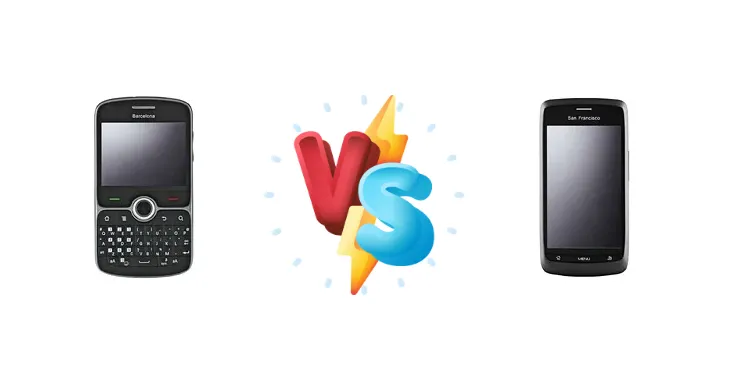
The Orange Barcelona and San Francisco represent distinct points in the early evolution of Android smartphones. While the San Francisco boasts a known Qualcomm Snapdragon S1 chipset, the Barcelona remains largely undocumented, making this comparison a study in contrasts – known versus unknown – and a reflection of the rapid advancements in mobile technology.
🏆 Quick Verdict
For the average user, the Orange San Francisco is the more understandable device, simply because its specifications are known. The 600MHz ARM 11 processor, while dated, provides a baseline Android experience. The Barcelona's lack of documented specs makes it a gamble for anyone seeking a functional device.
| Network |
|---|
| 2G bands | GSM 900 / 1800 / 1900 | GSM 900 / 1800 / 1900 |
| 3G bands | HSDPA 900 / 2100 | HSDPA 900 / 2100 |
| Speed | HSPA | HSPA 7.2/5.76 Mbps |
| Technology | GSM / HSPA | GSM / HSPA |
| Launch |
|---|
| Announced | 2011, Q2. Released 2011, Q2 | 2011, Q2. Released 2011, Q2 |
| Status | Discontinued | Discontinued |
| Body |
|---|
| Dimensions | 115 x 63 x 9.9 mm (4.53 x 2.48 x 0.39 in) | 116 x 56.5 x 11.8 mm (4.57 x 2.22 x 0.46 in) |
| Keyboard | QWERTY | - |
| SIM | Mini-SIM | Mini-SIM |
| Weight | 115 g (4.06 oz) | 130 g (4.59 oz) |
| Display |
|---|
| Resolution | 240 x 320 pixels, 4:3 ratio | 480 x 800 pixels, 5:3 ratio (~267 ppi density) |
| Size | 2.6 inches, 20.9 cm2 (~28.9% screen-to-body ratio) | 3.5 inches, 34.9 cm2 (~53.2% screen-to-body ratio) |
| Type | TFT, 256K colors | AMOLED, 256K colors |
| Platform |
|---|
| CPU | - | 600 MHz ARM 11 |
| Chipset | - | Qualcomm MSM7227 Snapdragon S1 |
| GPU | - | Adreno 200 |
| OS | Android 2.2 (Froyo) | Android 2.1 (Eclair), upgradable to 2.2 (Froyo) |
| Memory |
|---|
| Card slot | microSDHC (dedicated slot) | microSDHC (dedicated slot) |
| Internal | - | 512MB RAM, 512MB |
| Main Camera |
|---|
| Single | 3.15 MP, AF | 3.15 MP, AF |
| Video | Yes | Yes |
| Sound |
|---|
| 3.5mm jack | Yes | Yes |
| 35mm jack | Yes | Yes |
| Loudspeaker | Yes | Yes |
| Comms |
|---|
| Bluetooth | 2.1, A2DP | 2.1, A2DP, EDR |
| Positioning | GPS, A-GPS | GPS, A-GPS |
| Radio | Stereo FM radio, RDS | Stereo FM radio, RDS |
| USB | microUSB 2.0 | microUSB 2.0 |
| WLAN | Wi-Fi 802.11 b/g | Wi-Fi 802.11 b/g |
| Features |
|---|
| Sensors | Accelerometer | Accelerometer, proximity, compass |
| | MP4/H.264 player
MP3/WAV/eAAC+ player
Organizer
Voice memo
Predictive text input | MP4/H.264 player
MP3/WAV/eAAC+ player
Organizer
Voice memo
Predictive text input |
| Battery |
|---|
| Stand-by | Up to 288 h | Up to 216 h |
| Talk time | Up to 7 h | Up to 4 h |
| Type | Removable Li-Ion battery | Removable Li-Ion 1250 mAh battery |
Orange Barcelona
- Potential for collector's value due to obscurity.
- May offer a unique, unexplored Android experience.
- Could be a restoration project for enthusiasts.
- Completely unknown specifications.
- Likely limited functionality.
- Potential for hardware issues due to age.
Orange San Francisco
- Known specifications and chipset.
- Provides a baseline early Android experience.
- Easier to find information and support.
- Slow performance by modern standards.
- Limited app compatibility.
- Poor camera quality.
Display Comparison
Given the era, both devices likely featured resistive touchscreen displays with relatively low resolutions. The San Francisco, being a slightly later release, *may* have benefited from minor improvements in panel responsiveness, but neither is expected to offer the vibrant colors or high brightness levels of modern displays. Without Barcelona specs, we can only assume a similar, or potentially inferior, display quality.
Camera Comparison
Camera capabilities on both devices were rudimentary. The San Francisco likely featured a low-resolution camera (likely 3.2MP or less) with limited features. Image quality would be poor by modern standards, with significant noise and limited dynamic range. The Barcelona’s camera specifications are unknown, but it’s reasonable to assume similar or worse performance. Neither device is likely to offer optical image stabilization (OIS) or advanced image processing capabilities.
Performance
The Orange San Francisco’s Qualcomm MSM7227 Snapdragon S1, featuring a 600 MHz ARM 11 CPU, represents a significant step up from earlier feature phones but is dramatically slower than contemporary smartphones. This chipset was designed for basic Android functionality – web browsing, email, and simple apps. The Barcelona’s processor is unknown; however, given its contemporary release, it likely utilized a similar ARM 11 architecture or an earlier generation, potentially resulting in even lower performance. The San Francisco’s Snapdragon S1 benefits from Qualcomm’s early optimizations for mobile processing, offering a more stable experience than a generic ARM 11 implementation.
Battery Life
Battery life on both devices would have been heavily impacted by the power-hungry early Android operating system and the relatively inefficient processors. The San Francisco likely offered a battery capacity in the range of 1200-1500 mAh, providing a day of moderate use. The Barcelona’s battery capacity is unknown, but it’s unlikely to significantly outperform the San Francisco given the similar hardware constraints. Charging times would have been slow, likely several hours for a full charge.
Buying Guide
Buy the Orange Barcelona if you are a collector of obscure mobile devices and enjoy the challenge of researching and potentially restoring a phone with limited information. Buy the Orange San Francisco if you are interested in experiencing a very early Android implementation and want a device with documented specifications, even if performance is significantly limited by today's standards.
Frequently Asked Questions
❓ Is the Qualcomm MSM7227 Snapdragon S1 in the Orange San Francisco capable of running modern Android apps?
No. The Snapdragon S1 is severely underpowered by today's standards and lacks the necessary hardware and software support to run modern Android apps. It was designed for Android 1.5 Cupcake or 1.6 Donut, and attempting to run newer apps will likely result in crashes or extremely slow performance.
❓ What kind of connectivity does the Orange San Francisco offer?
The Orange San Francisco likely supports 2G and 3G cellular connectivity, as well as Wi-Fi 802.11b/g. Bluetooth 2.0 is also probable. Do not expect support for 4G, 5G, or modern Wi-Fi standards like 802.11ac or ax.
❓ Given the lack of information on the Orange Barcelona, is it worth purchasing?
Only if you are a dedicated collector of vintage mobile devices and are prepared for a potentially non-functional or difficult-to-repair device. The lack of documentation makes it a high-risk purchase.