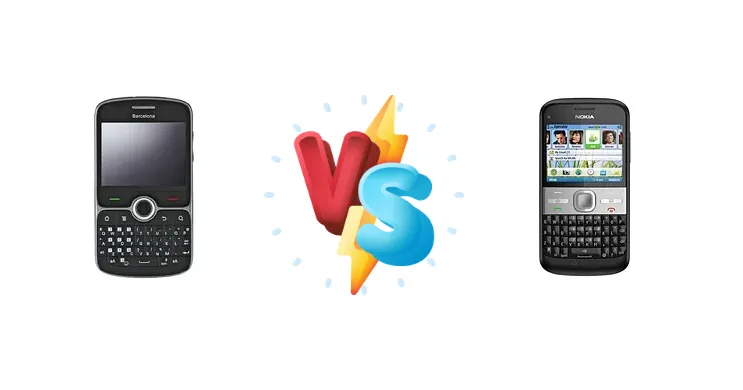
The mobile landscape has drastically changed since the Nokia E5’s release. Comparing it to the Orange Barcelona, a device with limited publicly available specifications, highlights the evolution – or lack thereof – in mobile functionality. This comparison isn’t about raw power, but about understanding the needs a modern or legacy device can fulfill.
🏆 Quick Verdict
For the average user seeking smartphone functionality, the Orange Barcelona is the likely choice, assuming it offers even basic smartphone features. The Nokia E5, while durable and offering a tactile QWERTY keyboard, is limited by its 600 MHz ARM 11 processor and basic photo capabilities, making it suitable only for very specific, minimalist use cases.
| Network |
|---|
| 2G bands | GSM 900 / 1800 / 1900 | GSM 850 / 900 / 1800 / 1900 |
| 3G bands | HSDPA 900 / 2100 | HSDPA 900 / 1900 / 2100 |
| Speed | HSPA | HSPA 10.2/2 Mbps |
| Technology | GSM / HSPA | GSM / HSPA |
| | - | HSDPA 850 / 1900 / 2100 |
| Launch |
|---|
| Announced | 2011, Q2. Released 2011, Q2 | 2010, April. Released 2010, August |
| Status | Discontinued | Discontinued |
| Body |
|---|
| Dimensions | 115 x 63 x 9.9 mm (4.53 x 2.48 x 0.39 in) | 115 x 58.9 x 12.8 mm, 75 cc (4.53 x 2.32 x 0.50 in) |
| Keyboard | QWERTY | QWERTY |
| SIM | Mini-SIM | Mini-SIM |
| Weight | 115 g (4.06 oz) | 126 g (4.44 oz) |
| Display |
|---|
| Resolution | 240 x 320 pixels, 4:3 ratio | 320 x 240 pixels, 4:3 ratio (~169 ppi density) |
| Size | 2.6 inches, 20.9 cm2 (~28.9% screen-to-body ratio) | 2.36 inches, 17.2 cm2 (~25.5% screen-to-body ratio) |
| Type | TFT, 256K colors | TFT, 256K colors |
| Platform |
|---|
| CPU | - | 600 MHz ARM 11 |
| OS | Android 2.2 (Froyo) | Symbian 9.3, Series 60 rel. 3.2 |
| Memory |
|---|
| Card slot | microSDHC (dedicated slot) | microSDHC (dedicated slot), 2 GB included |
| Internal | - | 250MB; 256MB RAM |
| Main Camera |
|---|
| Features | - | LED flash |
| Single | 3.15 MP, AF | 5 MP |
| Video | Yes | 480p@15fps |
| Sound |
|---|
| 3.5mm jack | Yes | Yes |
| 35mm jack | Yes | Yes |
| Loudspeaker | Yes | Yes |
| Comms |
|---|
| Bluetooth | 2.1, A2DP | 2.0, A2DP |
| Positioning | GPS, A-GPS | GPS, A-GPS; Ovi Maps |
| Radio | Stereo FM radio, RDS | Stereo FM radio, RDS |
| USB | microUSB 2.0 | microUSB 2.0 |
| WLAN | Wi-Fi 802.11 b/g | Wi-Fi 802.11 b/g, UPnP & DLNA technology |
| Features |
|---|
| Browser | - | WAP 2.0/xHTML, HTML, Adobe Flash Lite |
| Sensors | Accelerometer | - |
| | MP4/H.264 player
MP3/WAV/eAAC+ player
Organizer
Voice memo
Predictive text input | Document editor (Word, Excel, PowerPoint), PDF viewer
MP4/H.264/WMV player
MP3/WAV/WMA/eAAC+ player
Voice command/dial
Organizer
Predictive text input |
| Battery |
|---|
| Music play | - | Up to 38 h |
| Stand-by | Up to 288 h | Up to 635 h (2G) / Up to 670 h (3G) |
| Talk time | Up to 7 h | Up to 13 h 10 min (2G) / Up to 5 h 15 min (3G) |
| Type | Removable Li-Ion battery | Removable Li-Ion 1200 mAh battery (BL-4D) |
| Misc |
|---|
| Colors | Black | Carbon Black, Chalk White, Sky Blue, Copper Brown, Silver Grey |
| Price | - | About 90 EUR |
| SAR | - | 1.18 W/kg (head) 1.12 W/kg (body) |
| SAR EU | - | 0.88 W/kg (head) |
| Tests |
|---|
| Audio quality | - |
Noise -90.0dB / Crosstalk -91.5dB |
| Camera | - |
Photo |
| Loudspeaker | - |
Voice 75dB / Noise 66dB / Ring 75dB |
Orange Barcelona
- Potentially modern features (apps, internet)
- Likely superior display quality
- Improved camera capabilities (assuming modern sensor)
- Specifications largely unknown
- Potential for shorter battery life than Nokia E5
Nokia E5
- Exceptional battery life
- Durable build quality
- Tactile QWERTY keyboard for efficient texting
- Outdated processor and limited performance
- Low-resolution camera
- Limited functionality compared to smartphones
Display Comparison
Given the lack of display specifications for the Orange Barcelona, we can only assume it features a color display, a common expectation for modern devices. The Nokia E5, in contrast, has a 2.4-inch display. The Barcelona’s potential for higher resolution and brightness would offer a significantly improved viewing experience for media consumption, while the E5’s display prioritizes readability and battery efficiency.
Camera Comparison
Both devices feature a camera described simply as 'Photo'. The Nokia E5’s 5-megapixel camera was acceptable for its time, but image quality is limited by the sensor size and lack of advanced image processing. The Orange Barcelona’s camera, even if a basic sensor, likely benefits from modern image processing algorithms, resulting in better low-light performance and dynamic range. The absence of details on the Barcelona’s camera makes a precise comparison impossible, but modern sensors generally outperform older ones.
Performance
The Nokia E5’s 600 MHz ARM 11 processor is a significant bottleneck by today’s standards. It was adequate for basic tasks like calls and texts in 2010, but struggles with multitasking or any demanding applications. The Orange Barcelona, even with a modest processor, likely offers a substantial performance leap due to advancements in CPU architecture and manufacturing processes. The ARM 11’s single-core design limits its ability to handle concurrent tasks, impacting responsiveness.
Battery Life
The Nokia E5 is renowned for its exceptional battery life, often lasting several days on a single charge due to its low-power processor and basic features. The Orange Barcelona’s battery life will depend heavily on its display size, processor, and usage patterns. While it may offer faster charging capabilities, it’s unlikely to match the E5’s longevity without significant user intervention to conserve power.
Buying Guide
Buy the Orange Barcelona if you need access to modern apps, internet browsing, and a color display. It represents a potential entry point into smartphone functionality. Buy the Nokia E5 if you prioritize extreme durability, a physical QWERTY keyboard for extensive texting, and long battery life over any advanced features. It’s ideal for those needing a reliable, no-frills communication device.
Frequently Asked Questions
❓ Is the Nokia E5 still useful in 2024?
The Nokia E5 remains useful for individuals who prioritize simplicity, durability, and long battery life above all else. It's ideal for emergency communication, basic texting, and situations where a smartphone would be impractical or unnecessary. However, its limited functionality won't suit users accustomed to modern smartphone features.
❓ What kind of apps can the Orange Barcelona run, given its unknown specs?
Without specific specifications, it's difficult to say definitively. However, if the Orange Barcelona is a smartphone, it will likely run apps available through an app store (like Google Play or a similar platform). The extent of app compatibility will depend on the device's processor, RAM, and operating system version.
❓ Can I easily find replacement parts for the Nokia E5?
Yes, replacement parts for the Nokia E5 are still relatively easy to find online through various retailers and marketplaces specializing in legacy mobile phone parts. Its popularity and relatively simple design contribute to its continued parts availability.