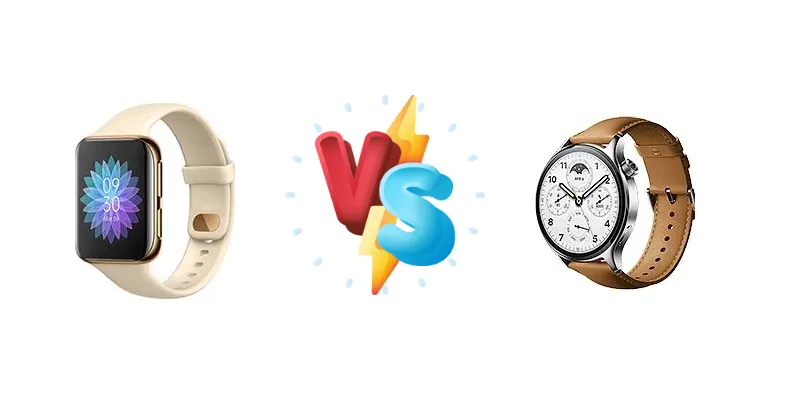
The smartwatch market is increasingly competitive, with both Oppo and Xiaomi offering compelling Wear OS options. The Oppo Watch, available in both international and China-specific variants, leverages Qualcomm's Snapdragon Wear platform. The Xiaomi Watch S1 Pro, meanwhile, focuses on a premium design and convenient wireless charging. This comparison dissects the core differences between these two devices, focusing on performance and usability.
🏆 Quick Verdict
For the average user prioritizing consistent performance and a wider range of app compatibility, the Oppo Watch, particularly the international version with the Snapdragon Wear 3100, is the better choice. While the Xiaomi Watch S1 Pro offers the convenience of wireless charging, its overall performance profile is less defined given the limited available specifications.
| Network |
|---|
| 2G bands | N/A | N/A |
| 3G bands | HSDPA 900 / 2100 | N/A |
| 4G bands | 1, 3, 7, 8, 20, 38 - International | N/A |
| EDGE | - | No |
| GPRS | - | No |
| Speed | HSPA, LTE | No |
| Technology | HSPA / LTE | No cellular connectivity |
| | 1, 3, 5, 8, 38, 39, 40, 41 - China | - |
| Launch |
|---|
| Announced | 2020, March 06. Released 2020, March 24 | 2022, August 12 |
| Status | Discontinued | Available. Released 2022, August 12 |
| Body |
|---|
| Build | Glass front, stainless steel frame or aluminum frame, ceramic/sapphire crystal back or plastic back | Sapphire crystal front, stainless steel frame, sapphire crystal (heart rate zone), plastic back |
| Dimensions | 46 x 39 x 11.4 mm (1.81 x 1.54 x 0.45 in) | 46 x 46 x 11.3 mm (1.81 x 1.81 x 0.44 in) |
| SIM | eSIM (market/region dependent) | No |
| Weight | 40 g (aluminum) / 45.5 g (stainless steel) (1.41 oz) | 48.5 g (1.73 oz) |
| | 5ATM water resistant (46mm model)
3ATM water resistant (41mm model) | Waterproof (5ATM) |
| Display |
|---|
| Protection | Schott Xensation Up (46mm), Corning Gorilla Glass (41mm) | - |
| Resolution | 402 x 476 pixels (~326 ppi density) | 480 x 480 pixels (~462 ppi density) |
| Size | 1.91 inches | 1.47 inches |
| Type | AMOLED | AMOLED, 600 nits (typ) |
| Platform |
|---|
| CPU | Quad-core 1.09 GHz Cortex-A7 | - |
| Chipset | Qualcomm Snapdragon Wear 3100 (28 nm) - InternationalQualcomm MSM8909W Snapdragon Wear 2500 (28 nm) - China | - |
| GPU | Adreno 304 | - |
| OS | Android Wear OS - InternationalColorOS Watch OS - China | MIUI Watch OS |
| Memory |
|---|
| Card slot | No | No |
| Internal | 8GB 1GB RAM | Unspecified storage |
| | eMMC 4.5 | - |
| Sound |
|---|
| 3.5mm jack | No | No |
| 35mm jack | No | No |
| Loudspeaker | Yes | Yes |
| Comms |
|---|
| Bluetooth | 4.2, LE | 5.2, A2DP, LE |
| NFC | Yes | Yes |
| Positioning | GPS, GLONASS, BDS | GPS (L1+L5), GLONASS, GALILEO, BDS, QZSS |
| Radio | No | No |
| USB | No | No |
| WLAN | Wi-Fi 802.11 b/g/n | Wi-Fi 802.11 b/g/n (China only) |
| Features |
|---|
| Sensors | Accelerometer, gyro, heart rate, compass, barometer | Accelerometer, gyro, compass, barometer, heart rate, SpO2, thermometer (body temperature) |
| Battery |
|---|
| Charging | - | Wireless, 100% in 85 min |
| Type | Li-Ion 430 mAh | Li-Po 500 mAh |
| Misc |
|---|
| Colors | Black, Glossy Gold, Pink Gold, Silver Mist | Black, Silver |
| Models | - | M2135W1, M2134W1 |
| Price | About 100 EUR | About 220 EUR |
Oppo Watch
- Proven Snapdragon Wear 3100 performance (International version)
- Wider app compatibility due to Wear OS
- Rectangular display maximizes screen real estate
- Older chipset compared to current smartphone processors
- China variant uses the less powerful Snapdragon Wear 2500
Xiaomi Watch S1 Pro
- Convenient wireless charging (100% in 85 minutes)
- Premium design aesthetic (inferred)
- Potentially longer battery life due to optimized software (speculation)
- Lack of detailed processor specifications
- Performance profile is less defined
Display Comparison
Display specifications are absent for the Xiaomi Watch S1 Pro, making a direct comparison difficult. However, given its positioning as a premium device, we can infer a high-resolution AMOLED panel. The Oppo Watch features a rectangular AMOLED display, a design choice that maximizes screen real estate. The absence of details like peak brightness or refresh rate for the Xiaomi Watch S1 Pro hinders a complete assessment. The Oppo Watch's rectangular form factor, while offering more information at a glance, may not appeal to users accustomed to traditional round smartwatch displays.
Camera Comparison
Neither the Oppo Watch nor the Xiaomi Watch S1 Pro are marketed as camera-centric devices. Consequently, detailed camera specifications are unavailable for either. Smartwatches generally offer limited camera capabilities, primarily for quick snapshots or video calls. The absence of camera details suggests that photography is not a primary use case for either device.
Performance
The Oppo Watch's core strength lies in its Qualcomm Snapdragon Wear 3100 (international) or MSM8909W Snapdragon Wear 2500 (China) chipset. The Wear 3100, built on a 28nm process, provides a significant performance boost over older Wear OS devices. The Xiaomi Watch S1 Pro lacks detailed processor information, making a direct performance comparison challenging. The Snapdragon Wear 3100's quad-core 1.09 GHz Cortex-A7 architecture is optimized for wearable devices, balancing performance and power efficiency. Users of the international Oppo Watch version will likely experience smoother app launches and more responsive system interactions compared to the China variant with the older Wear 2500.
Battery Life
The Xiaomi Watch S1 Pro boasts wireless charging, achieving a full charge in 85 minutes. This is a significant convenience factor for users who dislike the hassle of cables. The Oppo Watch's battery capacity and charging time are not specified in the provided data. However, the Snapdragon Wear 3100's power efficiency should contribute to reasonable battery life. The Xiaomi Watch S1 Pro's wireless charging capability provides a clear advantage in terms of user convenience, potentially offsetting any differences in raw battery capacity.
Buying Guide
Buy the Oppo Watch if you need a smartwatch with a proven, if slightly aging, processor capable of running a broad range of Wear OS apps smoothly. It's ideal for users who value performance and app ecosystem access. Buy the Xiaomi Watch S1 Pro if you prioritize a premium aesthetic and the convenience of wireless charging, and are less concerned with maximizing processing power or running demanding applications.
Frequently Asked Questions
❓ Does the Oppo Watch's Snapdragon Wear 3100 chipset feel dated in 2024?
While not the latest and greatest, the Snapdragon Wear 3100 remains a capable processor for smartwatch tasks. It provides a smooth experience for most Wear OS apps and features. However, users accustomed to the speed of modern smartphones may notice some limitations when running demanding applications.
❓ What are the key differences between the international and China versions of the Oppo Watch?
The primary difference lies in the chipset. The international version utilizes the Snapdragon Wear 3100, offering superior performance. The China version is equipped with the older Snapdragon Wear 2500, resulting in a less responsive user experience. Other potential differences may exist in software features and app availability.
❓ Is the wireless charging on the Xiaomi Watch S1 Pro a significant advantage?
Yes, the wireless charging capability is a notable convenience feature. It eliminates the need for cables and simplifies the charging process, particularly for users who frequently charge their smartwatch.