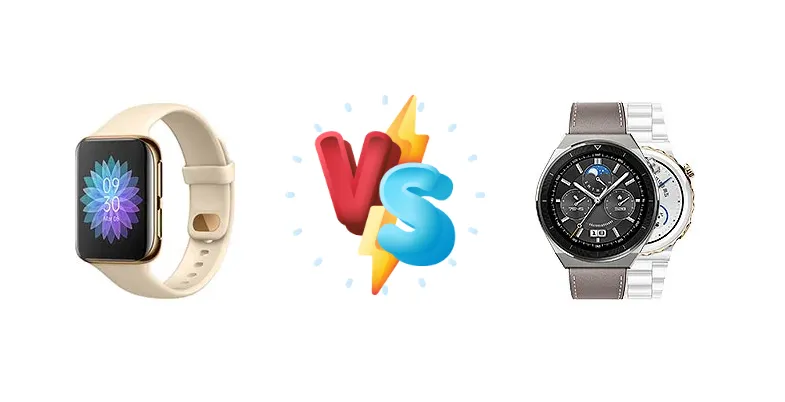
The smartwatch market offers a spectrum of choices, from full-featured Wear OS devices like the Oppo Watch to the long-lasting, feature-rich Huawei Watch GT 3 Pro. This comparison focuses on the core differences: the Oppo Watch’s emphasis on a familiar software experience powered by Qualcomm, versus the GT 3 Pro’s focus on extended battery life and premium build quality. We'll dissect the implications of these design choices for the average user.
🏆 Quick Verdict
For users deeply invested in the Google ecosystem and prioritizing app compatibility, the Oppo Watch offers a more versatile experience. However, the Huawei Watch GT 3 Pro wins for most users due to its significantly longer battery life and wireless charging convenience, making it a more practical daily companion.
| Network |
|---|
| 2G bands | N/A | N/A |
| 3G bands | HSDPA 900 / 2100 | N/A |
| 4G bands | 1, 3, 7, 8, 20, 38 - International | N/A |
| EDGE | - | No |
| GPRS | - | No |
| Speed | HSPA, LTE | No |
| Technology | HSPA / LTE | No cellular connectivity |
| | 1, 3, 5, 8, 38, 39, 40, 41 - China | - |
| Launch |
|---|
| Announced | 2020, March 06. Released 2020, March 24 | 2022, April 28 |
| Status | Discontinued | Available. Released 2022, May 05 |
| Body |
|---|
| Build | Glass front, stainless steel frame or aluminum frame, ceramic/sapphire crystal back or plastic back | Sapphire crystal front, titanium frame or ceramic frame, ceramic back |
| Dimensions | 46 x 39 x 11.4 mm (1.81 x 1.54 x 0.45 in) | 46.6 x 46.6 x 10.9 mm (1.83 x 1.83 x 0.43 in) |
| SIM | eSIM (market/region dependent) | No |
| Weight | 40 g (aluminum) / 45.5 g (stainless steel) (1.41 oz) | 50 g (43mm) / 54 g (46mm) (1.76 oz) |
| | 5ATM water resistant (46mm model)
3ATM water resistant (41mm model) | 30m water resistant
5 ATM
IP68
Compatible with standard 22mm straps (46mm model), 20mm straps (43mm model)
ECG certified |
| Display |
|---|
| Protection | Schott Xensation Up (46mm), Corning Gorilla Glass (41mm) | - |
| Resolution | 402 x 476 pixels (~326 ppi density) | 466 x 466 pixels (~326 ppi density) |
| Size | 1.91 inches | 1.43 inches |
| Type | AMOLED | AMOLED |
| Platform |
|---|
| CPU | Quad-core 1.09 GHz Cortex-A7 | - |
| Chipset | Qualcomm Snapdragon Wear 3100 (28 nm) - InternationalQualcomm MSM8909W Snapdragon Wear 2500 (28 nm) - China | - |
| GPU | Adreno 304 | - |
| OS | Android Wear OS - InternationalColorOS Watch OS - China | HarmonyOS 2.0, upgradable to 3.0 |
| Memory |
|---|
| Card slot | No | No |
| Internal | 8GB 1GB RAM | 32GB |
| | eMMC 4.5 | - |
| Sound |
|---|
| 3.5mm jack | No | No |
| 35mm jack | No | No |
| Loudspeaker | Yes | Yes |
| Comms |
|---|
| Bluetooth | 4.2, LE | 5.2, A2DP, LE |
| NFC | Yes | Yes |
| Positioning | GPS, GLONASS, BDS | GPS (L1+L5), GLONASS, BDS, GALILEO, QZSS |
| Radio | No | No |
| USB | No | No |
| WLAN | Wi-Fi 802.11 b/g/n | No |
| Features |
|---|
| Sensors | Accelerometer, gyro, heart rate, compass, barometer | Accelerometer, gyro, heart rate, barometer, compass, SpO2, thermometer (body temperature) |
| Battery |
|---|
| Charging | - | Wireless |
| Type | Li-Ion 430 mAh | Li-Po 530 mAh |
| Misc |
|---|
| Colors | Black, Glossy Gold, Pink Gold, Silver Mist | Silver |
| Models | - | ODN-B19, FRG-B19 |
| Price | About 100 EUR | About 200 EUR |
Oppo Watch
- Faster app performance due to Qualcomm Snapdragon Wear 3100.
- Access to the Google Play Store and Wear OS ecosystem.
- Potentially smoother animations with a higher refresh rate display (speculation).
- Likely shorter battery life compared to the Huawei Watch GT 3 Pro.
- Older 28nm manufacturing process may lead to thermal throttling.
- Requires more frequent charging.
Huawei Watch GT 3 Pro
- Significantly longer battery life due to Huawei’s optimized chipset.
- Convenient wireless charging.
- Premium build quality and design.
- Limited app ecosystem compared to Wear OS.
- Potentially slower app performance.
- Reliance on Huawei’s proprietary software.
Display Comparison
The provided data doesn't detail display specifications for either watch. However, given Oppo's smartphone history, the Oppo Watch likely utilizes an OLED panel, potentially with a higher refresh rate for smoother animations. The Huawei Watch GT 3 Pro, positioned as a premium device, likely also features an OLED display, but its focus is more on always-on functionality and power efficiency. Without specific nit brightness or resolution data, it's difficult to definitively declare a winner, but the GT 3 Pro’s emphasis on battery suggests a potentially more conservative display configuration.
Camera Comparison
Neither device is marketed for its camera capabilities, and no camera specifications are provided. Smartwatches generally offer limited camera functionality, and this comparison doesn't focus on that aspect.
Performance
The Oppo Watch, equipped with the Qualcomm Snapdragon Wear 3100 (or the MSM8909W Snapdragon Wear 2500 in China), represents a significant step up from older Wear OS devices. The quad-core 1.09 GHz Cortex-A7 CPU allows for relatively smooth app navigation and responsiveness. However, the 28nm manufacturing process is comparatively dated. The Huawei Watch GT 3 Pro, while not detailing its chipset, relies on Huawei’s proprietary Kirin processors, optimized for power efficiency rather than raw performance. This means the Oppo Watch will likely handle complex tasks and app installations faster, but at the cost of battery life. Users who frequently use apps or require quick responsiveness will benefit from the Oppo Watch’s chipset.
Battery Life
The lack of battery capacity data for both devices makes a direct comparison challenging. However, Huawei consistently prioritizes battery life in its wearables. The GT 3 Pro’s inclusion of wireless charging suggests a focus on convenience and a longer ownership experience. The Oppo Watch, powered by the more power-hungry Snapdragon Wear 3100, will likely require more frequent charging. The GT 3 Pro’s optimized chipset and software will likely translate to days of use on a single charge, while the Oppo Watch will likely need daily charging, especially with heavy use.
Buying Guide
Buy the Oppo Watch if you need seamless integration with Google services, access to a wider range of Wear OS apps, and prefer a more traditional smartwatch interface. Buy the Huawei Watch GT 3 Pro if you prioritize battery life above all else, appreciate a premium design with wireless charging, and are comfortable with Huawei’s proprietary ecosystem.
Frequently Asked Questions
❓ Will the Oppo Watch receive Wear OS updates for an extended period, given the age of the Snapdragon Wear 3100?
Qualcomm’s support for older chipsets can be limited. While Oppo has provided updates in the past, the long-term availability of Wear OS updates for the Oppo Watch is uncertain, potentially impacting future feature additions and security patches.
❓ Does the Huawei Watch GT 3 Pro’s proprietary ecosystem limit functionality when paired with a non-Huawei phone?
While the Huawei Watch GT 3 Pro functions with both Android and iOS devices, some features, such as seamless app notifications and certain health data synchronization options, may be limited when paired with a non-Huawei phone. The experience is generally best within the Huawei ecosystem.
❓ How does the Snapdragon Wear 3100’s 28nm process affect the Oppo Watch’s performance during extended use?
The 28nm process is less efficient than newer manufacturing nodes. This means the Snapdragon Wear 3100 in the Oppo Watch is more prone to generating heat during sustained tasks, potentially leading to performance throttling to prevent overheating. This is less of a concern for the GT 3 Pro’s Kirin chipset, which is optimized for efficiency.