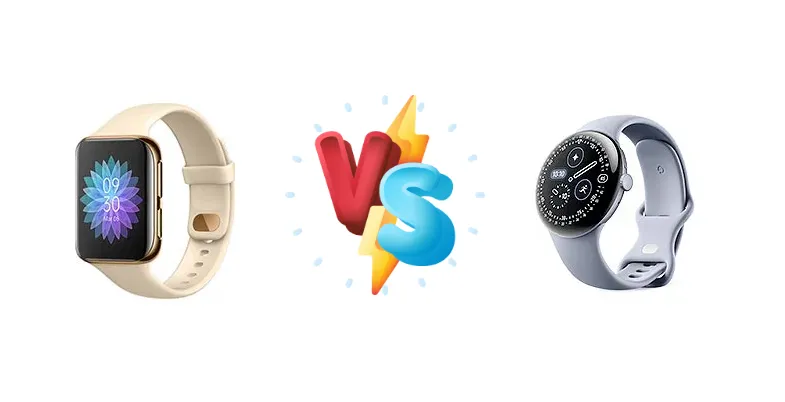
The smartwatch market is heating up, with Google’s Pixel Watch 4 aiming to redefine the Wear OS experience. But how does it stack up against established players like the Oppo Watch? This comparison dives deep into the core hardware – specifically the chipsets – to determine which watch delivers the best performance, battery life, and overall value.
🏆 Quick Verdict
For most users, the Google Pixel Watch 4 is the superior choice. Its Snapdragon W5 Gen 2 chipset offers a significant performance leap and improved efficiency over the Oppo Watch’s older Snapdragon Wear 3100 (or even the Wear 2500 in China), justifying the price premium for those prioritizing responsiveness and future-proofing.
| Network |
|---|
| 2G bands | N/A | GSM 850 / 900 / 1800 / 1900 |
| 3G bands | HSDPA 900 / 2100 | HSDPA 850 / 900 / 1700(AWS) / 1900 / 2100 |
| 4G bands | 1, 3, 7, 8, 20, 38 - International | LTE |
| Speed | HSPA, LTE | HSPA, LTE |
| Technology | HSPA / LTE | GSM / HSPA / LTE |
| | 1, 3, 5, 8, 38, 39, 40, 41 - China | - |
| Launch |
|---|
| Announced | 2020, March 06. Released 2020, March 24 | 2025, August 20 |
| Status | Discontinued | Available. Released 2025, October 09 |
| Body |
|---|
| Build | Glass front, stainless steel frame or aluminum frame, ceramic/sapphire crystal back or plastic back | Glass front (Gorilla Glass 5), aluminum frame |
| Dimensions | 46 x 39 x 11.4 mm (1.81 x 1.54 x 0.45 in) | 45 x 45 x 12.3 mm (1.77 x 1.77 x 0.48 in) |
| SIM | eSIM (market/region dependent) | eSIM |
| Weight | 40 g (aluminum) / 45.5 g (stainless steel) (1.41 oz) | 31 g or 37 g (1.09 oz) |
| | 5ATM water resistant (46mm model)
3ATM water resistant (41mm model) | - |
| Display |
|---|
| Protection | Schott Xensation Up (46mm), Corning Gorilla Glass (41mm) | Corning Gorilla Glass 5 |
| Resolution | 402 x 476 pixels (~326 ppi density) | 456 x 456 pixels (~320 ppi density) |
| Size | 1.91 inches | 1.4 inches |
| Type | AMOLED | LTPO AMOLED, 3000 nits (peak) |
| Platform |
|---|
| CPU | Quad-core 1.09 GHz Cortex-A7 | Quad-core (4x1.7 GHz Cortex-A53) |
| Chipset | Qualcomm Snapdragon Wear 3100 (28 nm) - InternationalQualcomm MSM8909W Snapdragon Wear 2500 (28 nm) - China | Qualcomm Snapdragon W5 Gen 2 (4 nm) |
| GPU | Adreno 304 | Adreno A702 |
| OS | Android Wear OS - InternationalColorOS Watch OS - China | Android Wear OS 6 |
| Memory |
|---|
| Card slot | No | No |
| Internal | 8GB 1GB RAM | 32GB 2GB RAM |
| | eMMC 4.5 | - |
| Sound |
|---|
| 3.5mm jack | No | - |
| 35mm jack | No | No |
| Loudspeaker | Yes | Yes |
| Comms |
|---|
| Bluetooth | 4.2, LE | 6.0, A2DP |
| NFC | Yes | Yes |
| Positioning | GPS, GLONASS, BDS | GPS (L1+L5), GLONASS, GALILEO (E1+E5a) |
| Radio | No | No |
| USB | No | No |
| WLAN | Wi-Fi 802.11 b/g/n | Wi-Fi 802.11 a/b/g/n/ac/6, dual-band |
| Features |
|---|
| Sensors | Accelerometer, gyro, heart rate, compass, barometer | Accelerometer, gyro, heart rate, altimeter, compass, SpO2, thermometer (skin temperature), skin conductance |
| Battery |
|---|
| Charging | - | Wired, 50% in 15 min, 80% in 30 min, 100% in 60 min - 45mm model
Wired, 50% in 15 min, 80% in 25 min, 100% in 45 min - 41mm model |
| Type | Li-Ion 430 mAh | Li-Ion 455 mAh |
| Misc |
|---|
| Colors | Black, Glossy Gold, Pink Gold, Silver Mist | Matte Black, Polished Silver, Champagne Gold, Satin Moonstone |
| Price | About 100 EUR | € 353.94 |
Oppo Watch
- More affordable price point
- Established Wear OS experience
- Potentially longer battery life with conservative usage
- Older, less efficient Snapdragon Wear 3100/2500 chipset
- Slower performance compared to the Pixel Watch 4
- Limited future software support potential
Google Pixel Watch 4
- Significantly faster and more efficient Snapdragon W5 Gen 2 chipset
- Faster charging speeds
- Improved long-term software support
- Higher price tag
- Circular design may not appeal to all users
- Battery life, while improved, may not drastically exceed Oppo Watch with heavy use
Display Comparison
While display specs aren't provided, the Oppo Watch historically features a rectangular AMOLED display, a design choice that maximizes screen real estate. The Pixel Watch 4 maintains a circular AMOLED, prioritizing aesthetics. The key difference lies under the hood; the Pixel Watch 4 benefits from the W5 Gen 2’s improved display driver, potentially leading to more efficient power consumption and smoother animations, even if peak brightness is similar. Bezels are likely comparable, given both brands' focus on premium designs.
Camera Comparison
Neither device is particularly known for its camera prowess, and detailed camera specs are unavailable. Smartwatches generally prioritize functionality over photographic excellence. Any camera on either device is likely intended for quick, casual snapshots rather than serious photography.
Performance
The core of this comparison is the chipset. The Oppo Watch utilizes either the Qualcomm Snapdragon Wear 3100 (international) or the older Wear 2500 (China), both built on a 28nm process. This translates to a 1.09 GHz quad-core Cortex-A7 CPU. In contrast, the Pixel Watch 4 boasts the Snapdragon W5 Gen 2, fabricated on a significantly more efficient 4nm process, with a quad-core 1.7 GHz Cortex-A53 CPU. This represents a substantial architectural upgrade. The 4nm node allows for higher transistor density and lower power consumption at a given performance level, meaning the Pixel Watch 4 will experience less thermal throttling during demanding tasks and deliver a consistently smoother experience. The higher clock speeds of the A53 cores further contribute to improved responsiveness.
Battery Life
Battery capacity isn’t specified for either watch, but the Pixel Watch 4’s Snapdragon W5 Gen 2 offers a significant advantage in power efficiency. This, combined with its faster charging capabilities – 50% in 15 minutes (45mm model), 80% in 30 minutes (45mm), 100% in 60 minutes (45mm) versus 50% in 15 minutes, 80% in 25 minutes, 100% in 45 minutes (41mm) – means users will spend less time tethered to a charger. While the Oppo Watch may have a slightly larger battery, the W5 Gen 2’s efficiency will likely result in comparable or even superior real-world battery life for the Pixel Watch 4.
Buying Guide
Buy the Oppo Watch if you’re seeking a more affordable entry point into the Wear OS ecosystem and prioritize a familiar design. It’s a solid option for basic fitness tracking and notifications. Buy the Google Pixel Watch 4 if you demand a smoother, more responsive user experience, faster charging, and the benefits of a cutting-edge, 4nm chipset that promises better long-term performance and software support.
Frequently Asked Questions
❓ Does the Snapdragon W5 Gen 2 in the Pixel Watch 4 actually translate to a noticeable performance improvement in everyday use?
Yes, the Snapdragon W5 Gen 2 offers a substantial performance boost. Users will experience faster app loading times, smoother animations, and a more responsive overall experience compared to the Oppo Watch’s older chipset. This is particularly noticeable when multitasking or using demanding apps.
❓ I'm concerned about battery life. Will the Pixel Watch 4's faster charging compensate for a potentially smaller battery capacity?
The Pixel Watch 4’s faster charging is a significant advantage. While battery capacity isn’t publicly available, the W5 Gen 2’s improved power efficiency means you’ll likely get comparable or even better real-world battery life than the Oppo Watch, and you’ll be able to top it up much quicker when needed.
❓ Is the difference between the Snapdragon Wear 3100 and the Snapdragon W5 Gen 2 significant enough to justify upgrading from the Oppo Watch?
For users who frequently use their smartwatch for more than basic notifications and fitness tracking, the upgrade is worthwhile. The W5 Gen 2 provides a much smoother and more responsive experience, and its improved efficiency will extend battery life. However, if you primarily use your watch for simple tasks, the upgrade may not be essential.