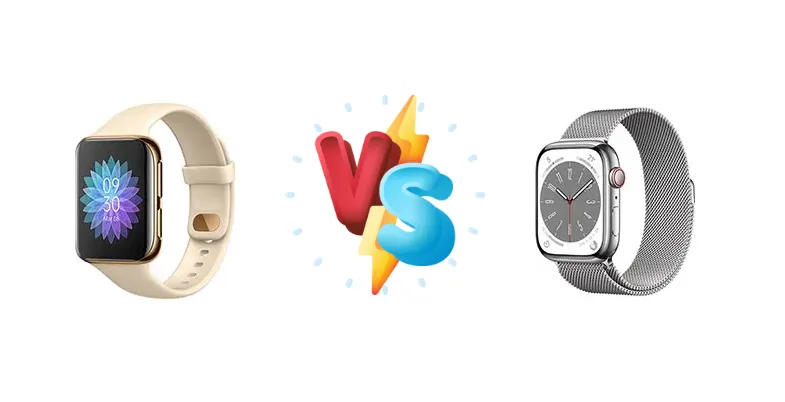
The smartwatch market is dominated by Apple, but challengers like Oppo are offering compelling alternatives. We pit the Oppo Watch, powered by Qualcomm's Snapdragon Wear 3100, against the Apple Watch Series 8, featuring Apple’s proprietary S8 chip, to determine which wearable reigns supreme. This comparison focuses on performance, battery life, and the overall user experience, acknowledging the significant ecosystem differences.
🏆 Quick Verdict
For Android users seeking a capable Wear OS smartwatch with a more open ecosystem, the Oppo Watch offers excellent value. However, the Apple Watch Series 8 wins for iPhone users due to its seamless integration, advanced health features, and superior performance stemming from the Apple S8 chip.
| Network |
|---|
| 2G bands | N/A | GSM 850 / 900 / 1800 / 1900 |
| 3G bands | HSDPA 900 / 2100 | HSDPA 850 / 900 / 1700(AWS) / 1900 / 2100 - International, China, HK |
| 4G bands | 1, 3, 7, 8, 20, 38 - International | 1, 2, 3, 4, 5, 6, 7, 8, 18, 19, 20, 25, 26, 28, 39, 40, 41, 66 - International, China, HK |
| Speed | HSPA, LTE | HSPA, LTE |
| Technology | HSPA / LTE | GSM / HSPA / LTE |
| | 1, 3, 5, 8, 38, 39, 40, 41 - China | 1, 2, 3, 4, 5, 6, 7, 12, 13, 14, 17, 18, 19, 25, 26, 39, 40, 41, 66 - USA, LATAM, Canada |
| Launch |
|---|
| Announced | 2020, March 06. Released 2020, March 24 | 2022, September 07 |
| Status | Discontinued | Available. Released 2022, September 16 |
| Body |
|---|
| Build | Glass front, stainless steel frame or aluminum frame, ceramic/sapphire crystal back or plastic back | Sapphire crystal front, ceramic/sapphire crystal back, stainless steel frame |
| Dimensions | 46 x 39 x 11.4 mm (1.81 x 1.54 x 0.45 in) | 45 x 38 x 10.7 mm (1.77 x 1.50 x 0.42 in) |
| SIM | eSIM (market/region dependent) | eSIM |
| Weight | 40 g (aluminum) / 45.5 g (stainless steel) (1.41 oz) | 42.3 g (41mm), 51.5 g (45mm) (1.48 oz) |
| | 5ATM water resistant (46mm model)
3ATM water resistant (41mm model) | IP6X certified
50m water resistant
ECG certified (region dependent SW application; HW available on all models) |
| Display |
|---|
| Protection | Schott Xensation Up (46mm), Corning Gorilla Glass (41mm) | Sapphire crystal glass |
| Resolution | 402 x 476 pixels (~326 ppi density) | 484 x 396 pixels (~326 ppi density) |
| Size | 1.91 inches | 1.9 inches |
| Type | AMOLED | Retina LTPO OLED, 1000 nits (peak) |
| | - | Always-on display |
| Platform |
|---|
| CPU | Quad-core 1.09 GHz Cortex-A7 | Dual-core |
| Chipset | Qualcomm Snapdragon Wear 3100 (28 nm) - InternationalQualcomm MSM8909W Snapdragon Wear 2500 (28 nm) - China | Apple S8 |
| GPU | Adreno 304 | PowerVR |
| OS | Android Wear OS - InternationalColorOS Watch OS - China | watchOS 9.0, upgradable to watchOS 26.1 |
| Memory |
|---|
| Card slot | No | No |
| Internal | 8GB 1GB RAM | 32GB 1GB RAM |
| | eMMC 4.5 | eMMC 5.1 |
| Sound |
|---|
| 3.5mm jack | No | No |
| 35mm jack | No | No |
| Loudspeaker | Yes | Yes |
| Comms |
|---|
| Bluetooth | 4.2, LE | 5.3, A2DP, LE |
| NFC | Yes | Yes |
| Positioning | GPS, GLONASS, BDS | GPS, GLONASS, GALILEO, QZSS, BDS |
| Radio | No | No |
| USB | No | No |
| WLAN | Wi-Fi 802.11 b/g/n | Wi-Fi 802.11 b/g/n, dual-band |
| Features |
|---|
| Sensors | Accelerometer, gyro, heart rate, compass, barometer | Accelerometer, gyro, heart rate, barometer, always-on altimeter, compass, SpO2, VO2max, temperature (body) |
| | - | Temperature sensing (0.01˚ accuracy)
Natural language commands and dictation (talking mode)
Ultra Wideband (UWB) support |
| Battery |
|---|
| Charging | - | Wireless, 0-80% in 45 min |
| Type | Li-Ion 430 mAh | Li-Ion 308 mAh |
| Misc |
|---|
| Colors | Black, Glossy Gold, Pink Gold, Silver Mist | Graphite, Silver, Gold |
| Models | - | A2773, A2775, A2772, A2774, A2857, A2858, watch6,16, watch6,17 |
| Price | About 100 EUR | About 330 EUR |
| SAR | - | 0.31 W/kg (head) 0.55 W/kg (body) |
| SAR EU | - | 0.31 W/kg (head) 0.55 W/kg (body) |
Oppo Watch
- More affordable price point
- Open Wear OS ecosystem (Android compatibility)
- Potentially longer battery life due to efficient processor
- Less powerful processor compared to Apple S8
- Limited app ecosystem compared to watchOS
- Less advanced health tracking features
Apple Watch Series 8
- Superior performance with Apple S8 chip
- Seamless integration with iPhone and Apple ecosystem
- Advanced health features (ECG, blood oxygen monitoring)
- Higher price point
- Limited to Apple ecosystem (iPhone required)
- Battery life can be shorter with heavy use
Display Comparison
The Oppo Watch’s display specifications are not provided, but based on its market positioning, it likely utilizes an OLED panel. The Apple Watch Series 8 boasts a bright and always-on Retina display. While the Oppo Watch may offer a comparable visual experience, the Apple Watch Series 8 benefits from Apple’s calibration and potentially higher peak brightness, enhancing outdoor visibility. The Apple Watch’s LTPO technology dynamically adjusts the refresh rate, contributing to better battery efficiency, a feature not confirmed for the Oppo Watch.
Camera Comparison
Neither watch is focused on camera capabilities, and detailed camera specs are unavailable for the Oppo Watch. Smartwatches generally offer limited camera functionality, primarily for quick scans or video calls. The Apple Watch Series 8 doesn’t emphasize camera features, focusing instead on health and fitness tracking.
Performance
The core difference lies in the chipsets. The Oppo Watch utilizes the Qualcomm Snapdragon Wear 3100 (28nm) – or the Snapdragon Wear 2500 in China – a quad-core 1.09 GHz Cortex-A7 processor. This is a mature platform, known for its efficiency but limited raw power. Conversely, the Apple Watch Series 8 is powered by the Apple S8, a dual-core chip. While core count is lower, Apple’s chip design and tight software integration provide significantly higher performance. The Apple S8’s architecture is optimized for the specific tasks a smartwatch performs, resulting in faster app loading times and smoother animations. The 28nm process of the Snapdragon Wear 3100 is less efficient than the Apple S8’s likely smaller node, potentially leading to more thermal throttling under sustained load.
Battery Life
Battery life is a critical factor. The Oppo Watch’s battery capacity is not specified, but the Snapdragon Wear 3100 is known for reasonable efficiency. The Apple Watch Series 8 offers up to 18 hours of battery life with typical use, and supports 0-80% charging in 45 minutes via wireless charging. The Oppo Watch’s charging speed is unknown. The Apple Watch’s faster charging, combined with optimized power management, provides a more convenient user experience, especially for those who charge overnight.
Buying Guide
Buy the Oppo Watch if you need a versatile smartwatch that works seamlessly with Android, prioritizes a more open operating system, and seeks a lower price point. Buy the Apple Watch Series 8 if you are deeply invested in the Apple ecosystem, demand the most accurate health tracking, and prioritize performance and a polished user experience, even at a premium.
Frequently Asked Questions
❓ Does the Snapdragon Wear 3100 in the Oppo Watch struggle with demanding apps?
The Snapdragon Wear 3100 is a capable processor, but it's several generations behind Apple's S8 chip. While it handles basic smartwatch functions well, you may experience slower loading times and occasional lag with more complex apps or features.
❓ Is the Oppo Watch compatible with iPhones?
No, the Oppo Watch is designed to work primarily with Android smartphones. While basic connectivity might be possible, you won't have access to the full range of features or seamless integration that Apple Watches offer with iPhones.
❓ How does the Apple Watch Series 8's health tracking compare to the Oppo Watch?
The Apple Watch Series 8 offers significantly more advanced health tracking features, including ECG, blood oxygen monitoring, and fall detection. The Oppo Watch likely offers standard fitness tracking, but lacks the medical-grade sensors found in the Apple Watch.
❓ What is the impact of the 28nm process on the Oppo Watch's battery life?
The 28nm process used in the Snapdragon Wear 3100 is less efficient than the process likely used in the Apple S8. This means the Oppo Watch may consume more power for the same tasks, potentially resulting in shorter battery life, especially under heavy use.