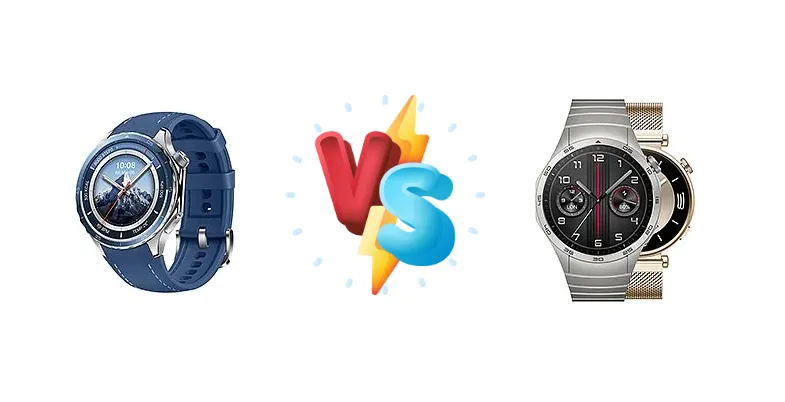
The smartwatch market is increasingly segmented, with options ranging from feature-packed Android Wear devices to long-lasting, health-focused wearables. The Oppo Watch X2, powered by the Qualcomm Snapdragon W5 Gen 1, aims for a balance of performance and features. Conversely, the Huawei Watch GT 4 prioritizes battery life and convenience with its wireless charging capabilities. This comparison dissects the core differences to help you choose the right smartwatch for your needs.
🏆 Quick Verdict
For users prioritizing app responsiveness and a smoother overall experience, the Oppo Watch X2 is the superior choice thanks to the Snapdragon W5 Gen 1. However, the Huawei Watch GT 4 appeals to those who value extended battery life and the simplicity of wireless charging, making it ideal for fitness tracking and basic notifications.
| Network |
|---|
| 2G bands | N/A | N/A |
| 3G bands | N/A | N/A |
| 4G bands | N/A | N/A |
| EDGE | No | No |
| GPRS | No | No |
| Speed | No | No |
| Technology | No cellular connectivity | No cellular connectivity |
| Launch |
|---|
| Announced | 2025, February 20 | 2023, September 14 |
| Status | Available. Released 2025, March 28 | Available. Released 2023, October 02 |
| Body |
|---|
| Build | Sapphire crystal front, stainless steel frame, plastic back | Glass front, plastic back, stainless steel frame |
| Dimensions | 47.6 x 46.6 x 11.8 mm (1.87 x 1.83 x 0.46 in) | 46 x 46 x 10.9 mm (1.81 x 1.81 x 0.43 in) |
| SIM | No | No |
| Weight | 49.7 g (1.76 oz) | 37 g (41mm) / 48 g (46mm) (1.31 oz) |
| Display |
|---|
| Protection | Sapphire crystal glass | - |
| Resolution | 466 x 466 pixels (~310 ppi density) | 466 x 466 pixels (~326 ppi density) |
| Size | 1.5 inches | 1.43 inches |
| Type | LTPO AMOLED, 2200 nits (peak) | AMOLED |
| Platform |
|---|
| Chipset | Qualcomm Snapdragon W5 Gen 1 (4 nm) | - |
| OS | ColorOS Watch 7.0 + Wear OS 5.0 | HarmonyOS 4.0 |
| Memory |
|---|
| Card slot | No | No |
| Internal | 32GB 2GB RAM | Unspecified |
| Sound |
|---|
| 35mm jack | No | No |
| Loudspeaker | Yes | Yes |
| Comms |
|---|
| Bluetooth | 5.2, A2DP, LE | 5.2, A2DP, LE |
| NFC | Yes | Yes |
| Positioning | GPS (L1+L5), GLONASS, GALILEO, BDS, QZSS | GPS (L1+L5), GLONASS, BDS, GALILEO, QZSS |
| Radio | No | No |
| USB | No | No |
| WLAN | Wi-Fi 802.11 a/b/g/n, dual-band | No |
| Features |
|---|
| Sensors | Accelerometer, gyro, barometer, compass, heart rate, SpO2, thermometer (skin temperature) | Accelerometer, gyro, heart rate, barometer, compass, SpO2, thermometer (body temperature) |
| Battery |
|---|
| Charging | 7.5W wired | Wireless |
| Type | Li-Ion 648 mAh | Li-Ion 524 mAh |
| Misc |
|---|
| Colors | Lava Black, Summit Blue | Black, Steel, Silver, Gold |
| Models | OPWWE251 | ARA-B19, PNX-B19 |
| Price | About 300 EUR | About 270 EUR |
Oppo Watch X2
- Superior performance with Snapdragon W5 Gen 1
- Faster app loading and smoother UI
- More versatile for running a wider range of apps
- Requires wired charging
- Potentially shorter battery life compared to GT 4
Huawei Watch GT 4
- Convenient wireless charging
- Likely longer battery life due to chipset optimization
- Streamlined experience focused on health and fitness
- Less powerful chipset for demanding tasks
- Potentially slower app loading times
Display Comparison
While specific display details (resolution, panel type) are absent for both devices, the focus shifts to charging and processing power. The lack of LTPO information means we can't assess adaptive refresh rates. However, the Oppo Watch X2's Snapdragon W5 Gen 1 will contribute to smoother animations and faster UI rendering, indirectly enhancing the perceived display quality. The Huawei Watch GT 4's display experience will likely be more standard, relying on efficient power management to maximize battery life.
Camera Comparison
Neither device is marketed for its camera capabilities, and detailed camera specs are unavailable. Smartwatches generally feature limited camera functionality, primarily for quick scans or video calls. Therefore, this is not a significant comparison point.
Performance
The core differentiator here is the chipset. The Oppo Watch X2 leverages the 4nm Qualcomm Snapdragon W5 Gen 1, a significant upgrade over previous Wear OS chipsets. This translates to improved CPU and GPU performance, enabling faster app launches and smoother multitasking. The Huawei Watch GT 4, while capable, likely utilizes a proprietary chipset optimized for efficiency rather than raw power. This difference is crucial for users who intend to run multiple apps or utilize demanding features like voice assistants frequently. The Snapdragon W5 Gen 1’s architecture allows for more complex operations without significant performance drops.
Battery Life
The Oppo Watch X2 features 7.5W wired charging, while the Huawei Watch GT 4 offers wireless charging. While wattage isn't everything, the convenience of wireless charging on the GT 4 is a clear advantage for many users. The Snapdragon W5 Gen 1 in the Oppo Watch X2 is more power-efficient, potentially mitigating the impact of the lower charging wattage, but the GT 4’s focus on battery optimization likely results in longer runtimes between charges. The trade-off is speed versus convenience; the X2 will charge faster when plugged in, but the GT 4 offers a cable-free experience.
Buying Guide
Buy the Oppo Watch X2 if you need a smartwatch that can handle a wider range of apps, offers a more fluid user interface, and benefits from the latest Qualcomm chipset for improved performance. Buy the Huawei Watch GT 4 if you prefer a smartwatch focused on long battery life, seamless wireless charging, and a streamlined experience centered around health and fitness tracking, potentially within Huawei’s ecosystem.
Frequently Asked Questions
❓ How does the Snapdragon W5 Gen 1 in the Oppo Watch X2 impact real-world app performance compared to the Huawei Watch GT 4?
The Snapdragon W5 Gen 1's 4nm process and improved architecture deliver significantly faster CPU and GPU performance. This translates to quicker app launches, smoother animations, and a more responsive user experience, especially when running multiple apps or using demanding features like voice assistants. The Huawei Watch GT 4, while capable, will likely exhibit slower loading times and occasional stutters with complex tasks.
❓ Is the wireless charging on the Huawei Watch GT 4 a significant advantage over the Oppo Watch X2's wired charging?
For many users, the convenience of wireless charging is a major benefit. It eliminates the need for cables and allows for easy charging on compatible charging pads. While the Oppo Watch X2's 7.5W wired charging is relatively fast, the GT 4's wireless charging offers a more seamless and hassle-free experience, particularly for overnight charging or quick top-ups.
❓ Which smartwatch is better suited for intensive fitness tracking and GPS usage?
Both smartwatches are capable of fitness tracking, but the Huawei Watch GT 4 is likely optimized for longer GPS usage due to its focus on battery efficiency. The Oppo Watch X2’s Snapdragon W5 Gen 1 will handle the processing of fitness data efficiently, but the GT 4’s chipset is designed to minimize power consumption during extended GPS sessions.