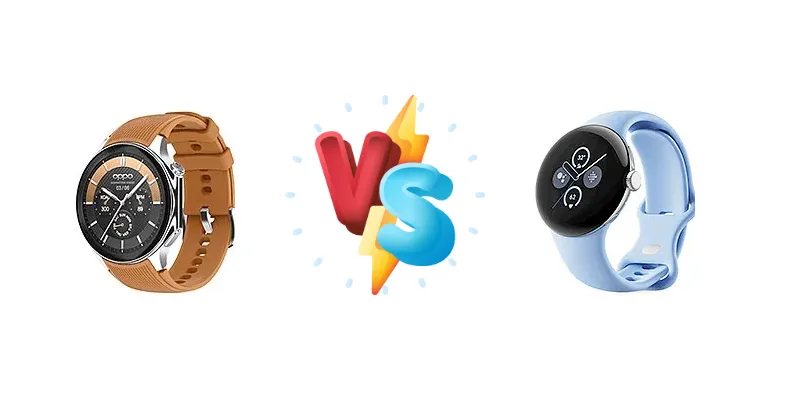
The smartwatch market is heating up, with the Oppo Watch X and Google Pixel Watch 2 representing compelling options for Android users. While both run Wear OS, they diverge significantly in their underlying hardware, particularly in their chipsets and charging capabilities. This comparison dissects these differences to determine which watch best suits your needs.
🏆 Quick Verdict
For most users, the Oppo Watch X offers a more compelling package. Its Snapdragon W5 Gen 1 chipset, built on a more efficient 4nm process, promises better performance and potentially longer battery life. While the Pixel Watch 2 boasts faster charging, the Oppo Watch X’s overall efficiency gives it an edge.
| Network |
|---|
| 2G bands | N/A | GSM 850 / 900 / 1800 / 1900 |
| 3G bands | N/A | HSDPA 850 / 900 / 1700(AWS) / 1900 / 2100 |
| 4G bands | N/A | LTE |
| EDGE | No | - |
| GPRS | No | - |
| Speed | No | HSPA, LTE |
| Technology | No cellular connectivity | GSM / HSPA / LTE |
| Launch |
|---|
| Announced | 2024, February 29 | 2023, October 04 |
| Status | Available. Released 2024, March 04 | Available. Released 2023, October 12 |
| Body |
|---|
| Build | Sapphire crystal front, stainless steel frame, plastic back | Glass front (Gorilla Glass 5), aluminum frame |
| Dimensions | 47 x 46.6 x 12.1 mm (1.85 x 1.83 x 0.48 in) | 41 x 41 x 12.3 mm (1.61 x 1.61 x 0.48 in) |
| SIM | No | eSIM |
| Weight | 49 g (1.73 oz) | 31 g (1.09 oz) |
| Display |
|---|
| Protection | Sapphire crystal glass | Corning Gorilla Glass 5 |
| Resolution | 466 x 466 pixels (~326 ppi density) | 450 x 450 pixels (~320 ppi density) |
| Size | 1.43 inches | 1.2 inches |
| Type | AMOLED, 1000 nits (HBM) | AMOLED, 1000 nits (peak) |
| Platform |
|---|
| Chipset | Qualcomm Snapdragon W5 Gen 1 (4 nm) | Qualcomm 5100 |
| OS | Android Wear OS 4 | Android Wear OS 4 |
| Memory |
|---|
| Card slot | No | No |
| Internal | 32GB 2GB RAM | 32GB 2GB RAM |
| Sound |
|---|
| 35mm jack | No | No |
| Loudspeaker | Yes | Yes |
| Comms |
|---|
| Bluetooth | 5.0, A2DP, LE | 5.0, A2DP, LE |
| NFC | Yes | Yes |
| Positioning | GPS (L1+L5), GLONASS, GALILEO, BDS, QZSS | GPS, GLONASS, GALILEO, BDS, QZSS |
| Radio | No | No |
| USB | No | No |
| WLAN | Wi-Fi 802.11 a/b/g/n, dual-band | Wi-Fi 802.11 b/g/n |
| Features |
|---|
| Sensors | Accelerometer, gyro, barometer, compass, heart rate, SpO2 | Accelerometer, gyro, heart rate, altimeter, compass, SpO2, thermometer (skin temperature), skin conductance |
| Battery |
|---|
| Charging | 7.5W wired | Wired, 80% in 45 min |
| Type | 500 mAh | Li-Ion 306 mAh |
| Misc |
|---|
| Colors | Platinum Black, Brown | Polished Silver, Matte Black, Champagne Gold |
| Models | OWWE231 | G4TSL, GC3G8, GD2WG |
| Price | About 360 EUR | About 160 EUR |
Oppo Watch X
- More efficient Snapdragon W5 Gen 1 chipset
- Potentially longer battery life due to 4nm process
- Likely better sustained performance with less throttling
- Slower charging speed (7.5W)
- Limited information on display specifications
Google Pixel Watch 2
- Faster charging (80% in 45 minutes)
- Seamless integration with Google ecosystem
- Fitbit integration for health tracking
- Less efficient Qualcomm 5100 chipset
- Potential for more throttling under heavy load
- May require more frequent charging
Display Comparison
Display specifications are not provided, so a direct comparison is limited. However, given Oppo’s history with AMOLED displays, the Watch X likely features a vibrant panel. The Pixel Watch 2’s display is known for its clarity and brightness. The key differentiator will likely be PWM dimming rates, impacting eye strain for sensitive users. Bezels and screen-to-body ratio will also be important visual factors.
Camera Comparison
Neither device is known for its camera capabilities, and detailed camera specs are unavailable. Smartwatches generally feature limited camera functionality, primarily for quick scans or remote control features. Any camera comparison would be minimal without further information.
Performance
The core difference lies in the chipsets. The Oppo Watch X utilizes the Qualcomm Snapdragon W5 Gen 1, fabricated on a 4nm process. This smaller node size translates to improved power efficiency and thermal performance compared to the Google Pixel Watch 2’s Qualcomm 5100. While the 5100 is a capable chip, the 4nm process of the W5 Gen 1 should result in less throttling under sustained loads, benefiting demanding applications and longer workout tracking. The W5 Gen 1 also benefits from architectural improvements in CPU and GPU cores.
Battery Life
Battery capacity is not specified for either device. However, the Oppo Watch X’s Snapdragon W5 Gen 1, with its 4nm efficiency, is likely to deliver superior battery life compared to the Pixel Watch 2’s 5100. The Pixel Watch 2 compensates with faster charging – 80% in 45 minutes – while the Oppo Watch X offers 7.5W wired charging. This means the Pixel Watch 2 can quickly top up, but the Oppo Watch X may require less frequent charging overall.
Buying Guide
Buy the Oppo Watch X if you prioritize long-term performance and battery efficiency, and are comfortable with a slightly slower charging speed. This watch is ideal for fitness enthusiasts and users who demand consistent responsiveness. Buy the Google Pixel Watch 2 if rapid charging is paramount and you are heavily invested in the Google ecosystem, valuing seamless integration with services like Google Assistant and Fitbit.
Frequently Asked Questions
❓ Will the Qualcomm 5100 in the Pixel Watch 2 overheat during extended GPS tracking for activities like marathon running?
The Qualcomm 5100, while capable, is built on a larger process node than the Snapdragon W5 Gen 1. This means it's more prone to generating heat under sustained load. While Google has implemented thermal management solutions, users undertaking prolonged GPS-intensive activities may experience some throttling or reduced performance compared to the Oppo Watch X.
❓ How does the 7.5W charging on the Oppo Watch X compare to the Pixel Watch 2’s 80% in 45 minutes in a typical daily use scenario?
While 7.5W is slower, the Oppo Watch X’s superior battery efficiency means you may not need to charge it as frequently. The Pixel Watch 2’s faster charging is convenient for quick top-ups, but if you consistently drain the battery, the time saved by faster charging may be negligible. Consider your charging habits – if you charge overnight, the slower speed is less of a concern.
❓ Does the Snapdragon W5 Gen 1 in the Oppo Watch X offer noticeable performance improvements for app loading and responsiveness compared to the Pixel Watch 2?
Yes, the Snapdragon W5 Gen 1’s architectural improvements and 4nm process should result in snappier app loading times and a more responsive user experience. The 5100 is adequate, but the W5 Gen 1 provides a tangible performance boost, particularly when multitasking or running demanding applications.