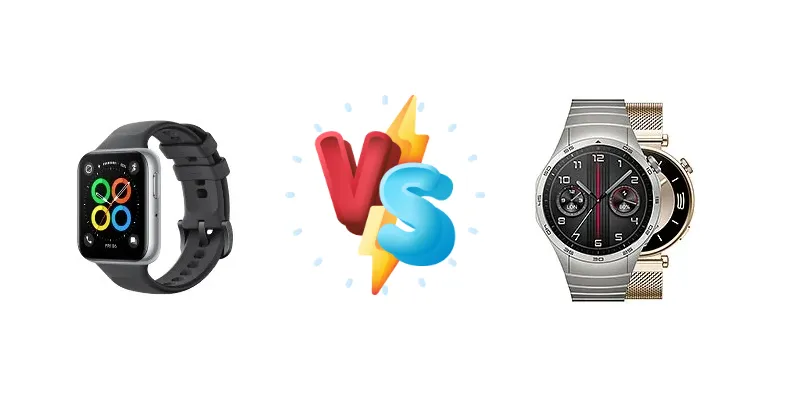
The smartwatch market offers a spectrum of choices, from feature-rich Wear OS devices to long-lasting, fitness-focused alternatives. The Oppo Watch SE, powered by the Qualcomm Snapdragon Wear 4100, aims to deliver a smooth Wear OS experience. Conversely, the Huawei Watch GT 4 prioritizes battery life and convenience with wireless charging, operating on Huawei’s HarmonyOS. This comparison dissects these key differences to help you determine which smartwatch best suits your needs.
🏆 Quick Verdict
For users prioritizing a responsive smartwatch experience with access to the Wear OS ecosystem, the Oppo Watch SE is the better choice. Its Snapdragon Wear 4100 chipset provides a noticeable performance advantage. However, if extended battery life and wireless charging are paramount, the Huawei Watch GT 4 is the clear winner.
| Network |
|---|
| 2G bands | N/A | N/A |
| 3G bands | HSDPA 850 / 900 / 2100 | N/A |
| 4G bands | LTE | N/A |
| EDGE | - | No |
| GPRS | - | No |
| Speed | HSPA, LTE | No |
| Technology | HSPA / LTE | No cellular connectivity |
| Launch |
|---|
| Announced | 2023, August 29 | 2023, September 14 |
| Status | Available. Released 2023, September | Available. Released 2023, October 02 |
| Body |
|---|
| Build | - | Glass front, plastic back, stainless steel frame |
| Dimensions | 43 x 37 x 11.7 mm (1.69 x 1.46 x 0.46 in) | 46 x 46 x 10.9 mm (1.81 x 1.81 x 0.43 in) |
| SIM | eSIM (market/region dependent) | No |
| Weight | 31 g (1.09 oz) | 37 g (41mm) / 48 g (46mm) (1.31 oz) |
| Display |
|---|
| Resolution | 372 x 430 pixels (~325 ppi density) | 466 x 466 pixels (~326 ppi density) |
| Size | 1.75 inches | 1.43 inches |
| Type | AMOLED | AMOLED |
| Platform |
|---|
| CPU | Quad-core 1.7 GHz Cortex-A53 | - |
| Chipset | Qualcomm Snapdragon Wear 4100 (12 nm) | - |
| GPU | Adreno 504 | - |
| OS | ColorOS Watch 3.0 - China | HarmonyOS 4.0 |
| Memory |
|---|
| Card slot | No | No |
| Internal | 8GB 1GB RAM | Unspecified |
| Sound |
|---|
| 35mm jack | No | No |
| Loudspeaker | Yes | Yes |
| Comms |
|---|
| Bluetooth | 5.0, A2DP, LE | 5.2, A2DP, LE |
| NFC | Yes | Yes |
| Positioning | GPS, GLONASS, GALILEO, BDS | GPS (L1+L5), GLONASS, BDS, GALILEO, QZSS |
| Radio | No | No |
| USB | No | No |
| WLAN | Wi-Fi 802.11 b/g/n | No |
| Features |
|---|
| Sensors | Accelerometer, gyro, heart rate, compass, barometer, SpO2 | Accelerometer, gyro, heart rate, barometer, compass, SpO2, thermometer (body temperature) |
| Battery |
|---|
| Charging | - | Wireless |
| Type | Li-Ion 400 mAh | Li-Ion 524 mAh |
| Misc |
|---|
| Colors | Gray, Purple, Brown | Black, Steel, Silver, Gold |
| Models | - | ARA-B19, PNX-B19 |
| Price | About 130 EUR | About 270 EUR |
Oppo Watch SE
- Faster performance with Snapdragon Wear 4100
- Access to the Wear OS ecosystem and Google apps
- Likely smoother animations and UI responsiveness
- Shorter battery life compared to Huawei Watch GT 4
- Lacks wireless charging convenience
- Potential for more frequent charging
Huawei Watch GT 4
- Extended battery life for multi-day use
- Convenient wireless charging support
- Optimized for fitness tracking and basic notifications
- Slower performance compared to Snapdragon Wear 4100
- Limited app ecosystem compared to Wear OS
- Potential lag with demanding tasks
Display Comparison
Context data lacks display specifics for both devices. However, given the Oppo Watch SE’s positioning, it likely utilizes an AMOLED panel for vibrant colors. The Huawei Watch GT 4, based on its market segment, likely also features an AMOLED display. The key difference will likely be in brightness and potentially refresh rate; Oppo’s Wear OS focus suggests a higher refresh rate for smoother animations, while Huawei may prioritize power efficiency with a lower refresh rate. Bezels will be a crucial visual differentiator, impacting the perceived screen real estate.
Camera Comparison
Neither device is marketed for its camera capabilities, and context data provides no information. Smartwatches generally feature limited camera functionality, primarily for quick scans or video calls. It’s safe to assume both devices, if equipped with cameras, will offer basic image quality suitable for these limited use cases. Focusing on camera specs would be a misdirection given the primary function of these devices.
Performance
The Oppo Watch SE’s Qualcomm Snapdragon Wear 4100 (12 nm) chipset is the defining performance factor. This quad-core 1.7 GHz processor provides a significant advantage over the likely less powerful chipset within the Huawei Watch GT 4. The 12nm fabrication process, while not leading-edge, offers a reasonable balance between performance and power consumption. Users will experience faster app loading times, smoother animations, and more responsive interactions on the Oppo Watch SE. The Huawei Watch GT 4, while optimized for efficiency, will likely exhibit noticeable lag when handling complex tasks. The Wear 4100’s architecture is designed for Wear OS, meaning better compatibility and optimization.
Battery Life
Context data only mentions wireless charging for the Huawei Watch GT 4. This suggests a strong emphasis on convenience and potentially a larger battery capacity to offset the efficiency losses inherent in wireless charging. The Oppo Watch SE, lacking wireless charging, likely relies on a more traditional charging method. While the exact mAh capacity is unknown for both, the Huawei Watch GT 4 is expected to offer significantly longer battery life – potentially several days – due to its HarmonyOS optimization and likely larger battery. The Oppo Watch SE, running Wear OS, will likely require daily charging with moderate to heavy use.
Buying Guide
Buy the Oppo Watch SE if you need a smartwatch with a fluid user interface, access to Google apps and services, and the ability to handle more demanding tasks like voice assistants and quick app launches. Buy the Huawei Watch GT 4 if you prefer a smartwatch that can last for days on a single charge, offers the convenience of wireless charging, and focuses primarily on fitness tracking and basic notifications.
Frequently Asked Questions
❓ Will the Oppo Watch SE feel sluggish compared to a modern smartphone?
While the Snapdragon Wear 4100 is a capable processor for a smartwatch, it won't match the performance of a modern smartphone. However, it's significantly faster than older Wear OS devices and should provide a smooth experience for most tasks, including notifications, fitness tracking, and basic app usage. Expect some loading times for more complex apps.
❓ How much does the wireless charging of the Huawei Watch GT 4 impact its charging speed?
Wireless charging is generally slower than wired charging. While convenient, the Huawei Watch GT 4 will likely take longer to fully charge wirelessly compared to the Oppo Watch SE with a wired connection. However, the GT 4’s larger battery and longer battery life mitigate this slower charging speed.
❓ Can I use Google Pay on the Huawei Watch GT 4?
No, the Huawei Watch GT 4 runs on HarmonyOS and does not support Google Pay. It utilizes Huawei’s own payment system, Huawei Pay, which has limited availability depending on your region and bank.