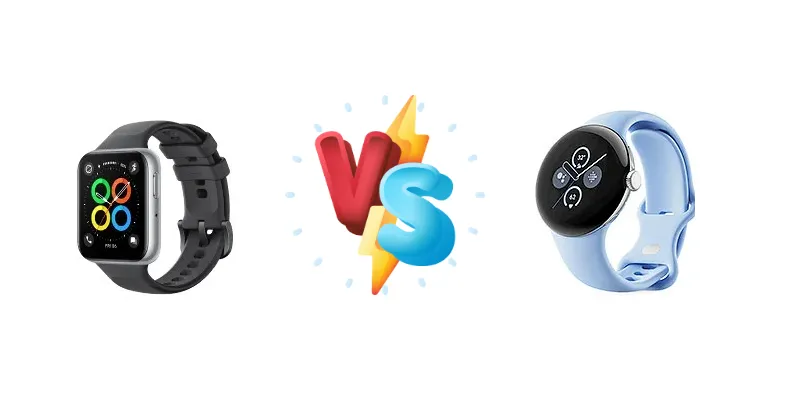
The smartwatch market is increasingly segmented, with options ranging from ultra-premium to budget-friendly. The Oppo Watch SE and Google Pixel Watch 2 represent distinct approaches within the Wear OS ecosystem. The Oppo Watch SE aims to deliver essential smartwatch functionality at an accessible price point, while the Pixel Watch 2 focuses on a more refined experience with Google’s latest features and hardware. This comparison dissects their core differences to help you choose the right fit.
🏆 Quick Verdict
For the average user prioritizing value and a functional Wear OS experience, the Oppo Watch SE emerges as the stronger choice. While the Pixel Watch 2 boasts a newer chipset and faster charging, the Oppo Watch SE’s established Snapdragon Wear 4100 platform provides sufficient performance for everyday tasks at a significantly lower cost.
| Network |
|---|
| 2G bands | N/A | GSM 850 / 900 / 1800 / 1900 |
| 3G bands | HSDPA 850 / 900 / 2100 | HSDPA 850 / 900 / 1700(AWS) / 1900 / 2100 |
| 4G bands | LTE | LTE |
| Speed | HSPA, LTE | HSPA, LTE |
| Technology | HSPA / LTE | GSM / HSPA / LTE |
| Launch |
|---|
| Announced | 2023, August 29 | 2023, October 04 |
| Status | Available. Released 2023, September | Available. Released 2023, October 12 |
| Body |
|---|
| Build | - | Glass front (Gorilla Glass 5), aluminum frame |
| Dimensions | 43 x 37 x 11.7 mm (1.69 x 1.46 x 0.46 in) | 41 x 41 x 12.3 mm (1.61 x 1.61 x 0.48 in) |
| SIM | eSIM (market/region dependent) | eSIM |
| Weight | 31 g (1.09 oz) | 31 g (1.09 oz) |
| Display |
|---|
| Protection | - | Corning Gorilla Glass 5 |
| Resolution | 372 x 430 pixels (~325 ppi density) | 450 x 450 pixels (~320 ppi density) |
| Size | 1.75 inches | 1.2 inches |
| Type | AMOLED | AMOLED, 1000 nits (peak) |
| Platform |
|---|
| CPU | Quad-core 1.7 GHz Cortex-A53 | - |
| Chipset | Qualcomm Snapdragon Wear 4100 (12 nm) | Qualcomm 5100 |
| GPU | Adreno 504 | - |
| OS | ColorOS Watch 3.0 - China | Android Wear OS 4 |
| Memory |
|---|
| Card slot | No | No |
| Internal | 8GB 1GB RAM | 32GB 2GB RAM |
| Sound |
|---|
| 35mm jack | No | No |
| Loudspeaker | Yes | Yes |
| Comms |
|---|
| Bluetooth | 5.0, A2DP, LE | 5.0, A2DP, LE |
| NFC | Yes | Yes |
| Positioning | GPS, GLONASS, GALILEO, BDS | GPS, GLONASS, GALILEO, BDS, QZSS |
| Radio | No | No |
| USB | No | No |
| WLAN | Wi-Fi 802.11 b/g/n | Wi-Fi 802.11 b/g/n |
| Features |
|---|
| Sensors | Accelerometer, gyro, heart rate, compass, barometer, SpO2 | Accelerometer, gyro, heart rate, altimeter, compass, SpO2, thermometer (skin temperature), skin conductance |
| Battery |
|---|
| Charging | - | Wired, 80% in 45 min |
| Type | Li-Ion 400 mAh | Li-Ion 306 mAh |
| Misc |
|---|
| Colors | Gray, Purple, Brown | Polished Silver, Matte Black, Champagne Gold |
| Models | - | G4TSL, GC3G8, GD2WG |
| Price | About 130 EUR | About 160 EUR |
Oppo Watch SE
- More affordable price point
- Established Snapdragon Wear 4100 platform
- Likely longer battery life with moderate use
- Older chipset compared to Pixel Watch 2
- Less premium design and build quality
- Potentially slower app loading times
Google Pixel Watch 2
- Newer Qualcomm 5100 chipset for improved performance
- Faster charging (80% in 45 minutes)
- Seamless Google ecosystem integration
- Significantly higher price
- Potentially shorter battery life under heavy load
- Premium price may not justify the performance gains for all users
Display Comparison
Details regarding display technology are missing for both devices. However, given the Oppo Watch SE’s positioning, it likely utilizes an AMOLED panel, though potentially with lower peak brightness compared to the Pixel Watch 2. The Pixel Watch 2’s circular design is a key aesthetic differentiator. The Oppo Watch SE adopts a rectangular form factor, maximizing screen real estate within a smaller overall size. Bezels are likely more pronounced on the Oppo Watch SE to maintain its lower price point. Color accuracy is expected to be good on both, but the Pixel Watch 2 may offer slightly wider color gamut coverage.
Camera Comparison
Neither device is marketed for its camera capabilities, and detailed camera specs are unavailable. Smartwatches generally feature limited camera functionality, primarily for quick video calls. Any camera on either device is likely a low-resolution sensor suitable only for basic video conferencing.
Performance
The core difference lies in the chipsets: the Oppo Watch SE features the Qualcomm Snapdragon Wear 4100 (12nm), while the Pixel Watch 2 utilizes the newer Qualcomm 5100. The 5100 represents a generational leap, offering improved efficiency and performance. While the 4100 is a capable processor for standard smartwatch tasks, the 5100 in the Pixel Watch 2 will handle more demanding applications and animations with greater fluidity. The 12nm process node of the Snapdragon Wear 4100 is less efficient than the 5100’s, potentially impacting battery life under heavy load. RAM specifications are not provided, but the Pixel Watch 2 likely benefits from faster LPDDR5x RAM, further enhancing responsiveness.
Battery Life
Battery capacity is not specified for either watch. However, the Pixel Watch 2 compensates for a potentially smaller battery with faster charging – achieving 80% charge in 45 minutes. The Oppo Watch SE’s battery life will depend heavily on usage patterns, but the less efficient Snapdragon Wear 4100 may necessitate more frequent charging. The Pixel Watch 2’s faster charging is a significant convenience factor, minimizing downtime.
Buying Guide
Buy the Oppo Watch SE if you need a reliable, affordable Wear OS smartwatch for fitness tracking, notifications, and basic app usage. It’s ideal for users new to smartwatches or those seeking a secondary device. Buy the Google Pixel Watch 2 if you prioritize seamless integration with the Google ecosystem, advanced health tracking features (like ECG and fall detection), and a more premium design, and are willing to pay a premium for those benefits.
Frequently Asked Questions
❓ Does the Snapdragon Wear 4100 in the Oppo Watch SE struggle with demanding apps?
While not as powerful as the Snapdragon 5100, the Wear 4100 is perfectly capable of handling standard smartwatch apps like fitness trackers, notification management, and music playback. More graphically intensive apps may experience slightly longer loading times or reduced frame rates, but it remains a functional platform for everyday use.
❓ How does the Pixel Watch 2's charging speed compare to other smartwatches?
The Pixel Watch 2’s 80% charge in 45 minutes is competitive, but not class-leading. Some smartwatches offer even faster charging speeds, but 45 minutes is a reasonable timeframe for a quick top-up, especially considering the convenience of wireless charging.
❓ Is the Oppo Watch SE compatible with iPhones?
The Oppo Watch SE, being a Wear OS device, has limited compatibility with iPhones. While basic connectivity for notifications may be possible, full functionality and app support are significantly restricted compared to pairing with an Android phone.