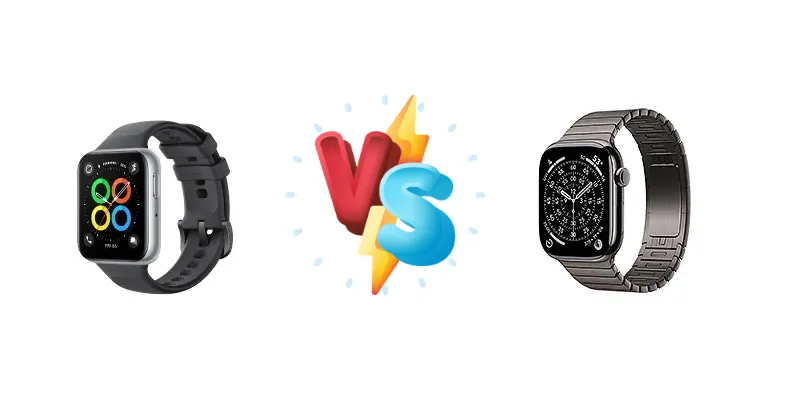
The smartwatch market offers a spectrum of choices, from premium experiences like Apple's ecosystem to more accessible options. We pit the Oppo Watch SE, powered by Qualcomm's Snapdragon Wear 4100, against the Apple Watch Series 11, featuring Apple's S10 chip, to determine which delivers the best blend of performance, features, and value.
🏆 Quick Verdict
For the average user prioritizing a balance of features and affordability, the Oppo Watch SE emerges as the stronger contender. While the Apple Watch Series 11 benefits from Apple’s optimized software and wireless charging, the Snapdragon Wear 4100 offers a compelling performance profile at a potentially lower price point.
| Network |
|---|
| 2G bands | N/A | GSM 850 / 900 / 1800 / 1900 |
| 3G bands | HSDPA 850 / 900 / 2100 | HSDPA 850 / 900 / 1700(AWS) / 1900 / 2100 - International, China, HK |
| 4G bands | LTE | 1, 2, 3, 4, 5, 6, 7, 8, 18, 19, 20, 25, 26, 28, 39, 40, 41, 66 - International, China, HK |
| 5G bands | - | SA/NSA |
| Speed | HSPA, LTE | HSPA, LTE, 5G |
| Technology | HSPA / LTE | GSM / HSPA / LTE / 5G |
| Launch |
|---|
| Announced | 2023, August 29 | 2025, September 09 |
| Status | Available. Released 2023, September | Available. Released 2025, September 19 |
| Body |
|---|
| Build | - | Sapphire crystal front, ceramic/sapphire crystal back, titanium frame (grade 5) |
| Dimensions | 43 x 37 x 11.7 mm (1.69 x 1.46 x 0.46 in) | 46 x 39 x 9.7 mm (1.81 x 1.54 x 0.38 in) |
| SIM | eSIM (market/region dependent) | eSIM |
| Weight | 31 g (1.09 oz) | 34.6 g (42mm), 43.1 g (46mm) (1.52 oz) |
| Display |
|---|
| Protection | - | Sapphire crystal glass |
| Resolution | 372 x 430 pixels (~325 ppi density) | 496 x 416 pixels (~330 ppi density) |
| Size | 1.75 inches | 1.96 inches |
| Type | AMOLED | Retina LTPO3 OLED, 2000 nits (peak) |
| Platform |
|---|
| CPU | Quad-core 1.7 GHz Cortex-A53 | Dual-core |
| Chipset | Qualcomm Snapdragon Wear 4100 (12 nm) | Apple S10 |
| GPU | Adreno 504 | PowerVR |
| OS | ColorOS Watch 3.0 - China | watchOS 26, upgradable to watchOS 26.1 |
| Memory |
|---|
| Card slot | No | No |
| Internal | 8GB 1GB RAM | 64GB |
| Sound |
|---|
| 35mm jack | No | No |
| Loudspeaker | Yes | Yes |
| Comms |
|---|
| Bluetooth | 5.0, A2DP, LE | 5.3, A2DP, LE |
| NFC | Yes | Yes |
| Positioning | GPS, GLONASS, GALILEO, BDS | GPS, GLONASS, GALILEO, QZSS, BDS |
| Radio | No | No |
| USB | No | No |
| WLAN | Wi-Fi 802.11 b/g/n | Wi-Fi 802.11 b/g/n, dual-band |
| Features |
|---|
| Sensors | Accelerometer, gyro, heart rate, compass, barometer, SpO2 | Accelerometer, gyro, heart rate, barometer, always-on altimeter, compass, SpO2, VO2max, temperature (body), temperature (water) |
| Battery |
|---|
| Charging | - | Wireless, 0-80% in 30 min |
| Type | Li-Ion 400 mAh | Li-Ion |
| Misc |
|---|
| Colors | Gray, Purple, Brown | Slate, Gold, Natural |
| Models | - | A3335, A3337, A3452, A3453 |
| Price | About 130 EUR | € 818.00 |
| SAR | - | 1.19 W/kg (head) |
| SAR EU | - | 0.97 W/kg (head) |
Oppo Watch SE
- Potentially longer battery life due to Snapdragon Wear 4100’s efficiency.
- More processing cores for smoother multitasking.
- Likely more affordable price point.
- Wear OS ecosystem may not be as refined as watchOS.
- Display specifications are unknown, potentially impacting visual quality.
Apple Watch Series 11
- Seamless integration with the Apple ecosystem.
- Convenient wireless charging with fast charging capabilities (0-80% in 30 min).
- Apple’s optimized software for smooth performance.
- Older Apple S10 chip may struggle with demanding tasks.
- Potentially higher price point compared to the Oppo Watch SE.
Display Comparison
The context data lacks display specifics for both devices. However, given the Oppo Watch SE’s positioning, it likely utilizes an AMOLED panel, common in the mid-range smartwatch segment. The Apple Watch Series 11, being an older model, likely features an OLED display. Apple historically prioritizes color accuracy and brightness, so the Series 11 likely boasts superior color reproduction. Bezels are also a key consideration; Apple typically minimizes these, offering a more immersive viewing experience. Without specific nit ratings, it’s difficult to definitively declare a winner, but Apple’s display engineering generally provides a visual edge.
Camera Comparison
Neither device is known for its camera capabilities, and the provided data doesn’t mention cameras. Smartwatches primarily rely on connected smartphone cameras for photography. Therefore, this section is largely irrelevant for a direct comparison.
Performance
The core difference lies in the chipsets. The Oppo Watch SE’s Qualcomm Snapdragon Wear 4100 (12nm) is a quad-core processor, offering a significant advantage in core count over the Apple Watch Series 11’s dual-core Apple S10. While core count isn’t everything, the Snapdragon’s architecture, built on a 12nm process, suggests a focus on efficiency. The Apple S10, however, benefits from Apple’s tight hardware-software integration, potentially optimizing performance despite the lower core count. The Snapdragon Wear 4100’s architecture is designed for Wear OS, enabling smoother multitasking and app responsiveness. The lack of RAM specifications makes a direct comparison difficult, but the Snapdragon’s processing power suggests it can handle more demanding tasks.
Battery Life
Battery life is a critical factor. The Oppo Watch SE’s battery capacity is unknown, but Qualcomm’s Snapdragon Wear 4100 is designed for power efficiency. The Apple Watch Series 11 offers wireless charging, reaching 80% charge in 30 minutes, a significant convenience factor. However, the actual battery life will depend on usage patterns. The Snapdragon’s 12nm process could translate to longer battery life during moderate use, while the Apple Watch Series 11’s optimized software might mitigate the impact of its older chipset. Without mAh figures, it’s impossible to definitively state which device offers superior endurance.
Buying Guide
Buy the Oppo Watch SE if you need a capable smartwatch with a modern chipset and are comfortable with the Wear OS ecosystem. It’s ideal for Android users seeking a feature-rich experience without the premium Apple price tag. Buy the Apple Watch Series 11 if you are deeply embedded in the Apple ecosystem, prioritize seamless integration with iPhones, and value the convenience of wireless charging and Apple’s established health features.
Frequently Asked Questions
❓ Does the Snapdragon Wear 4100 chipset in the Oppo Watch SE offer sufficient performance for demanding apps like music streaming and navigation?
Yes, the quad-core Snapdragon Wear 4100 is designed to handle modern smartwatch applications, including music streaming and navigation. While it may not match the raw power of flagship smartphone processors, it provides a smooth and responsive experience for typical smartwatch usage.
❓ Is the Apple Watch Series 11 still receiving software updates, and how does this impact its long-term usability?
As an older model, the Apple Watch Series 11 has likely reached its end-of-life for major software updates. While it may still function with older versions of watchOS, it will miss out on new features, security patches, and app compatibility improvements, potentially limiting its long-term usability.
❓ How does the Wear OS experience on the Oppo Watch SE compare to watchOS on the Apple Watch Series 11 in terms of app availability and customization?
Wear OS offers a wider range of customization options compared to watchOS, allowing users to personalize watch faces and settings more extensively. However, watchOS generally boasts a more curated app ecosystem with a focus on quality and integration with Apple services. App availability is comparable, but the specific apps available may differ between the two platforms.