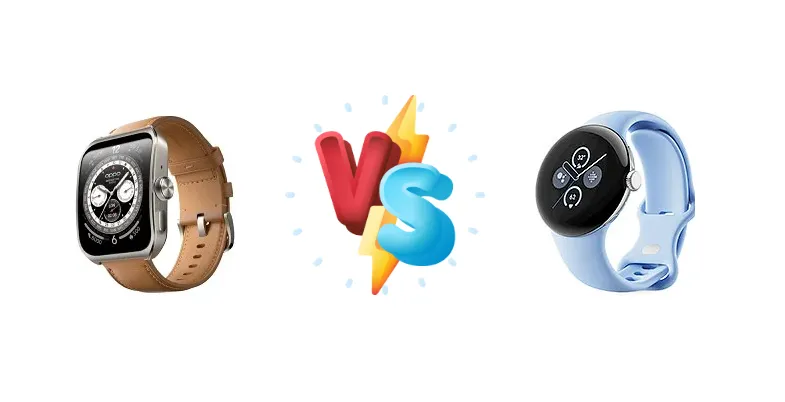
The smartwatch market is heating up, with the Oppo Watch 4 Pro and Google Pixel Watch 2 representing distinct approaches to Wear OS. While both aim to be your all-day wrist companion, they diverge significantly in their core hardware, particularly the chipset and charging capabilities. This comparison dissects these differences to determine which watch best suits your needs.
🏆 Quick Verdict
For users prioritizing raw performance and potentially longer sustained usage, the Oppo Watch 4 Pro, powered by the 4nm Snapdragon W5+ Gen 1, emerges as the winner. However, the Pixel Watch 2’s streamlined software experience and faster 80% charge in 45 minutes make it a compelling choice for those valuing convenience and Google’s ecosystem integration.
| Network |
|---|
| 2G bands | N/A | GSM 850 / 900 / 1800 / 1900 |
| 3G bands | HSDPA 850 / 900 / 2100 | HSDPA 850 / 900 / 1700(AWS) / 1900 / 2100 |
| 4G bands | LTE | LTE |
| Speed | HSPA, LTE | HSPA, LTE |
| Technology | HSPA / LTE | GSM / HSPA / LTE |
| Launch |
|---|
| Announced | 2023, August 29 | 2023, October 04 |
| Status | Available. Released 2023, September 08 | Available. Released 2023, October 12 |
| Body |
|---|
| Build | Glass front, stainless steel frame | Glass front (Gorilla Glass 5), aluminum frame |
| Dimensions | 50.1 x 38.3 x 12.9 mm (1.97 x 1.51 x 0.51 in) | 41 x 41 x 12.3 mm (1.61 x 1.61 x 0.48 in) |
| SIM | eSIM (market/region dependent) | eSIM |
| Weight | 52.3 g (1.83 oz) | 31 g (1.09 oz) |
| Display |
|---|
| Protection | - | Corning Gorilla Glass 5 |
| Resolution | 378 x 496 pixels (~327 ppi density) | 450 x 450 pixels (~320 ppi density) |
| Size | 1.91 inches | 1.2 inches |
| Type | LTPO AMOLED | AMOLED, 1000 nits (peak) |
| Platform |
|---|
| CPU | Quad-core 1.7 GHz Cortex-A53 | - |
| Chipset | Qualcomm Snapdragon W5+ Gen 1 (4 nm) | Qualcomm 5100 |
| GPU | Adreno A702 | - |
| OS | ColorOS Watch 3.0 - China | Android Wear OS 4 |
| Memory |
|---|
| Card slot | No | No |
| Internal | 32GB 2GB RAM | 32GB 2GB RAM |
| Sound |
|---|
| 35mm jack | No | No |
| Loudspeaker | Yes | Yes |
| Comms |
|---|
| Bluetooth | 5.0, A2DP, LE | 5.0, A2DP, LE |
| NFC | Yes | Yes |
| Positioning | GPS, GLONASS, BDS, GALILEO, QZSS | GPS, GLONASS, GALILEO, BDS, QZSS |
| Radio | No | No |
| USB | No | No |
| WLAN | Wi-Fi 802.11 a/b/g/n | Wi-Fi 802.11 b/g/n |
| Features |
|---|
| Sensors | Accelerometer, gyro, heart rate, compass, barometer, SpO2, thermometer (skin temperature) | Accelerometer, gyro, heart rate, altimeter, compass, SpO2, thermometer (skin temperature), skin conductance |
| Battery |
|---|
| Charging | - | Wired, 80% in 45 min |
| Type | Li-Ion 570 mAh | Li-Ion 306 mAh |
| Misc |
|---|
| Colors | Black, Silver | Polished Silver, Matte Black, Champagne Gold |
| Models | - | G4TSL, GC3G8, GD2WG |
| Price | About 290 EUR | About 160 EUR |
Oppo Watch 4 Pro
- More efficient Snapdragon W5+ Gen 1 chipset
- Potentially longer battery life due to 4nm process
- Stronger CPU performance for multitasking
- Charging speed not specified, potentially slower than Pixel Watch 2
- Software experience may not be as polished as Google’s Wear OS
Google Pixel Watch 2
- Fast charging: 80% in 45 minutes
- Seamless integration with Google services
- Refined Wear OS software experience
- Less efficient Qualcomm 5100 chipset
- Potentially shorter battery life under heavy load
- CPU performance likely lower than Oppo Watch 4 Pro
Display Comparison
Context data lacks display specifics for both devices. However, given Oppo’s history with AMOLED panels, the Watch 4 Pro likely features a vibrant display. The Pixel Watch 2’s circular design is a key aesthetic differentiator. Without nit brightness or resolution data, a direct comparison is impossible, but both will likely target similar outdoor visibility levels for their respective price brackets.
Camera Comparison
Neither device’s camera capabilities are detailed in the provided context. Smartwatches generally prioritize functionality over photographic excellence, so camera quality is unlikely to be a deciding factor for most users. We can assume both will offer basic functionality for quick snapshots or video calls.
Performance
The Oppo Watch 4 Pro’s Qualcomm Snapdragon W5+ Gen 1 (4nm) represents a significant architectural advantage over the Google Pixel Watch 2’s Qualcomm 5100. The 4nm process node inherently delivers superior power efficiency compared to the 5100, meaning the Oppo watch should exhibit less thermal throttling under sustained load and potentially offer longer battery life during demanding activities like GPS tracking or music playback. The quad-core Cortex-A53 CPU in the Oppo watch also suggests a more robust multitasking capability.
Battery Life
While mAh capacity isn’t specified, the Snapdragon W5+ Gen 1’s efficiency in the Oppo Watch 4 Pro suggests it can extract more usage from a given battery size. The Pixel Watch 2 compensates with a faster charging rate – 80% in 45 minutes – which is a significant convenience factor. Users who frequently top up their watch throughout the day will benefit from the Pixel Watch 2’s quicker charging, while those who prefer less frequent charging may lean towards the Oppo Watch 4 Pro’s potentially longer runtime.
Buying Guide
Buy the Oppo Watch 4 Pro if you need a smartwatch with a demonstrably more efficient chipset for demanding tasks and potentially longer battery life during intensive use. Its quad-core 1.7 GHz Cortex-A53 CPU offers a performance edge. Buy the Google Pixel Watch 2 if you prefer a seamless integration with Google services, prioritize quick charging, and value a refined software experience over absolute processing power.
Frequently Asked Questions
❓ Does the Qualcomm 5100 in the Pixel Watch 2 experience thermal throttling during extended GPS use?
Given the 5100’s less efficient architecture compared to the Snapdragon W5+ Gen 1, it’s more susceptible to thermal throttling during prolonged, demanding tasks like GPS tracking for outdoor activities. This could lead to reduced performance and potentially inaccurate tracking over extended periods.
❓ How does the 4nm process of the Snapdragon W5+ Gen 1 impact real-world battery life on the Oppo Watch 4 Pro?
The 4nm process node allows the Snapdragon W5+ Gen 1 to operate more efficiently, consuming less power for the same level of performance. This translates to longer battery life, especially during tasks like always-on display usage, sleep tracking, and moderate activity monitoring. Expect a noticeable difference in longevity compared to the Pixel Watch 2 under similar conditions.
❓ Is the 80% charge in 45 minutes on the Pixel Watch 2 sufficient for a full day of typical use?
Yes, for most users, an 80% charge in 45 minutes on the Pixel Watch 2 is likely sufficient to power through a full day of typical use, including notifications, fitness tracking, and occasional app interactions. This quick charging capability is a significant convenience factor for those who prefer to top up their watch frequently.