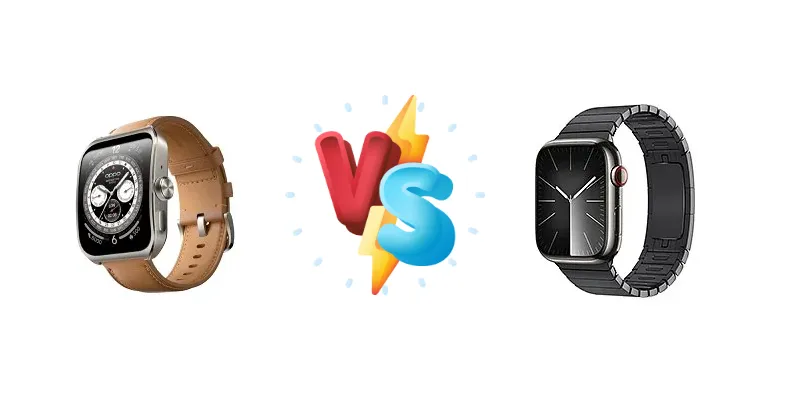
The smartwatch market is dominated by Apple, but Oppo is making a strong push with the Watch 4 Pro, leveraging Qualcomm's latest wearable platform. This comparison dissects the core differences between the Oppo Watch 4 Pro, powered by the Snapdragon W5+ Gen 1, and the Apple Watch Series 9, driven by Apple’s in-house S9 chip, to determine which device offers the best blend of performance, features, and value.
🏆 Quick Verdict
For the average user prioritizing seamless ecosystem integration and established app support, the Apple Watch Series 9 remains the superior choice. However, the Oppo Watch 4 Pro presents a compelling alternative for those seeking longer battery life and a more open platform, particularly at a potentially lower price point.
| Network |
|---|
| 2G bands | N/A | GSM 850 / 900 / 1800 / 1900 |
| 3G bands | HSDPA 850 / 900 / 2100 | HSDPA 850 / 900 / 1700(AWS) / 1900 / 2100 - International, China, HK |
| 4G bands | LTE | 1, 2, 3, 4, 5, 6, 7, 8, 18, 19, 20, 25, 26, 28, 39, 40, 41, 66 - International, China, HK |
| Speed | HSPA, LTE | HSPA, LTE |
| Technology | HSPA / LTE | GSM / HSPA / LTE |
| Launch |
|---|
| Announced | 2023, August 29 | 2023, September 12 |
| Status | Available. Released 2023, September 08 | Available. Released 2023, September 22 |
| Body |
|---|
| Build | Glass front, stainless steel frame | Sapphire crystal front, ceramic/sapphire crystal back, stainless steel frame |
| Dimensions | 50.1 x 38.3 x 12.9 mm (1.97 x 1.51 x 0.51 in) | 45 x 38 x 10.7 mm (1.77 x 1.50 x 0.42 in) |
| SIM | eSIM (market/region dependent) | eSIM |
| Weight | 52.3 g (1.83 oz) | 42.3 g (41mm), 51.5 g (45mm) (1.48 oz) |
| Display |
|---|
| Protection | - | Sapphire crystal glass |
| Resolution | 378 x 496 pixels (~327 ppi density) | 484 x 396 pixels (~326 ppi density) |
| Size | 1.91 inches | 1.9 inches |
| Type | LTPO AMOLED | Retina LTPO OLED, 2000 nits (peak) |
| Platform |
|---|
| CPU | Quad-core 1.7 GHz Cortex-A53 | Dual-core |
| Chipset | Qualcomm Snapdragon W5+ Gen 1 (4 nm) | Apple S9 |
| GPU | Adreno A702 | PowerVR |
| OS | ColorOS Watch 3.0 - China | watchOS 10, upgradable to watchOS 26.1 |
| Memory |
|---|
| Card slot | No | No |
| Internal | 32GB 2GB RAM | 64GB |
| Sound |
|---|
| 35mm jack | No | No |
| Loudspeaker | Yes | Yes |
| Comms |
|---|
| Bluetooth | 5.0, A2DP, LE | 5.3, A2DP, LE |
| NFC | Yes | Yes |
| Positioning | GPS, GLONASS, BDS, GALILEO, QZSS | GPS, GLONASS, GALILEO, QZSS, BDS |
| Radio | No | No |
| USB | No | No |
| WLAN | Wi-Fi 802.11 a/b/g/n | Wi-Fi 802.11 b/g/n, dual-band |
| Features |
|---|
| Sensors | Accelerometer, gyro, heart rate, compass, barometer, SpO2, thermometer (skin temperature) | Accelerometer, gyro, heart rate, barometer, always-on altimeter, compass, SpO2, VO2max, temperature (body) |
| Battery |
|---|
| Charging | - | Wireless, 0-80% in 45 min |
| Type | Li-Ion 570 mAh | Li-Ion 308 mAh |
| Misc |
|---|
| Colors | Black, Silver | Graphite, Silver, Gold, Red |
| Models | - | A2982, A2984, A2983, A2985, Watch7,3, Watch7,4 |
| Price | About 290 EUR | About 630 EUR |
| SAR | - | 1.02 W/kg (head) |
| SAR EU | - | 0.64 W/kg (head) |
Oppo Watch 4 Pro
- Potentially longer battery life due to Snapdragon W5+ Gen 1 efficiency
- More open Wear OS platform with greater customization
- Likely more affordable price point
- App ecosystem may be less mature than watchOS
- Integration with non-Android devices is limited
- Specific display and battery specs are currently unknown
Apple Watch Series 9
- Seamless integration with Apple ecosystem
- Mature and extensive app library
- Advanced health tracking features (ECG, fall detection)
- Potentially shorter battery life compared to Oppo Watch 4 Pro
- Closed ecosystem limits customization
- Higher price point
Display Comparison
While specific display specs for the Oppo Watch 4 Pro are unavailable, its larger size suggests a focus on readability. The Apple Watch Series 9’s display, though not specified in terms of nits, benefits from Apple’s calibration expertise, ensuring accurate colors. Both likely utilize LTPO technology for variable refresh rates, conserving battery. The key difference will be color accuracy and outdoor visibility, where Apple typically excels. Bezels are a critical factor; Oppo’s design language often favors slimmer bezels, potentially offering a more immersive experience.
Camera Comparison
Neither device is primarily marketed for its camera capabilities, and detailed camera specs are unavailable for the Oppo Watch 4 Pro. The Apple Watch Series 9 doesn’t feature a camera. Therefore, this is not a significant differentiating factor for these two models.
Performance
The Oppo Watch 4 Pro’s Qualcomm Snapdragon W5+ Gen 1 (4nm) chipset, a quad-core 1.7 GHz Cortex-A53, represents a significant leap in efficiency over previous Wear OS devices. However, Apple’s dual-core S9 chip, while lacking core count information, is built on a highly optimized architecture. The 4nm process node of the Snapdragon W5+ Gen 1 should provide better thermal efficiency, potentially leading to sustained performance during demanding tasks. The Apple S9’s advantage lies in its tight integration with watchOS, allowing for superior software optimization. Real-world performance will depend heavily on software, but the Snapdragon’s raw processing power suggests it can handle complex tasks efficiently.
Battery Life
The Oppo Watch 4 Pro benefits from the Snapdragon W5+ Gen 1’s power efficiency. While mAh capacity is unknown, the chipset’s 4nm process suggests significantly improved battery life compared to older Wear OS devices. The Apple Watch Series 9 offers 0-80% charge in 45 minutes with wireless charging. The Oppo Watch 4 Pro’s battery life will likely be longer between charges, but the Apple Watch’s faster charging could be more convenient for some users. The actual battery performance will depend on usage patterns and feature utilization.
Buying Guide
Buy the Oppo Watch 4 Pro if you need extended battery life, prefer the Wear OS ecosystem with its greater customization options, and are comfortable with a potentially less polished app experience. Buy the Apple Watch Series 9 if you prioritize tight integration with other Apple devices, a mature and extensive app library, and advanced health tracking features like fall detection and ECG.
Frequently Asked Questions
❓ How does the Snapdragon W5+ Gen 1 in the Oppo Watch 4 Pro compare to the Apple S9 in terms of app loading times and overall responsiveness?
While the Snapdragon W5+ Gen 1 boasts a higher core count, Apple’s S9 benefits from deep software optimization within watchOS. Expect comparable app loading times for common tasks, but the S9 may maintain smoother performance during complex operations due to its optimized architecture and tight integration with the operating system.
❓ Does the Oppo Watch 4 Pro support the same range of health and fitness tracking features as the Apple Watch Series 9, such as ECG and fall detection?
The Apple Watch Series 9 is renowned for its advanced health tracking capabilities, including ECG and fall detection. While the Oppo Watch 4 Pro offers standard fitness tracking features, it’s unlikely to match the breadth and accuracy of Apple’s health sensors and algorithms. Specific health features on the Oppo Watch 4 Pro will depend on software implementation.
❓ What is the impact of Wear OS on the Oppo Watch 4 Pro’s app availability compared to watchOS on the Apple Watch Series 9?
watchOS has a significantly larger and more mature app ecosystem than Wear OS. While Wear OS is improving, the Apple Watch Series 9 offers a wider selection of apps, particularly for specialized tasks and third-party integrations. The Oppo Watch 4 Pro will rely on the growing Wear OS app library, which may have fewer options.