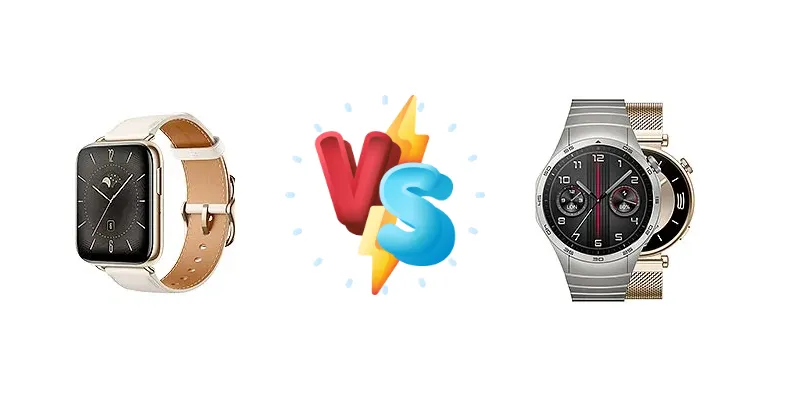
The smartwatch market is heating up, with Oppo and Huawei offering compelling options. The Oppo Watch 3 leverages Qualcomm's latest Snapdragon W5+ Gen 1 platform, promising a performance boost, while the Huawei Watch GT 4 focuses on refined design and convenient wireless charging. This comparison dissects these key differences to determine which smartwatch best suits your needs.
🏆 Quick Verdict
For users prioritizing performance and a smoother app experience, the Oppo Watch 3, powered by the Snapdragon W5+ Gen 1, is the clear winner. However, those valuing effortless charging and potentially longer battery life (pending further testing) will find the Huawei Watch GT 4 a more appealing choice.
| Network |
|---|
| 2G bands | N/A | N/A |
| 3G bands | HSDPA 850 / 900 / 2100 | N/A |
| 4G bands | LTE | N/A |
| EDGE | - | No |
| GPRS | - | No |
| Speed | HSPA, LTE | No |
| Technology | HSPA / LTE | No cellular connectivity |
| Launch |
|---|
| Announced | 2022, August 10 | 2023, September 14 |
| Status | Available. Released 2022, August 19 | Available. Released 2023, October 02 |
| Body |
|---|
| Build | Glass front, aluminum frame | Glass front, plastic back, stainless steel frame |
| Dimensions | 43 x 37 x 11.7 mm (1.69 x 1.46 x 0.46 in) | 46 x 46 x 10.9 mm (1.81 x 1.81 x 0.43 in) |
| SIM | eSIM (market/region dependent) | No |
| Weight | 31.9 g (1.13 oz) | 37 g (41mm) / 48 g (46mm) (1.31 oz) |
| | 5ATM water resistant | - |
| Display |
|---|
| Resolution | 372 x 430 pixels (~326 ppi density) | 466 x 466 pixels (~326 ppi density) |
| Size | 1.75 inches | 1.43 inches |
| Type | AMOLED | AMOLED |
| Platform |
|---|
| CPU | Quad-core 1.7 GHz Cortex-A53 | - |
| Chipset | Qualcomm Snapdragon W5+ Gen 1 (4 nm) | - |
| GPU | Adreno A702 | - |
| OS | Android Wear OS - InternationalColorOS Watch 3.0 - China | HarmonyOS 4.0 |
| Memory |
|---|
| Card slot | No | No |
| Internal | 32GB 1GB RAM | Unspecified |
| | eMMC 4.5 | - |
| Sound |
|---|
| 3.5mm jack | No | - |
| 35mm jack | No | No |
| Loudspeaker | Yes | Yes |
| Comms |
|---|
| Bluetooth | 5.0, A2DP, LE | 5.2, A2DP, LE |
| NFC | Yes | Yes |
| Positioning | GPS, GLONASS, BDS, GALILEO, QZSS | GPS (L1+L5), GLONASS, BDS, GALILEO, QZSS |
| Radio | No | No |
| USB | No | No |
| WLAN | - | No |
| Features |
|---|
| Sensors | Accelerometer, gyro, heart rate, compass, barometer, SpO2 | Accelerometer, gyro, heart rate, barometer, compass, SpO2, thermometer (body temperature) |
| Battery |
|---|
| Charging | - | Wireless |
| Type | Li-Ion 400 mAh | Li-Ion 524 mAh |
| Misc |
|---|
| Colors | Black, Gold | Black, Steel, Silver, Gold |
| Models | - | ARA-B19, PNX-B19 |
| Price | About 220 EUR | About 270 EUR |
Oppo Watch 3
- Powerful Snapdragon W5+ Gen 1 chipset for smooth performance
- 4nm process for improved power efficiency
- Potential for a more responsive user experience
- Lack of wireless charging
- Battery life may be shorter than the Huawei Watch GT 4
Huawei Watch GT 4
- Convenient wireless charging
- Potentially longer battery life due to efficient chipset
- Refined design aesthetic (based on Huawei's brand reputation)
- Likely less powerful processor than the Oppo Watch 3
- App performance may be slower
Display Comparison
Information regarding display specifications (brightness, resolution, panel type) is currently unavailable for both devices. However, given Oppo's history with AMOLED displays, the Watch 3 likely features a vibrant panel. The Huawei Watch GT 4's display quality will be crucial to its overall appeal, as it lacks the performance advantage of the Oppo. Bezels and color accuracy will be key differentiators once tested.
Camera Comparison
Neither device is marketed for its camera capabilities, and detailed camera specifications are unavailable. Smartwatches generally feature limited camera functionality, primarily for quick snapshots or video calls. Any camera features on these devices are likely to be secondary to their core smartwatch functions.
Performance
The Oppo Watch 3's defining feature is the Qualcomm Snapdragon W5+ Gen 1 (4nm) chipset, a significant upgrade over previous generations. This 4nm process node translates to improved power efficiency and thermal performance, allowing for sustained performance during demanding tasks. The quad-core 1.7 GHz Cortex-A53 CPU provides ample processing power for smooth animations, quick app launches, and responsive interactions. The Huawei Watch GT 4, while likely utilizing a capable processor, doesn't disclose its chipset details. This suggests a focus on efficiency rather than raw power, potentially leading to longer battery life but slower app performance.
Battery Life
The Huawei Watch GT 4's inclusion of wireless charging is a significant convenience factor, eliminating the need for proprietary cables. While the mAh capacity is unknown for both devices, the Snapdragon W5+ Gen 1 in the Oppo Watch 3 is designed for efficiency, potentially mitigating the battery life advantage of the Huawei Watch GT 4. Real-world testing will be crucial to determine which device offers superior battery endurance under typical usage scenarios. The charging wattage for both devices is also currently unknown.
Buying Guide
Buy the Oppo Watch 3 if you need a smartwatch capable of running more demanding applications and appreciate the responsiveness of a modern chipset. This is ideal for users who frequently use third-party apps or rely on complex watch faces. Buy the Huawei Watch GT 4 if you prefer a hassle-free charging experience with wireless capabilities and prioritize a potentially longer battery life between charges, even if it means sacrificing some raw processing power.
Frequently Asked Questions
❓ How does the Snapdragon W5+ Gen 1 in the Oppo Watch 3 impact app loading times compared to the Huawei Watch GT 4?
The Snapdragon W5+ Gen 1's advanced architecture and higher clock speeds should result in significantly faster app loading times on the Oppo Watch 3. The Huawei Watch GT 4, lacking detailed chipset information, likely prioritizes power efficiency over raw processing power, leading to slower app launches and potentially lag during complex tasks.
❓ Is wireless charging on the Huawei Watch GT 4 significantly more convenient than using a cable with the Oppo Watch 3?
For users already invested in a wireless charging ecosystem, the Huawei Watch GT 4's wireless charging offers a streamlined experience, eliminating the need for a dedicated cable. This is particularly beneficial for travel or frequent charging. However, the convenience factor is subjective and depends on individual charging habits.
❓ Will the Oppo Watch 3 experience throttling during extended use of demanding apps?
The Snapdragon W5+ Gen 1's 4nm process node and optimized thermal design aim to minimize throttling. While sustained performance will still be affected by heat, the Oppo Watch 3 should maintain a higher level of performance for longer periods compared to devices with less efficient chipsets.