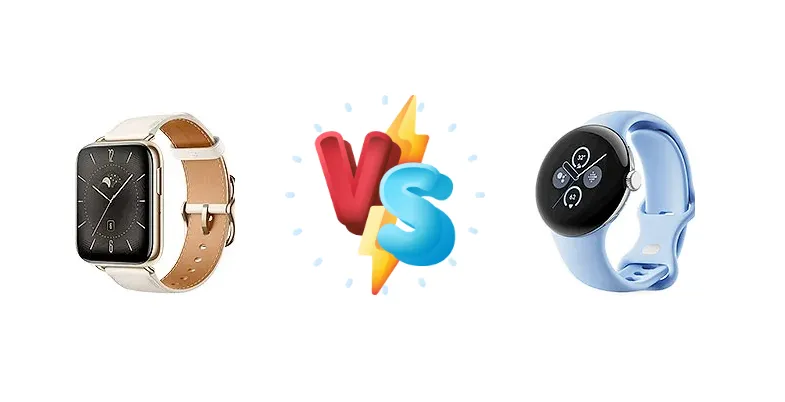
The smartwatch market is heating up, with the Oppo Watch 3 and Google Pixel Watch 2 representing distinct approaches to Wear OS. The Oppo leverages Qualcomm’s latest Snapdragon W5+ Gen 1, while Google opts for the 5100. This comparison dissects the implications of these chipset choices, alongside charging capabilities, to determine which watch best suits your needs.
🏆 Quick Verdict
For users prioritizing raw performance and potentially longer battery life, the Oppo Watch 3, powered by the 4nm Snapdragon W5+ Gen 1, emerges as the winner. However, the Pixel Watch 2’s streamlined software experience and faster 80% charge in 45 minutes make it a compelling alternative for those within the Google ecosystem.
| Network |
|---|
| 2G bands | N/A | GSM 850 / 900 / 1800 / 1900 |
| 3G bands | HSDPA 850 / 900 / 2100 | HSDPA 850 / 900 / 1700(AWS) / 1900 / 2100 |
| 4G bands | LTE | LTE |
| Speed | HSPA, LTE | HSPA, LTE |
| Technology | HSPA / LTE | GSM / HSPA / LTE |
| Launch |
|---|
| Announced | 2022, August 10 | 2023, October 04 |
| Status | Available. Released 2022, August 19 | Available. Released 2023, October 12 |
| Body |
|---|
| Build | Glass front, aluminum frame | Glass front (Gorilla Glass 5), aluminum frame |
| Dimensions | 43 x 37 x 11.7 mm (1.69 x 1.46 x 0.46 in) | 41 x 41 x 12.3 mm (1.61 x 1.61 x 0.48 in) |
| SIM | eSIM (market/region dependent) | eSIM |
| Weight | 31.9 g (1.13 oz) | 31 g (1.09 oz) |
| | 5ATM water resistant | - |
| Display |
|---|
| Protection | - | Corning Gorilla Glass 5 |
| Resolution | 372 x 430 pixels (~326 ppi density) | 450 x 450 pixels (~320 ppi density) |
| Size | 1.75 inches | 1.2 inches |
| Type | AMOLED | AMOLED, 1000 nits (peak) |
| Platform |
|---|
| CPU | Quad-core 1.7 GHz Cortex-A53 | - |
| Chipset | Qualcomm Snapdragon W5+ Gen 1 (4 nm) | Qualcomm 5100 |
| GPU | Adreno A702 | - |
| OS | Android Wear OS - InternationalColorOS Watch 3.0 - China | Android Wear OS 4 |
| Memory |
|---|
| Card slot | No | No |
| Internal | 32GB 1GB RAM | 32GB 2GB RAM |
| | eMMC 4.5 | - |
| Sound |
|---|
| 3.5mm jack | No | - |
| 35mm jack | No | No |
| Loudspeaker | Yes | Yes |
| Comms |
|---|
| Bluetooth | 5.0, A2DP, LE | 5.0, A2DP, LE |
| NFC | Yes | Yes |
| Positioning | GPS, GLONASS, BDS, GALILEO, QZSS | GPS, GLONASS, GALILEO, BDS, QZSS |
| Radio | No | No |
| USB | No | No |
| WLAN | - | Wi-Fi 802.11 b/g/n |
| Features |
|---|
| Sensors | Accelerometer, gyro, heart rate, compass, barometer, SpO2 | Accelerometer, gyro, heart rate, altimeter, compass, SpO2, thermometer (skin temperature), skin conductance |
| Battery |
|---|
| Charging | - | Wired, 80% in 45 min |
| Type | Li-Ion 400 mAh | Li-Ion 306 mAh |
| Misc |
|---|
| Colors | Black, Gold | Polished Silver, Matte Black, Champagne Gold |
| Models | - | G4TSL, GC3G8, GD2WG |
| Price | About 220 EUR | About 160 EUR |
Oppo Watch 3
- Potentially longer battery life due to the 4nm Snapdragon W5+ Gen 1.
- Improved thermal efficiency, reducing performance throttling.
- Likely smoother performance with demanding applications.
- Battery capacity and charging speed are unknown.
- Software experience may not be as refined as the Pixel Watch 2.
Google Pixel Watch 2
- Fast charging: 80% in 45 minutes.
- Seamless integration with Google services.
- Refined Wear OS user experience.
- Less efficient Qualcomm 5100 chipset.
- Potential for more thermal throttling under heavy load.
- Battery life may be shorter compared to the Oppo Watch 3.
Display Comparison
Context data lacks display specifics for both devices. However, given Oppo’s history with AMOLED panels, the Watch 3 likely features a vibrant display. The Pixel Watch 2’s display is known for its brightness and clarity. Without nit ratings or panel technology details, a direct comparison is impossible, but both are expected to deliver a premium visual experience. Bezels and color accuracy will be key differentiators in real-world testing.
Camera Comparison
Neither device’s camera capabilities are detailed in the provided context. Smartwatches generally prioritize functionality over photographic excellence, so camera quality is unlikely to be a deciding factor for most users. Any camera features on either watch would be considered a bonus.
Performance
The Oppo Watch 3’s Qualcomm Snapdragon W5+ Gen 1 (4nm) represents a significant leap in efficiency compared to the Google Pixel Watch 2’s Qualcomm 5100. The 4nm process node allows for greater transistor density and reduced power consumption, meaning the Oppo Watch 3 should exhibit less thermal throttling under sustained load and potentially offer longer battery life. The quad-core 1.7 GHz Cortex-A53 CPU in the Oppo Watch 3, while not explicitly detailed in terms of core architecture versus the 5100, benefits from the improved process technology. Users engaging in frequent fitness tracking with GPS or utilizing demanding apps will likely see a performance advantage on the Oppo.
Battery Life
The context data only provides charging information for the Pixel Watch 2 (80% in 45 minutes). The Oppo Watch 3’s battery capacity and charging speed are unknown. However, the Snapdragon W5+ Gen 1’s improved efficiency suggests the Oppo Watch 3 could achieve comparable or superior battery life with a similar capacity battery. The Pixel Watch 2’s 80% charge in 45 minutes is a convenient feature for users needing a quick top-up, but the overall battery endurance will depend on usage patterns.
Buying Guide
Buy the Oppo Watch 3 if you need a smartwatch with a demonstrably more efficient chipset, potentially translating to longer real-world usage between charges and smoother performance during demanding tasks. Buy the Google Pixel Watch 2 if you prioritize seamless integration with Google services, a refined user experience, and a quicker partial charge, even if it means potentially sacrificing some raw processing power.
Frequently Asked Questions
❓ Does the Qualcomm 5100 in the Pixel Watch 2 experience noticeable overheating during extended GPS use for activities like running or cycling?
While the Qualcomm 5100 is a capable chipset, its larger process node compared to the Snapdragon W5+ Gen 1 suggests it may be more prone to thermal throttling during sustained, high-intensity tasks like GPS tracking. Users engaging in long workouts may experience some performance degradation or reduced battery life.
❓ How does the Snapdragon W5+ Gen 1 in the Oppo Watch 3 impact the responsiveness of apps and animations compared to the Pixel Watch 2?
The 4nm Snapdragon W5+ Gen 1 should provide a smoother and more responsive user experience, particularly when launching apps or navigating complex interfaces. The improved efficiency allows for sustained performance without significant throttling, resulting in fewer stutters and delays.
❓ Given the lack of detailed battery information for the Oppo Watch 3, can we estimate its typical battery life based on the Snapdragon W5+ Gen 1's efficiency?
Based on Qualcomm's claims and comparisons to other devices using the Snapdragon W5+ Gen 1, the Oppo Watch 3 could potentially achieve 24-36 hours of typical usage on a single charge, assuming a moderate battery capacity. However, this is an estimate and actual battery life will vary depending on usage patterns and enabled features.