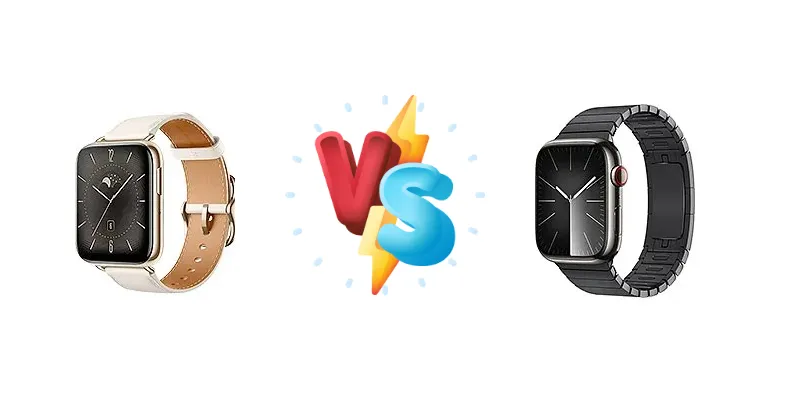
The smartwatch market is dominated by Apple, but challengers like Oppo are stepping up with compelling alternatives. We pit the Oppo Watch 3, powered by Qualcomm’s latest Snapdragon W5+ Gen 1, against the Apple Watch Series 9, featuring Apple’s proprietary S9 chip, to determine which wearable reigns supreme in terms of performance, efficiency, and overall user experience.
🏆 Quick Verdict
For the average user deeply embedded in the Apple ecosystem, the Apple Watch Series 9 remains the superior choice due to its seamless integration and refined software. However, the Oppo Watch 3 offers a compelling alternative, particularly for Android users, leveraging the Snapdragon W5+ Gen 1 for strong performance and potentially longer battery life at a competitive price point.
| Network |
|---|
| 2G bands | N/A | GSM 850 / 900 / 1800 / 1900 |
| 3G bands | HSDPA 850 / 900 / 2100 | HSDPA 850 / 900 / 1700(AWS) / 1900 / 2100 - International, China, HK |
| 4G bands | LTE | 1, 2, 3, 4, 5, 6, 7, 8, 18, 19, 20, 25, 26, 28, 39, 40, 41, 66 - International, China, HK |
| Speed | HSPA, LTE | HSPA, LTE |
| Technology | HSPA / LTE | GSM / HSPA / LTE |
| Launch |
|---|
| Announced | 2022, August 10 | 2023, September 12 |
| Status | Available. Released 2022, August 19 | Available. Released 2023, September 22 |
| Body |
|---|
| Build | Glass front, aluminum frame | Sapphire crystal front, ceramic/sapphire crystal back, stainless steel frame |
| Dimensions | 43 x 37 x 11.7 mm (1.69 x 1.46 x 0.46 in) | 45 x 38 x 10.7 mm (1.77 x 1.50 x 0.42 in) |
| SIM | eSIM (market/region dependent) | eSIM |
| Weight | 31.9 g (1.13 oz) | 42.3 g (41mm), 51.5 g (45mm) (1.48 oz) |
| | 5ATM water resistant | - |
| Display |
|---|
| Protection | - | Sapphire crystal glass |
| Resolution | 372 x 430 pixels (~326 ppi density) | 484 x 396 pixels (~326 ppi density) |
| Size | 1.75 inches | 1.9 inches |
| Type | AMOLED | Retina LTPO OLED, 2000 nits (peak) |
| Platform |
|---|
| CPU | Quad-core 1.7 GHz Cortex-A53 | Dual-core |
| Chipset | Qualcomm Snapdragon W5+ Gen 1 (4 nm) | Apple S9 |
| GPU | Adreno A702 | PowerVR |
| OS | Android Wear OS - InternationalColorOS Watch 3.0 - China | watchOS 10, upgradable to watchOS 26.1 |
| Memory |
|---|
| Card slot | No | No |
| Internal | 32GB 1GB RAM | 64GB |
| | eMMC 4.5 | - |
| Sound |
|---|
| 3.5mm jack | No | - |
| 35mm jack | No | No |
| Loudspeaker | Yes | Yes |
| Comms |
|---|
| Bluetooth | 5.0, A2DP, LE | 5.3, A2DP, LE |
| NFC | Yes | Yes |
| Positioning | GPS, GLONASS, BDS, GALILEO, QZSS | GPS, GLONASS, GALILEO, QZSS, BDS |
| Radio | No | No |
| USB | No | No |
| WLAN | - | Wi-Fi 802.11 b/g/n, dual-band |
| Features |
|---|
| Sensors | Accelerometer, gyro, heart rate, compass, barometer, SpO2 | Accelerometer, gyro, heart rate, barometer, always-on altimeter, compass, SpO2, VO2max, temperature (body) |
| Battery |
|---|
| Charging | - | Wireless, 0-80% in 45 min |
| Type | Li-Ion 400 mAh | Li-Ion 308 mAh |
| Misc |
|---|
| Colors | Black, Gold | Graphite, Silver, Gold, Red |
| Models | - | A2982, A2984, A2983, A2985, Watch7,3, Watch7,4 |
| Price | About 220 EUR | About 630 EUR |
| SAR | - | 1.02 W/kg (head) |
| SAR EU | - | 0.64 W/kg (head) |
Oppo Watch 3
- Potentially longer battery life due to Snapdragon W5+ Gen 1 efficiency
- Wear OS offers greater customization options
- Likely more affordable price point
- Software ecosystem less mature than watchOS
- Integration with iOS devices is limited
- Specific display and battery specs are currently unknown
Apple Watch Series 9
- Seamless integration with iPhones and Apple ecosystem
- Mature and feature-rich watchOS operating system
- Fast charging (0-80% in 45 minutes)
- Higher price point
- Battery life may be shorter compared to Oppo Watch 3
- Limited customization options compared to Wear OS
Display Comparison
While specific display details for the Oppo Watch 3 are missing, it's reasonable to assume a modern AMOLED panel. The Apple Watch Series 9 likely features an LTPO display, enabling variable refresh rates down to 1Hz for improved power efficiency. This LTPO technology is a significant advantage for the Apple Watch, allowing it to conserve battery when displaying static content. The Series 9’s peak brightness is expected to be higher, enhancing outdoor visibility. Bezels are likely comparable, with Apple consistently minimizing them for a more immersive experience.
Camera Comparison
Neither watch is primarily marketed for its camera capabilities, and detailed camera specs are unavailable for the Oppo Watch 3. The Apple Watch Series 9 also lacks detailed camera information, but historically, Apple Watches have not prioritized camera quality. This section is less critical for these devices, focusing instead on core smartwatch functionality.
Performance
The core difference lies in the chipsets. The Oppo Watch 3 utilizes the Qualcomm Snapdragon W5+ Gen 1 (4nm), a quad-core 1.7 GHz Cortex-A53 processor. This represents a significant leap forward for Qualcomm in the wearable space, offering improved power efficiency and performance compared to previous generations. However, the Apple Watch Series 9’s Apple S9 is a dual-core processor built on an undisclosed process node, but Apple’s silicon is renowned for its efficiency and optimized performance within the watchOS environment. While core count favors the Oppo, Apple’s architectural advantages and software integration likely result in a smoother, more responsive user experience. The 4nm process of the Snapdragon W5+ Gen 1 should contribute to better thermal management, potentially reducing throttling during sustained tasks.
Battery Life
The Oppo Watch 3’s battery capacity is unknown, but the Snapdragon W5+ Gen 1’s 4nm process suggests improved efficiency. The Apple Watch Series 9 offers wireless charging, reaching 80% charge in 45 minutes. This is a respectable charging speed, but the Snapdragon’s efficiency could allow the Oppo Watch 3 to achieve a longer overall battery life on a single charge, potentially offsetting a smaller battery capacity. Real-world usage will be the ultimate determining factor.
Buying Guide
Buy the Oppo Watch 3 if you prioritize a longer-lasting battery and prefer the Wear OS ecosystem, especially if you're already invested in Android. Its Snapdragon W5+ Gen 1 chipset offers a solid performance profile without the Apple tax. Buy the Apple Watch Series 9 if you value tight integration with iPhones, a mature and feature-rich operating system (watchOS), and access to Apple’s extensive health and fitness ecosystem. The S9 chip provides a smooth and responsive experience, but at the cost of battery life and a higher price.
Frequently Asked Questions
❓ Does the Snapdragon W5+ Gen 1 in the Oppo Watch 3 offer sufficient performance for demanding apps and features?
Yes, the Snapdragon W5+ Gen 1 is a significant upgrade over previous Qualcomm wearable chipsets. It provides ample processing power for smooth operation of apps, fitness tracking, and notifications. While it may not match the raw speed of the Apple S9 in certain benchmarks, it delivers a responsive and enjoyable user experience.
❓ How does the Apple Watch Series 9's S9 chip benefit users beyond raw processing speed?
The Apple S9 chip isn't just about speed; it's deeply integrated with watchOS and Apple's ecosystem. This integration enables features like advanced health tracking (ECG, blood oxygen), seamless Siri integration, and optimized power management. Apple’s silicon is designed to work in harmony with its software, resulting in a fluid and efficient experience.
❓ Is the 45-minute charging time of the Apple Watch Series 9 a significant advantage over the Oppo Watch 3?
While 45 minutes to 80% is convenient, the Oppo Watch 3’s potentially longer battery life could reduce the need for frequent charging. If you prioritize minimizing charging frequency, the Oppo Watch 3 might be a better fit. However, if you often forget to charge your watch, the Apple Watch’s faster charging is a valuable benefit.