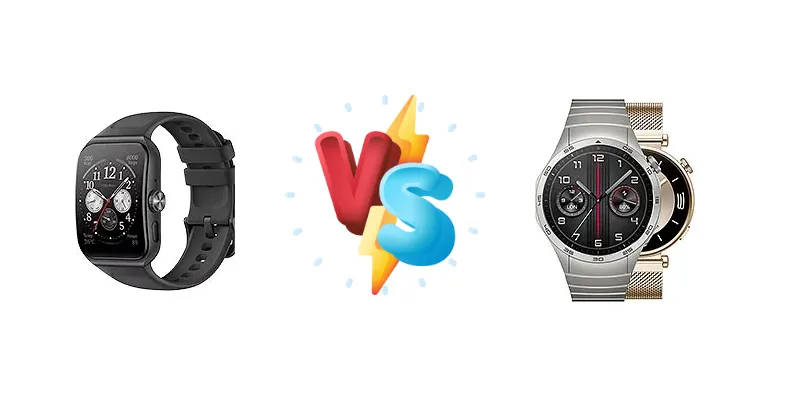
The smartwatch market is increasingly segmented, with options ranging from fitness-focused trackers to fully-fledged extensions of your smartphone. The Oppo Watch 3 Pro, powered by Qualcomm’s latest wearable chipset, aims for the latter, while the Huawei Watch GT 4 prioritizes convenience with its wireless charging and established health tracking features. This comparison dissects the core differences to help you choose the right wearable for your needs.
🏆 Quick Verdict
For users prioritizing raw performance and a more app-rich experience, the Oppo Watch 3 Pro is the clear winner. Its Snapdragon W5+ Gen 1 chipset provides a significant advantage. However, the Huawei Watch GT 4 appeals to those who value wireless charging convenience and a potentially longer battery life, though specific battery details are currently unavailable.
| Network |
|---|
| 2G bands | N/A | N/A |
| 3G bands | HSDPA 850 / 900 / 2100 | N/A |
| 4G bands | LTE | N/A |
| EDGE | - | No |
| GPRS | - | No |
| Speed | HSPA, LTE | No |
| Technology | HSPA / LTE | No cellular connectivity |
| Launch |
|---|
| Announced | 2022, August 10 | 2023, September 14 |
| Status | Available. Released 2022, August 19 | Available. Released 2023, October 02 |
| Body |
|---|
| Build | Glass front, aluminum frame | Glass front, plastic back, stainless steel frame |
| Dimensions | 50.4 x 38.5 x 12.8 mm (1.98 x 1.52 x 0.50 in) | 46 x 46 x 10.9 mm (1.81 x 1.81 x 0.43 in) |
| SIM | eSIM (market/region dependent) | No |
| Weight | 37.5 g (1.34 oz) | 37 g (41mm) / 48 g (46mm) (1.31 oz) |
| | 5ATM water resistant | - |
| Display |
|---|
| Resolution | 378 x 496 pixels (~327 ppi density) | 466 x 466 pixels (~326 ppi density) |
| Size | 1.91 inches | 1.43 inches |
| Type | LTPO AMOLED | AMOLED |
| | Always-on display | - |
| Platform |
|---|
| CPU | Quad-core 1.7 GHz Cortex-A53 | - |
| Chipset | Qualcomm Snapdragon W5+ Gen 1 (4 nm) | - |
| GPU | Adreno A702 | - |
| OS | Android Wear OS - InternationalColorOS Watch 3.0 - China | HarmonyOS 4.0 |
| Memory |
|---|
| Card slot | No | No |
| Internal | 32GB 1GB RAM | Unspecified |
| | eMMC 4.5 | - |
| Sound |
|---|
| 3.5mm jack | No | - |
| 35mm jack | No | No |
| Loudspeaker | Yes | Yes |
| Comms |
|---|
| Bluetooth | 5.0, A2DP, LE | 5.2, A2DP, LE |
| NFC | Yes | Yes |
| Positioning | GPS, GLONASS, BDS, GALILEO, QZSS | GPS (L1+L5), GLONASS, BDS, GALILEO, QZSS |
| Radio | No | No |
| USB | No | No |
| WLAN | - | No |
| Features |
|---|
| Sensors | Accelerometer, gyro, heart rate, compass, barometer, SpO2 | Accelerometer, gyro, heart rate, barometer, compass, SpO2, thermometer (body temperature) |
| Battery |
|---|
| Charging | - | Wireless |
| Type | Li-Ion 550 mAh | Li-Ion 524 mAh |
| Misc |
|---|
| Colors | Black, Silver | Black, Steel, Silver, Gold |
| Models | - | ARA-B19, PNX-B19 |
| Price | About 270 EUR | About 270 EUR |
Oppo Watch 3 Pro
- Powerful Snapdragon W5+ Gen 1 chipset for smooth performance
- 4nm process for improved power efficiency
- Potential for a more app-rich experience
- Battery life details currently unknown
- Display specifications currently unavailable
Huawei Watch GT 4
- Convenient wireless charging
- Potentially longer battery life due to optimized power management
- Integration with Huawei’s health ecosystem
- Likely less powerful processor compared to the Oppo Watch 3 Pro
- Battery capacity and charging speed details currently unavailable
Display Comparison
Information regarding display specifications (resolution, brightness, panel type) is currently unavailable for both devices. However, given Oppo’s history with AMOLED displays, the Watch 3 Pro likely features a vibrant panel. The Huawei Watch GT 4, based on previous generations, may also utilize AMOLED technology. The absence of data prevents a direct comparison of color accuracy or peak brightness, but the display quality will likely be a key differentiator.
Camera Comparison
Neither device is known for camera capabilities, and detailed camera specifications are unavailable. Smartwatches generally feature limited camera functionality, primarily for quick snapshots or video calls. Without specific details, it’s difficult to assess the camera performance of either device.
Performance
The Oppo Watch 3 Pro’s Qualcomm Snapdragon W5+ Gen 1 (4nm) chipset is the defining performance advantage. This 4nm process node translates to improved power efficiency and thermal management compared to older wearable chipsets. The quad-core 1.7 GHz Cortex-A53 CPU provides ample processing power for running apps and handling complex tasks. The Huawei Watch GT 4’s chipset is not specified, but Huawei typically focuses on optimizing power efficiency rather than raw processing speed. This means the GT 4 will likely handle basic smartwatch functions smoothly, but may struggle with more demanding applications. Users who plan to install numerous apps or utilize features like voice assistants will benefit significantly from the Oppo Watch 3 Pro’s superior processing power.
Battery Life
Battery capacity and charging speeds are currently unknown for the Huawei Watch GT 4, beyond the inclusion of wireless charging. The Oppo Watch 3 Pro’s battery details are also unavailable. However, the Snapdragon W5+ Gen 1’s 4nm process should contribute to improved battery life compared to older generation wearables. Wireless charging on the GT 4 offers convenience, but may be slower than wired charging options. The actual battery life will depend heavily on usage patterns and feature utilization.
Buying Guide
Buy the Oppo Watch 3 Pro if you need a smartwatch capable of running demanding applications, require a smoother user interface, and anticipate utilizing features beyond basic fitness tracking. Buy the Huawei Watch GT 4 if you prefer the simplicity of wireless charging, prioritize a potentially longer battery life between charges, and are heavily invested in Huawei’s ecosystem for health and fitness data synchronization.
Frequently Asked Questions
❓ How does the Snapdragon W5+ Gen 1 in the Oppo Watch 3 Pro impact app loading times compared to the Huawei Watch GT 4?
The Snapdragon W5+ Gen 1’s significantly more powerful CPU and GPU will result in noticeably faster app loading times on the Oppo Watch 3 Pro. The Huawei Watch GT 4, likely utilizing a less powerful chipset, will experience longer loading times, especially for complex applications.
❓ Is wireless charging on the Huawei Watch GT 4 significantly slower than a potential fast-wired charging option on the Oppo Watch 3 Pro?
Wireless charging is generally slower than wired charging. While the exact charging speeds for both devices are unknown, if the Oppo Watch 3 Pro supports fast-wired charging, it will likely reach a full charge much quicker than the Huawei Watch GT 4 using wireless charging. The convenience of wireless charging comes at the cost of speed.
❓ Will the Oppo Watch 3 Pro’s processor allow for more complex watch faces and widgets compared to the Huawei Watch GT 4?
Yes, the Snapdragon W5+ Gen 1’s processing power enables the Oppo Watch 3 Pro to handle more complex watch faces and widgets with animations and real-time data updates without significant performance lag. The Huawei Watch GT 4 may struggle with resource-intensive watch faces, leading to a less fluid user experience.