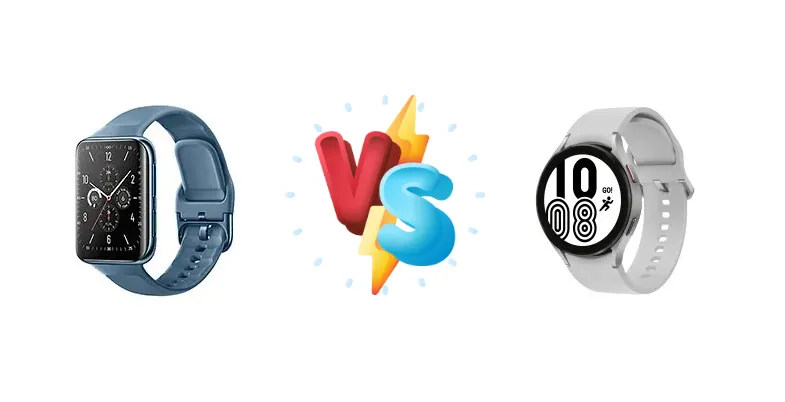
The smartwatch market is booming, and choosing the right one can be overwhelming. Today, we're pitting two strong contenders against each other: the Oppo Watch 2 and the Samsung Galaxy Watch4. Let's dive into a comprehensive comparison to help you decide which wearable deserves a spot on your wrist.
🏆 Quick Verdict
The Samsung Galaxy Watch4 emerges as the overall winner thanks to its superior chipset, smoother performance, and robust Wear OS integration. While the Oppo Watch 2 offers a unique design and decent features, the Galaxy Watch4’s advanced health tracking and software experience give it the edge.
| Network |
|---|
| 2G bands | N/A | GSM 850 / 900 / 1800 / 1900 |
| 3G bands | HSDPA 850 / 900 / 2100 | HSDPA 850 / 900 / 2100 |
| 4G bands | 1, 3, 5, 8, 34, 38, 39, 40, 41 - China | 1, 3, 5, 7, 8, 20 |
| Speed | HSPA, LTE | HSPA, LTE |
| Technology | HSPA / LTE | GSM / HSPA / LTE |
| Launch |
|---|
| Announced | 2021, July 27 | 2021, August 11 |
| Status | Available. Released 2021, July 27 | Available. Released 2021, August 27 |
| Body |
|---|
| Build | Glass front, aluminum frame | Glass front (Gorilla Glass DX+), aluminum frame |
| Dimensions | 46.4 x 38.5 x 11.6 mm (1.83 x 1.52 x 0.46 in) | 44.4 x 43.3 x 9.8 mm (1.75 x 1.70 x 0.39 in) |
| SIM | eSIM (market/region dependent) | eSIM |
| Weight | 35 g (46mm) / 31 g (42mm) (1.09 oz) | 30.3 g (44mm), 25.9 g (40mm) (1.06 oz) |
| | 5ATM water resistant | MIL-STD-810G compliant*
50m water resistant (IP68)
Compatible with standard 20mm straps
ECG certified
Blood pressure monitor
*does not guarantee ruggedness or use in extreme conditions |
| Display |
|---|
| Protection | - | Corning Gorilla Glass DX+ |
| Resolution | 402 x 476 pixels (~326 ppi density) | 450 x 450 pixels (~321 ppi density) |
| Size | 1.91 inches | 1.4 inches |
| Type | AMOLED | Super AMOLED |
| | - | Always-on display |
| Platform |
|---|
| CPU | Quad-core 1.7 GHz Cortex-A53 | Dual-core 1.18 GHz Cortex-A55 |
| Chipset | Qualcomm Snapdragon Wear 4100 (12 nm) | Exynos W920 (5 nm) |
| GPU | Adreno 504 | Mali-G68 |
| OS | Android Wear OS - InternationalColorOS Watch 2.0 - China | Android Wear OS 4, One UI Watch 5 |
| Memory |
|---|
| Card slot | No | No |
| Internal | 8GB 1GB RAM | 16GB 1.5GB RAM |
| | eMMC 4.5 | - |
| Sound |
|---|
| 3.5mm jack | No | No |
| 35mm jack | No | No |
| Loudspeaker | Yes | Yes |
| Comms |
|---|
| Bluetooth | 5.0, A2DP, LE | 5.0, A2DP, LE |
| NFC | Yes | Yes |
| Positioning | GPS, GLONASS, GALILEO, BDS | GPS, GLONASS, GALILEO, BDS |
| Radio | No | No |
| USB | No | No |
| WLAN | Wi-Fi 802.11 b/g/n | Wi-Fi 802.11 a/b/g/n, dual-band |
| Features |
|---|
| Sensors | Accelerometer, gyro, heart rate, compass, barometer, SpO2 | Accelerometer, gyro, compass, barometer, heart rate, SpO2 |
| | - | Natural language commands and dictation
Samsung Pay |
| Battery |
|---|
| Charging | - | Wireless |
| Type | Li-Ion 510 mAh | Li-Ion 361 mAh |
| Misc |
|---|
| Colors | Star Blue, Platinum Black, Rose Gold | Black, Pink Gold, Silver, Green, Thom Browne Edition, Bespoke Edition, PXG Golf Edition |
| Models | OW20W2 | SM-R860, SM-R870 |
| Price | About 170 EUR | About 110 EUR |
Oppo Watch 2
- Stylish curved design
- Larger display
- Decent battery life (with moderate use)
- VOOC fast charging
- Slower performance
- Less polished software experience
- Limited app ecosystem compared to Wear OS
Samsung Galaxy Watch4
- Superior performance (Exynos W920)
- Wear OS integration
- Advanced health tracking (BioActive Sensor)
- Wireless charging
- Rotating bezel (Classic model)
- Battery life could be better with heavy use
- Some features require a Samsung phone for full functionality
Display Comparison
Both watches boast vibrant AMOLED displays, but the Galaxy Watch4 generally offers slightly better color accuracy and brightness. The Oppo Watch 2's curved display is visually appealing, but can sometimes be less practical for everyday use. The Galaxy Watch4's smaller bezels contribute to a more immersive viewing experience.
Camera Comparison
Neither watch has a built-in camera, a common omission in smartwatches. Users will need to rely on their smartphones for capturing photos and videos.
Performance
This is where the Galaxy Watch4 truly shines. The Exynos W920 chipset, built on a 5nm process, provides significantly faster and smoother performance compared to the Oppo Watch 2's Snapdragon Wear 4100. App loading times are quicker, and multitasking is more fluid on the Galaxy Watch4.
Battery Life
Battery life is a mixed bag. The Oppo Watch 2, with its larger battery, can often last longer on a single charge, especially with moderate usage. However, the Galaxy Watch4's wireless charging is a convenient feature. Actual battery life depends heavily on usage patterns and enabled features.
Buying Guide
The Oppo Watch 2 is a good choice for users prioritizing a stylish design and a larger screen, especially those already invested in the Oppo ecosystem. The Samsung Galaxy Watch4 is ideal for Android users seeking a feature-rich smartwatch with excellent health tracking, seamless integration with the Google ecosystem, and a more modern software experience.
Frequently Asked Questions
❓ Is the Oppo Watch 2 good for fitness tracking?
Yes, it offers standard fitness tracking features like heart rate monitoring, step counting, and sleep tracking. However, the Galaxy Watch4's BioActive Sensor provides more advanced metrics like body composition analysis.
❓ Does the Samsung Galaxy Watch4 work with iPhones?
While it pairs with iPhones, functionality is limited compared to Android devices. You'll miss out on features like ECG and blood pressure monitoring.