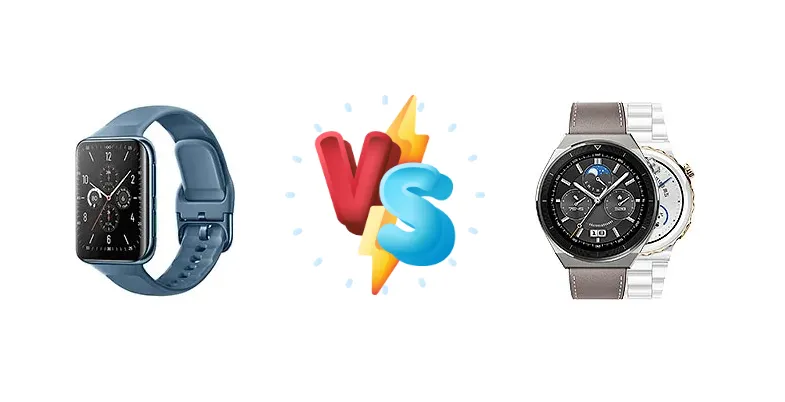
The smartwatch market offers a spectrum of choices, from performance-focused devices to those prioritizing battery life and convenience. The Oppo Watch 2, powered by the Qualcomm Snapdragon Wear 4100, aims to deliver a full-featured Wear OS experience. Conversely, the Huawei Watch GT 3 Pro emphasizes extended battery life and a premium design, leaning into a more holistic health and fitness tracking approach. This comparison dissects the core differences to help you determine which smartwatch best suits your needs.
🏆 Quick Verdict
For users prioritizing a responsive, app-rich smartwatch experience, the Oppo Watch 2, with its Snapdragon Wear 4100 chipset, is the better choice. However, if extended battery life and wireless charging are paramount, the Huawei Watch GT 3 Pro offers a compelling alternative, albeit with a potentially less versatile software ecosystem.
| Network |
|---|
| 2G bands | N/A | N/A |
| 3G bands | HSDPA 850 / 900 / 2100 | N/A |
| 4G bands | 1, 3, 5, 8, 34, 38, 39, 40, 41 - China | N/A |
| EDGE | - | No |
| GPRS | - | No |
| Speed | HSPA, LTE | No |
| Technology | HSPA / LTE | No cellular connectivity |
| Launch |
|---|
| Announced | 2021, July 27 | 2022, April 28 |
| Status | Available. Released 2021, July 27 | Available. Released 2022, May 05 |
| Body |
|---|
| Build | Glass front, aluminum frame | Sapphire crystal front, titanium frame or ceramic frame, ceramic back |
| Dimensions | 46.4 x 38.5 x 11.6 mm (1.83 x 1.52 x 0.46 in) | 46.6 x 46.6 x 10.9 mm (1.83 x 1.83 x 0.43 in) |
| SIM | eSIM (market/region dependent) | No |
| Weight | 35 g (46mm) / 31 g (42mm) (1.09 oz) | 50 g (43mm) / 54 g (46mm) (1.76 oz) |
| | 5ATM water resistant | 30m water resistant
5 ATM
IP68
Compatible with standard 22mm straps (46mm model), 20mm straps (43mm model)
ECG certified |
| Display |
|---|
| Resolution | 402 x 476 pixels (~326 ppi density) | 466 x 466 pixels (~326 ppi density) |
| Size | 1.91 inches | 1.43 inches |
| Type | AMOLED | AMOLED |
| Platform |
|---|
| CPU | Quad-core 1.7 GHz Cortex-A53 | - |
| Chipset | Qualcomm Snapdragon Wear 4100 (12 nm) | - |
| GPU | Adreno 504 | - |
| OS | Android Wear OS - InternationalColorOS Watch 2.0 - China | HarmonyOS 2.0, upgradable to 3.0 |
| Memory |
|---|
| Card slot | No | No |
| Internal | 8GB 1GB RAM | 32GB |
| | eMMC 4.5 | - |
| Sound |
|---|
| 3.5mm jack | No | No |
| 35mm jack | No | No |
| Loudspeaker | Yes | Yes |
| Comms |
|---|
| Bluetooth | 5.0, A2DP, LE | 5.2, A2DP, LE |
| NFC | Yes | Yes |
| Positioning | GPS, GLONASS, GALILEO, BDS | GPS (L1+L5), GLONASS, BDS, GALILEO, QZSS |
| Radio | No | No |
| USB | No | No |
| WLAN | Wi-Fi 802.11 b/g/n | No |
| Features |
|---|
| Sensors | Accelerometer, gyro, heart rate, compass, barometer, SpO2 | Accelerometer, gyro, heart rate, barometer, compass, SpO2, thermometer (body temperature) |
| Battery |
|---|
| Charging | - | Wireless |
| Type | Li-Ion 510 mAh | Li-Po 530 mAh |
| Misc |
|---|
| Colors | Star Blue, Platinum Black, Rose Gold | Silver |
| Models | OW20W2 | ODN-B19, FRG-B19 |
| Price | About 170 EUR | About 200 EUR |
Oppo Watch 2
- Powerful Snapdragon Wear 4100 processor
- Full Wear OS experience with app access
- Likely vibrant AMOLED display
- Potentially shorter battery life
- Requires wired charging
Huawei Watch GT 3 Pro
- Wireless charging convenience
- Likely extended battery life
- Premium design and build quality
- Potentially less responsive performance
- Limited app ecosystem compared to Wear OS
Display Comparison
Context data lacks display specifics for both devices. However, given Oppo’s history, the Watch 2 likely utilizes an AMOLED panel for vibrant colors and deep blacks, benefiting from the Snapdragon Wear 4100’s processing power to drive a smooth user interface. The Huawei Watch GT 3 Pro, positioned as a premium device, likely features a high-resolution AMOLED display as well, potentially with sapphire glass for enhanced durability. The GT 3 Pro’s focus on aesthetics suggests a bezel-conscious design, while the Watch 2 may prioritize screen real estate for Wear OS’s information-dense interface.
Camera Comparison
Neither device is known for camera capabilities, and context data provides no information. Smartwatches generally feature limited camera functionality, and it’s unlikely either device will excel in this area. Any camera present would likely be low-resolution and intended for quick, casual snapshots.
Performance
The Oppo Watch 2’s Qualcomm Snapdragon Wear 4100 (12 nm) chipset represents a significant leap over previous Wear OS platforms. The quad-core 1.7 GHz Cortex-A53 CPU provides ample processing power for smooth app navigation, quick notifications, and responsive interactions. The GT 3 Pro, while lacking detailed chipset information, likely employs a proprietary Huawei chipset optimized for power efficiency. This difference translates to a trade-off: the Oppo Watch 2 offers a more fluid and capable smartwatch experience, while the GT 3 Pro prioritizes battery longevity over raw processing speed. The 12nm process node of the Snapdragon Wear 4100, while not the most cutting-edge, still provides a good balance between performance and power consumption.
Battery Life
Context data only highlights the Huawei Watch GT 3 Pro’s wireless charging capability. This convenience is a significant advantage for users who dislike dealing with cables. The Oppo Watch 2 likely relies on traditional wired charging. While the mAh capacity of both devices is unknown, Huawei’s emphasis on battery life suggests a larger battery and more aggressive power management. The Snapdragon Wear 4100, while powerful, is known to be relatively power-hungry, meaning the Oppo Watch 2 will likely require more frequent charging compared to the GT 3 Pro.
Buying Guide
Buy the Oppo Watch 2 if you need a smartwatch capable of running a wide range of apps, require seamless integration with Google services, and value a more traditional smartwatch experience. Buy the Huawei Watch GT 3 Pro if you prioritize multi-day battery life, appreciate the convenience of wireless charging, and are heavily invested in Huawei’s health and fitness ecosystem, accepting a more limited app selection.
Frequently Asked Questions
❓ How does the Snapdragon Wear 4100 in the Oppo Watch 2 impact app loading times compared to the Huawei Watch GT 3 Pro?
The Snapdragon Wear 4100 is a dedicated smartwatch processor designed for responsive performance. Expect significantly faster app loading times and smoother multitasking on the Oppo Watch 2 compared to the Huawei Watch GT 3 Pro, which likely uses a less powerful, proprietary chipset optimized for efficiency rather than speed.
❓ Is the wireless charging on the Huawei Watch GT 3 Pro compatible with any Qi-certified wireless charger?
Yes, the Huawei Watch GT 3 Pro supports Qi wireless charging, meaning it should be compatible with most Qi-certified wireless chargers. However, Huawei may recommend using its own charger for optimal charging speeds and efficiency.
❓ Does the Oppo Watch 2 receive regular software updates and security patches, given its Wear OS foundation?
The Oppo Watch 2 benefits from Google’s Wear OS platform, meaning it *should* receive regular software updates and security patches. However, the frequency and duration of support depend on Oppo’s commitment to the device, which is a factor to consider when making a purchase.