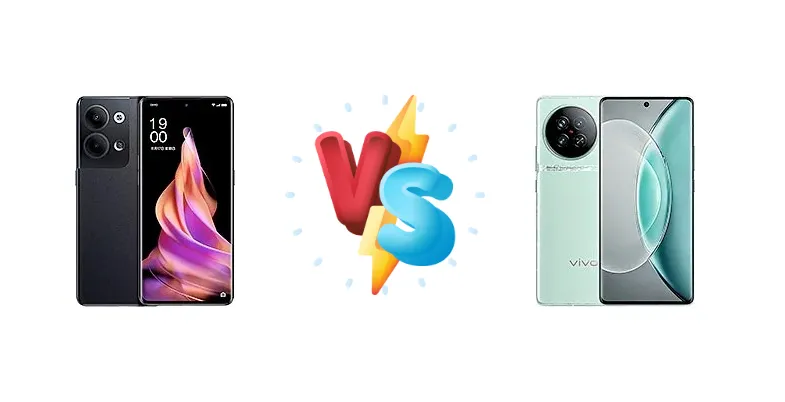
The Oppo Reno9 and vivo X90s represent compelling options in the increasingly competitive mid-range smartphone market. While both aim for a premium experience, they take distinctly different approaches. The Reno9 leverages the well-established Snapdragon 778G 5G platform, prioritizing efficiency and a balanced experience. Conversely, the X90s boasts the more powerful Mediatek Dimensity 9200+, aiming for near-flagship performance, but at the potential cost of increased power consumption. This comparison will dissect the key differences to help you determine which device best suits your needs.
🏆 Quick Verdict
For the average user prioritizing sustained performance and efficient power management, the vivo X90s emerges as the stronger contender. Its Dimensity 9200+ chipset delivers a significant performance uplift over the Reno9’s Snapdragon 778G, and the 120W charging is a game-changer. However, the Reno9 remains a viable option for those seeking a more balanced and potentially cooler-running device.
| Network |
|---|
| 2G bands | GSM 850 / 900 / 1800 / 1900 | GSM 850 / 900 / 1800 / 1900 |
| 3G bands | HSDPA 850 / 900 / 1700(AWS) / 2100 | HSDPA 800 / 850 / 900 / 1700(AWS) / 1900 / 2100 |
| 4G bands | 1, 3, 4, 5, 7, 8, 28, 34, 38, 39, 40, 41 | 1, 2, 3, 4, 5, 7, 8, 18, 19, 26, 28, 34, 38, 39, 40, 41 |
| 5G bands | 1, 5, 8, 28, 41, 77, 78 SA/NSA | 1, 3, 5, 8, 28, 41, 77, 88 SA/NSA |
| Speed | HSPA, LTE, 5G | HSPA, LTE, 5G |
| Technology | GSM / CDMA / HSPA / CDMA2000 / LTE / 5G | GSM / CDMA / HSPA / CDMA2000 / LTE / 5G |
| | CDMA2000 1x | - |
| Launch |
|---|
| Announced | 2022, November 24 | 2023, June 26 |
| Status | Available. Released 2022, December 02 | Available. Released 2023, June 30 |
| Body |
|---|
| Build | - | Glass front, glass back or eco leather back |
| Dimensions | 162.3 x 74.2 x 7.2 mm (6.39 x 2.92 x 0.28 in) | 164.1 x 74.4 x 8.5 mm or 8.9 mm |
| SIM | Nano-SIM + Nano-SIM | Nano-SIM + Nano-SIM |
| Weight | 174 g (6.14 oz) | 197.5 / 201.5 / 202.2 / 203.5 g (6.98 oz) |
| Display |
|---|
| Protection | Asahi Glass AGC DT-Star2 | - |
| Resolution | 1080 x 2412 pixels, 20:9 ratio (~394 ppi density) | 1260 x 2800 pixels, 20:9 ratio (~453 ppi density) |
| Size | 6.7 inches, 108.0 cm2 (~89.7% screen-to-body ratio) | 6.78 inches, 111.0 cm2 (~90.9% screen-to-body ratio) |
| Type | AMOLED, 1B colors, 120Hz, HDR10+, 500 nits (typ), 800 nits (HBM), 950 nits (peak) | AMOLED, 1B colors, 120Hz, HDR10+, 1300 nits (peak) |
| Platform |
|---|
| CPU | Octa-core (1x2.4 GHz Cortex-A78 & 3x2.2 GHz Cortex-A78 & 4x1.9 GHz Cortex-A55) | Octa-core (1x3.35 GHz Cortex-X3 & 3x3.0 GHz Cortex-A715 & 4x2.0 GHz Cortex-A510) |
| Chipset | Qualcomm SM7325 Snapdragon 778G 5G (6 nm) | Mediatek Dimensity 9200+ (4 nm) |
| GPU | Adreno 642L | Immortalis-G715 MC11 |
| OS | Android 13, ColorOS 13 | Android 13, OriginOS 3 |
| Memory |
|---|
| Card slot | No | No |
| Internal | 256GB 8GB RAM, 256GB 12GB RAM, 512GB 12GB RAM | 256GB 8GB RAM, 256GB 12GB RAM, 512GB 12GB RAM |
| | UFS 3.1 - 512GB
UFS 2.2 - 256GB | - |
| Main Camera |
|---|
| Dual | 64 MP, f/1.8, 26mm (wide), PDAF
Auxiliary lens | - |
| Features | Color spectrum sensor, LED flash, HDR, panorama | Laser AF, color spectrum sensor, Zeiss optics, Zeiss T* lens coating, Pixel Shift, dual-LED dual-tone flash, HDR, panorama |
| Single | 32 MP, f/2.4, 22mm (wide), 1/2.74", 0.8µm, AF | - |
| Triple | - | 50 MP, f/1.8, (wide), 1/1.49", 1.0µm, PDAF, OIS
12 MP, f/2.0, 50mm (telephoto), 1/2.93", 1.22µm, AF, 2x optical zoom
12 MP, f/2.0, 16mm (ultrawide), 1/2.93", 1.22µm, AF |
| Video | 4K@30fps, 1080p@30/60/120fps, gyro-EIS | 4K@30/60fps, 1080p@30/60fps, gyro-EIS |
| Selfie camera |
|---|
| Features | Panorama, HDR | HDR |
| Single | 32 MP, f/2.4, 22mm (wide), 1/2.74", 0.8µm, AF | 32 MP, f/2.5, 24mm (wide), 1/2.8", 0.8µm |
| Video | 1080p@30fps, gyro-EIS | 1080p@30/60fps |
| Sound |
|---|
| 3.5mm jack | No | - |
| 35mm jack | No | No |
| Loudspeaker | Yes | Yes, with stereo speakers |
| | 24-bit/192kHz audio | - |
| Comms |
|---|
| Bluetooth | 5.2, A2DP, LE, aptX HD | 5.3, A2DP, LE, aptX HD |
| Infrared port | Yes | Yes |
| NFC | Yes | Yes |
| Positioning | GPS, GLONASS, GALILEO, BDS, QZSS | GPS (L1+L5), GLONASS (G1), BDS (B1I+B2a+B2c), GALILEO (E1+E5a), QZSS (L1+L5), NavIC (L5) |
| Radio | No | No |
| USB | USB Type-C 2.0, OTG | USB Type-C 2.0, OTG |
| WLAN | Wi-Fi 802.11 a/b/g/n/ac/6, dual-band, Wi-Fi Direct | Wi-Fi 802.11 a/b/g/n/ac/6/7, tri-band |
| Features |
|---|
| Sensors | Fingerprint (under display, optical), accelerometer, gyro, proximity, compass | Fingerprint (under display, optical), accelerometer, gyro, proximity, compass |
| Battery |
|---|
| Charging | 67W wired, PD, QC2, 33% in 10 min, 100% in 44 min
Reverse wired | 120W wired, 50% in 8 min
Reverse wired |
| Type | Li-Po 4500 mAh | 4810 mAh |
| Misc |
|---|
| Colors | Black, Gold, Pink gradient, Red | Black, White, Red, Green |
| Models | PHM110 | V2241HA |
| Price | About 600 EUR | About 510 EUR |
Oppo Reno9
- Efficient Snapdragon 778G chipset
- Balanced performance for everyday tasks
- Reliable 67W fast charging
- Less powerful than the Dimensity 9200+
- May struggle with demanding games at max settings
- Potentially slower app loading times
vivo X90s
- Powerful Mediatek Dimensity 9200+ chipset
- Ultra-fast 120W charging
- Superior image processing capabilities
- Potentially higher power consumption
- May run warmer under heavy load
- Higher price point
Display Comparison
While display specifications aren't provided, both phones likely feature OLED panels given their market positioning. However, the core difference lies beneath the surface. The Reno9, with its Snapdragon 778G, likely utilizes a standard refresh rate panel to conserve power. The X90s, powered by the Dimensity 9200+, has the headroom to support a higher refresh rate (potentially 120Hz) and potentially LTPO technology for adaptive refresh rates, improving both smoothness and efficiency. Bezels are expected to be minimal on both, but the X90s’ more powerful ISP could translate to slightly better color accuracy and dynamic range.
Camera Comparison
Without detailed camera specs, we can infer differences based on chipset capabilities. The Dimensity 9200+ in the X90s boasts a more advanced ISP (Image Signal Processor) capable of handling higher resolution sensors and more complex image processing algorithms. This suggests the X90s will likely deliver superior image quality, particularly in challenging lighting conditions. While both phones may feature similar camera setups (main, ultrawide, potentially macro), the X90s’ ISP will likely provide better dynamic range, noise reduction, and overall detail. The Reno9’s camera will still be competent, but the X90s has the potential for a more refined and versatile camera experience.
Performance
The performance gap is the most significant differentiator. The Mediatek Dimensity 9200+ in the X90s, built on a 4nm process, is a substantial upgrade over the Qualcomm Snapdragon 778G 5G (6nm) in the Reno9. The X90s’ CPU configuration – 1x3.35 GHz Cortex-X3, 3x3.0 GHz Cortex-A715, and 4x2.0 GHz Cortex-A510 – offers significantly higher peak performance and improved multi-core capabilities compared to the Reno9’s 1x2.4 GHz Cortex-A78, 3x2.2 GHz Cortex-A78, and 4x1.9 GHz Cortex-A55. This translates to faster app loading times, smoother multitasking, and a more responsive gaming experience. While the Reno9 is capable, the X90s is designed for demanding users. The X90s also benefits from potentially faster LPDDR5x RAM, further enhancing performance.
Battery Life
The Reno9’s 67W charging is respectable, achieving 100% in 44 minutes. However, the X90s’ 120W charging is a game-changer, reaching 50% in just 8 minutes. This drastically reduces downtime and is a significant convenience factor. While battery capacity isn’t specified, the more efficient 4nm Dimensity 9200+ in the X90s could offset a potentially smaller battery size compared to the Reno9, resulting in comparable or even better real-world battery life. The Reno9’s Snapdragon 778G, while efficient, simply can’t match the power efficiency of the X90s’ flagship-tier chipset.
Buying Guide
Buy the Oppo Reno9 if you need a reliable, all-rounder smartphone with good battery life and a focus on consistent performance for everyday tasks and moderate gaming. Buy the vivo X90s if you prioritize raw processing power for demanding applications, fast charging speeds are critical, and you're willing to accept potentially higher temperatures during intensive use.
Frequently Asked Questions
❓ Will the Dimensity 9200+ in the X90s overheat during prolonged gaming sessions?
While the Dimensity 9200+ is a powerful chip, it's known to generate more heat than the Snapdragon 778G. However, vivo typically employs robust thermal management solutions, including vapor chamber cooling, to mitigate throttling. Expect some warmth during extended gaming, but it shouldn't reach uncomfortable levels. The Reno9, with its less powerful chipset, will likely remain cooler.
❓ Is the 120W charging on the X90s safe for the battery's long-term health?
vivo employs battery health management technologies alongside its 120W SuperVOOC charging to minimize degradation. The charging system intelligently adjusts voltage and current to protect the battery. While fast charging *can* contribute to battery wear over time, the X90s’ implementation is designed to mitigate these effects.
❓ Does the Snapdragon 778G in the Reno9 still offer a good gaming experience?
The Snapdragon 778G is a capable chipset for gaming, but it's not in the same league as the Dimensity 9200+. You'll be able to play most popular games at medium to high settings, but you may need to lower graphics settings for more demanding titles to maintain a smooth frame rate. The X90s will provide a noticeably smoother and more consistent gaming experience.