
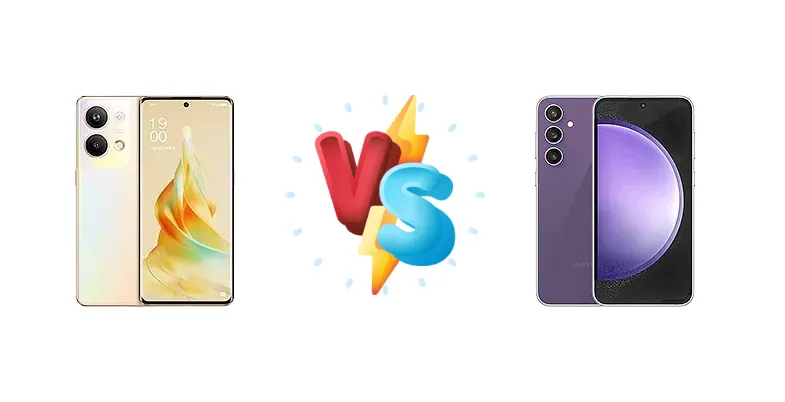
Oppo Reno9 Pro vs. Samsung Galaxy S23 FE: Which Flagship Killer Wins?
| Phones Images | |||||
|---|---|---|---|---|---|
|
🏆 Quick Verdict
For the average user prioritizing consistent performance and a well-rounded experience, the Samsung Galaxy S23 FE emerges as the stronger contender. While the Reno9 Pro boasts significantly faster charging, the S23 FE’s Snapdragon 8 Gen 1 (or Exynos 2200 depending on region) offers a more robust and thermally managed platform, coupled with a brighter display and longer battery life in active use.
| PHONES | ||
|---|---|---|
| Phone Names | Oppo Reno9 Pro | Samsung Galaxy S23 FE |
| Network | ||
|---|---|---|
| 2G bands | GSM 850 / 900 / 1800 / 1900 | GSM 850 / 900 / 1800 / 1900 |
| 3G bands | HSDPA 850 / 900 / 1700(AWS) / 2100 | HSDPA 850 / 900 / 1700(AWS) / 1900 / 2100 |
| 4G bands | 1, 3, 4, 5, 7, 8, 18, 19, 26, 28, 34, 38, 39, 40, 41 | 1, 2, 3, 4, 5, 7, 8, 12, 13, 17, 20, 26, 28, 38, 40, 41, 66 - International |
| 5G bands | 1, 5, 8, 28, 41, 77, 78 SA/NSA | 1, 2, 3, 5, 7, 8, 20, 28, 38, 40, 41, 66, 77, 78 SA/NSA/Sub6 - International |
| Speed | HSPA, LTE, 5G | HSPA, LTE, 5G |
| Technology | GSM / CDMA / HSPA / CDMA2000 / LTE / 5G | GSM / HSPA / LTE / 5G |
| CDMA2000 1x | - | |
| Launch | ||
|---|---|---|
| Announced | 2022, November 24 | 2023, October 04 |
| Status | Available. Released 2022, December 02 | Available. Released 2023, October 05 |
| Body | ||
|---|---|---|
| Build | - | Glass front (Gorilla Glass 5), glass back (Gorilla Glass 5), aluminum frame |
| Dimensions | 162.3 x 74.2 x 7.2 mm (6.39 x 2.92 x 0.28 in) | 158 x 76.5 x 8.2 mm (6.22 x 3.01 x 0.32 in) |
| SIM | Nano-SIM + Nano-SIM | · Nano-SIM· Nano-SIM + Nano-SIM· Nano-SIM + Nano-SIM + eSIM (max 2 at a time) |
| Weight | 174 g (6.14 oz) | 209 g (7.37 oz) |
| Display | ||
|---|---|---|
| Protection | Asahi Glass AGC DT-Star2 | Corning Gorilla Glass 5 |
| Resolution | 1080 x 2412 pixels, 20:9 ratio (~394 ppi density) | 1080 x 2340 pixels, 19.5:9 ratio (~403 ppi density) |
| Size | 6.7 inches, 108.0 cm2 (~89.7% screen-to-body ratio) | 6.4 inches, 100.5 cm2 (~83.2% screen-to-body ratio) |
| Type | AMOLED, 1B colors, 120Hz, HDR10+, 500 nits (typ), 800 nits (HBM), 950 nits (peak) | Dynamic AMOLED 2X, 120Hz, HDR10+, 1450 nits (peak) |
| Platform | ||
|---|---|---|
| CPU | Octa-core (4x2.85 GHz Cortex-A78 & 4x2.0 GHz Cortex-A55) | Octa-core (1x2.8 GHz Cortex-X2 & 3x2.50 GHz Cortex-A710 & 4x1.8 GHz Cortex-A510) - InternationalOcta-core (1x3.00 GHz Cortex-X2 & 3x2.50 GHz Cortex-A710 & 4x1.80 GHz Cortex-A510) - USA |
| Chipset | Mediatek Dimensity 8100 Max (5 nm) | Exynos 2200 (4 nm) - InternationalQualcomm SM8450 Snapdragon 8 Gen 1 (4 nm) - USA |
| GPU | Mali-G610 MC6 | Xclipse 920 - InternationalAdreno 730 - USA |
| OS | Android 13, ColorOS 13 | Android 13, up to 4 major Android upgrades, One UI 8 |
| Memory | ||
|---|---|---|
| Card slot | No | No |
| Internal | 256GB 16GB RAM, 512GB 16GB RAM | 128GB 8GB RAM, 256GB 8GB RAM |
| UFS 3.1 | - | |
| Main Camera | ||
|---|---|---|
| Dual | 50 MP, f/1.8, 24mm (wide), 1/1.56", 1.0µm, multi-directional PDAF 8 MP, f/2.2, 112˚ (ultrawide), 1/4.0", 1.12µm | - |
| Features | Color spectrum sensor, LED flash, HDR, panorama | LED flash, HDR, panorama |
| Single | 32 MP, f/2.4, 22mm (wide), 1/2.74", 0.8µm, AF | - |
| Triple | - | 50 MP, f/1.8, 23mm (wide), 1/1.57", 1.0µm, dual pixel PDAF, OIS 8 MP, f/2.4, 76mm (telephoto), 1/4.5", 1.0µm, PDAF, OIS, 3x optical zoom 12 MP, f/2.2, 13mm, 123˚ (ultrawide), 1/3.0", 1.12µm |
| Video | 4K@30fps, 1080p@30/60/120fps, gyro-EIS, HDR | 8K@24fps, 4K@30/60fps, 1080p@30/60/120/240fps |
| Selfie camera | ||
|---|---|---|
| Features | Panorama, HDR | - |
| Single | 32 MP, f/2.4, 22mm (wide), 1/2.74", 0.8µm, AF | 10 MP, f/2.4, 25mm (wide), 1/3.0", 1.22µm |
| Video | 1080p@30fps, gyro-EIS | 4K@30/60fps, 1080p@30/60fps; gyro-EIS |
| Sound | ||
|---|---|---|
| 3.5mm jack | No | - |
| 35mm jack | No | No |
| Loudspeaker | Yes | Yes, with stereo speakers |
| 24-bit/192kHz audio | - | |
| Comms | ||
|---|---|---|
| Bluetooth | 5.3, A2DP, LE, aptX HD | 5.3, A2DP, LE |
| Infrared port | Yes | - |
| NFC | Yes | Yes |
| Positioning | GPS, GLONASS, GALILEO, BDS, QZSS | GPS, GLONASS, GALILEO, BDS |
| Radio | No | Unspecified |
| USB | USB Type-C 2.0, OTG | USB Type-C, OTG |
| WLAN | Wi-Fi 802.11 a/b/g/n/ac/6, dual-band, Wi-Fi Direct | Wi-Fi 802.11 a/b/g/n/ac/6e, dual-band, Wi-Fi Direct |
| Features | ||
|---|---|---|
| Sensors | Fingerprint (under display, optical), accelerometer, gyro, proximity, compass | Fingerprint (under display, optical), accelerometer, gyro, compass |
| Battery | ||
|---|---|---|
| Charging | 67W wired, PD, 35% in 10 min, 100% in 44 min Reverse wired | 25W wired, PD3.0, 50% in 30 min 15W wireless Reverse wireless |
| Type | Li-Po 4500 mAh | Li-Ion 4500 mAh |
| Misc | ||
|---|---|---|
| Colors | Black, Gold, Pink gradient | Mint, Cream, Graphite, Purple, Indigo, Tangerine |
| Models | PGX110 | SM-S711B, SM-S711B/DS, SM-S711U1, SM-S711U, SM-S711W, SM-S7110, SM-S711N |
| Price | About 470 EUR | $ 219.95 / C$ 327.90 / £ 248.99 / € 272.00 / ₹ 34,999 |
| SAR | - | 0.80 W/kg (head) 0.72 W/kg (body) |
| SAR EU | - | 0.76 W/kg (head) 1.04 W/kg (body) |
Oppo Reno9 Pro
- Blazing-fast 67W wired charging
- Sleek and modern design
- Competitive performance from Dimensity 8100 Max
- Likely inferior battery life compared to S23 FE
- Less versatile camera system
- No wireless charging
Samsung Galaxy S23 FE
- Stronger processor (Snapdragon 8 Gen 1/Exynos 2200)
- Brighter and potentially more color-accurate display
- Longer battery life in active use
- Significantly slower 25W wired charging
- Potential for thermal throttling (Exynos variant)
- Samsung’s One UI can be polarizing
Display Comparison
The Samsung Galaxy S23 FE boasts a significantly brighter display, reaching a measured 985 nits, compared to an unstated peak brightness for the Reno9 Pro. This translates to superior visibility under direct sunlight. While both likely utilize OLED panels, Samsung’s display technology often benefits from superior color accuracy and calibration. The S23 FE’s panel is also likely to have a variable refresh rate (LTPO) for improved efficiency, a feature not explicitly mentioned for the Reno9 Pro, potentially impacting battery life during static content viewing.
Camera Comparison
Samsung typically excels in camera processing, and the S23 FE is no exception. While specific sensor details are missing for both, the S23 FE’s camera system is likely more versatile, offering a wider range of shooting modes and potentially better low-light performance. The Reno9 Pro’s camera is competent, but Samsung’s image processing algorithms often deliver more vibrant and detailed results. The presence of Optical Image Stabilization (OIS) on the S23 FE is a significant advantage for video recording and reducing blur in low-light photos. We’ll disregard the likely inclusion of 2MP macro lenses on both devices as they offer minimal practical benefit.
Performance
The chipset choice is the core differentiator. The Reno9 Pro’s Mediatek Dimensity 8100 Max (5nm) is a strong performer, featuring an octa-core configuration with Cortex-A78 cores clocked at 2.85 GHz. However, the S23 FE’s Exynos 2200 (4nm - International) or Snapdragon 8 Gen 1 (4nm - USA) represent a step up in raw processing power, particularly in the GPU department. The Snapdragon 8 Gen 1, with its Cortex-X2 prime core clocked at 3.0 GHz, offers a noticeable advantage in demanding tasks. Crucially, the 4nm process node of the Snapdragon/Exynos provides better thermal efficiency, mitigating throttling during sustained workloads compared to the 5nm Dimensity. The S23 FE’s LPDDR5 RAM (speed unspecified) is likely comparable to the Reno9 Pro’s, but the chipset’s inherent efficiency is more impactful.
Battery Life
The Samsung Galaxy S23 FE demonstrates superior battery endurance with an active use score of 8:28h, indicating a more efficient power management system. While the Reno9 Pro’s battery capacity is unstated, its 67W wired charging is a standout feature, achieving 35% charge in 10 minutes and 100% in 44 minutes. The S23 FE’s 25W charging is considerably slower, taking 30 minutes to reach 50%. However, the S23 FE also supports 15W wireless charging and reverse wireless charging, features absent on the Reno9 Pro. The Reno9 Pro’s charging speed is a compelling advantage for those who prioritize quick top-ups, but the S23 FE’s overall battery life and wireless charging options offer greater flexibility.
Buying Guide
Buy the Oppo Reno9 Pro if you absolutely prioritize charging speed and a sleek design. Its 67W charging is unmatched in this price bracket, making it ideal for users who frequently need to top up their battery quickly. Buy the Samsung Galaxy S23 FE if you value a more complete package – a brighter display, a more versatile camera system, and the assurance of Samsung’s software support and ecosystem integration. It’s the better choice for power users and those invested in the Samsung world.