
Oppo Reno8 vs Xiaomi 12 Lite: Which Mid-Range Phone Reigns Supreme?
| Phones Images | |||||
|---|---|---|---|---|---|
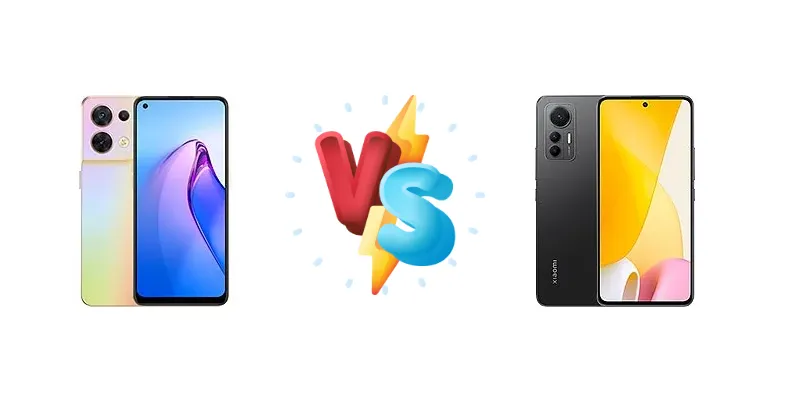
|
🏆 Quick Verdict
For users prioritizing demanding tasks like gaming and video editing, the Oppo Reno8 is the clear winner thanks to its significantly more powerful Dimensity 1300 chipset. However, the Xiaomi 12 Lite offers a brighter display and a more refined aesthetic, making it a compelling choice for everyday users.
| PHONES | ||
|---|---|---|
| Phone Names | Oppo Reno8 | Xiaomi 12 Lite |
| Network | ||
|---|---|---|
| 2G bands | GSM 850 / 900 / 1800 / 1900 | GSM 850 / 900 / 1800 / 1900 |
| 3G bands | HSDPA 800 / 850 / 900 / 1700(AWS) / 1900 / 2100 | HSDPA 850 / 900 / 1700(AWS) / 1900 / 2100 |
| 4G bands | 1, 2, 3, 4, 5, 7, 8, 12, 17, 18, 19, 20, 26, 28, 38, 39, 40, 41 | 1, 2, 3, 4, 5, 7, 8, 12, 13, 17, 18, 19, 20, 26, 28, 32, 38, 40, 41, 42, 48, 66 |
| 5G bands | 1, 3, 5, 7, 8, 20, 28, 38, 40, 41, 77, 78 SA/NSA | 1, 3, 5, 7, 8, 20, 28, 38, 40, 41, 66, 77, 78 SA/NSA |
| Speed | HSPA, LTE, 5G | HSPA, LTE, 5G |
| Technology | GSM / HSPA / LTE / 5G | GSM / HSPA / LTE / 5G |
| Launch | ||
|---|---|---|
| Announced | 2022, July 18 | 2022, July 09 |
| Status | Available. Released 2022, July 25 | Available. Released 2022, July 11 |
| Body | ||
|---|---|---|
| Build | Glass front (Gorilla Glass 5), plastic back, plastic frame | Glass front (Gorilla Glass 5), glass back, plastic frame |
| Dimensions | 160.6 x 73.4 x 7.7 mm (6.32 x 2.89 x 0.30 in) | 159.3 x 73.7 x 7.3 mm (6.27 x 2.90 x 0.29 in) |
| SIM | Nano-SIM + Nano-SIM | Nano-SIM + Nano-SIM |
| Weight | 179 g (6.31 oz) | 173 g (6.10 oz) |
| Display | ||
|---|---|---|
| Protection | Corning Gorilla Glass 5 | Corning Gorilla Glass 5 |
| Resolution | 1080 x 2400 pixels, 20:9 ratio (~411 ppi density) | 1080 x 2400 pixels, 20:9 ratio (~402 ppi density) |
| Size | 6.4 inches, 98.9 cm2 (~83.9% screen-to-body ratio) | 6.55 inches, 103.6 cm2 (~88.2% screen-to-body ratio) |
| Type | AMOLED, 90Hz, 430 nits (typ), 600 nits (HBM), 800 nits (peak) | AMOLED, 68B colors, 120Hz, Dolby Vision, HDR10+, 950 nits (peak) |
| Platform | ||
|---|---|---|
| CPU | Octa-core (1x3.0 GHz Cortex-A78 & 3x2.6 GHz Cortex-A78 & 4x2.0 GHz Cortex-A55) | Octa-core (1x2.4 GHz Cortex-A78 & 3x2.2 GHz Cortex-A78 & 4x1.9 GHz Cortex-A55) |
| Chipset | Mediatek Dimensity 1300 (6 nm) | Qualcomm SM7325 Snapdragon 778G 5G (6 nm) |
| GPU | Mali-G77 MC9 | Adreno 642L |
| OS | Android 12, upgradable to Android 14, ColorOS 14 | Android 12, upgradable to Android 14, HyperOS |
| Memory | ||
|---|---|---|
| Card slot | No | No |
| Internal | 128GB 8GB RAM, 256GB 8GB RAM, 256GB 12GB RAM | 128GB 6GB RAM, 128GB 8GB RAM, 256GB 8GB RAM |
| UFS 3.1 | UFS 2.2 | |
| Main Camera | ||
|---|---|---|
| Features | Dual-LED flash, HDR, panorama | Dual-LED dual-tone flash, HDR, panorama |
| Single | 32 MP, f/2.4, 23mm (wide), 1/2.74", 0.8µm | 32 MP, f/2.5, (wide), 1/2.8", 0.8µm, AF |
| Triple | 50 MP, f/1.8, 23mm (wide), 1/1.56", 1.0µm, multi-directional PDAF 8 MP, f/2.2, 16mm, 112˚ (ultrawide), 1/4.0", 1.12µm 2 MP (macro) | 108 MP, f/1.9, 26mm (wide), 1/1.52", 0.7µm, PDAF 8 MP, f/2.2, 120˚ (ultrawide), 1/4.0", 1.12µm 2 MP (macro) |
| Video | 4K@30fps, 1080p@30/60/120fps, gyro-EIS | 4K@30fps, 1080p@30/60/120fps; gyro-EIS |
| Selfie camera | ||
|---|---|---|
| Features | Panorama, HDR | HDR, panorama |
| Single | 32 MP, f/2.4, 23mm (wide), 1/2.74", 0.8µm | 32 MP, f/2.5, (wide), 1/2.8", 0.8µm, AF |
| Video | 1080p@30fps, gyro-EIS | 1080p@30/60fps, 720p@120fps |
| Sound | ||
|---|---|---|
| 3.5mm jack | No | No |
| 35mm jack | No | No |
| Loudspeaker | Yes | Yes, with dual speakers |
| - | 24-bit/192kHz audio | |
| Comms | ||
|---|---|---|
| Bluetooth | 5.3, A2DP, LE, aptX HD | 5.2, A2DP, LE, aptX HD, aptX Adaptive |
| Infrared port | - | Yes |
| NFC | Yes | Yes (market/region dependent) |
| Positioning | GPS, GLONASS, BDS, GALILEO, QZSS | GPS (L1), GLONASS (G1), BDS (B1I+B1c), GALILEO (E1), QZSS (L1) |
| Radio | No | No |
| USB | USB Type-C 2.0, OTG | USB Type-C 2.0, OTG |
| WLAN | Wi-Fi 802.11 a/b/g/n/ac/6, dual-band, Wi-Fi Direct | Wi-Fi 802.11 a/b/g/n/ac/6, dual-band, Wi-Fi Direct |
| Features | ||
|---|---|---|
| Sensors | Fingerprint (under display, optical), accelerometer, gyro, proximity, compass | Fingerprint (under display, optical), accelerometer, gyro, compass |
| - | Virtual proximity sensing | |
| Battery | ||
|---|---|---|
| Charging | 80W wired, 50% in 11 min, 100% in 28 min Reverse wired | 67W wired, PD3.0, QC4, 50% in 13 min |
| Type | Li-Po 4500 mAh | Li-Po 4300 mAh |
| Misc | ||
|---|---|---|
| Colors | Shimmer Gold, Shimmer Black | Black, Lite Green, Lite Pink |
| Models | CPH2359 | 2203129G |
| Price | £ 279.99 / € 158.14 / ₹ 24,999 | € 119.80 / $ 269.00 / £ 121.15 |
| SAR | - | 1.09 W/kg (head) 0.73 W/kg (body) |
| SAR EU | - | 0.60 W/kg (head) 1.00 W/kg (body) |
| Tests | ||
|---|---|---|
| Battery life | Endurance rating 105h | Endurance rating 100h |
| Camera | Photo / Video | Photo / Video |
| Display | Contrast ratio: Infinite (nominal) | Contrast ratio: Infinite (nominal) |
| Loudspeaker | -28.7 LUFS (Average) | -25.2 LUFS (Very good) |
| Performance | AnTuTu: 619610a (v9) GeekBench: 2694 (v5.1) GFXBench: 42fps (ES 3.1 onscreen) | AnTuTu: 528905 (v9) GeekBench: 2943 (v5.1) GFXBench: 29fps (ES 3.1 onscreen) |
Oppo Reno8
- Faster charging (80W vs 67W)
- More powerful processor (Dimensity 1300)
- Reverse wired charging capability
- Lower peak display brightness
- Less refined design (subjective)
Xiaomi 12 Lite
- Brighter display (824 nits)
- Sleeker and lighter design
- Efficient Snapdragon 778G processor
- Slower charging speed
- Less powerful processor for demanding tasks
Display Comparison
The Xiaomi 12 Lite boasts a significantly brighter display, reaching 824 nits compared to the Reno8’s 633 nits. This translates to better visibility outdoors under direct sunlight. Both phones share an 'Infinite' (nominal) contrast ratio, suggesting deep blacks, but the Xiaomi’s higher peak brightness is a tangible advantage. While both likely utilize AMOLED panels, the Reno8’s display specifications lack detail regarding refresh rate or PWM dimming, potentially making the 12 Lite a safer choice for users sensitive to flicker if it employs a higher PWM frequency.
Camera Comparison
Both phones are listed as having 'Photo / Video' capabilities, lacking specific details. However, the Reno8’s potential for superior image processing is implied by its more powerful chipset, allowing for faster computational photography. Without sensor size or aperture information, it’s difficult to definitively declare a camera winner. The absence of details suggests both phones likely target similar image quality levels, focusing on versatility rather than groundbreaking innovation. We can assume both will offer standard features like portrait mode and night mode, but the Reno8’s processing power could lead to better low-light performance.
Performance
The Oppo Reno8’s Mediatek Dimensity 1300, built on a 6nm process, features a more aggressive CPU core configuration – a 3.0 GHz Cortex-A78 prime core alongside three 2.6 GHz Cortex-A78 cores – compared to the Xiaomi 12 Lite’s Snapdragon 778G 5G (also 6nm) with its 2.4 GHz Cortex-A78 prime core. This architectural difference translates to a noticeable performance advantage for the Reno8 in CPU-intensive tasks. However, the Snapdragon 778G is known for its excellent efficiency and sustained performance, potentially mitigating the Reno8’s raw power advantage during prolonged gaming sessions. Both phones benefit from 6nm fabrication, offering a good balance between performance and power consumption.
Battery Life
The Oppo Reno8 offers an endurance rating of 105 hours, slightly exceeding the Xiaomi 12 Lite’s 100 hours. However, this difference is marginal. The Reno8’s 80W wired charging is a significant advantage, achieving 50% charge in just 11 minutes and a full charge in 28 minutes, compared to the 12 Lite’s 67W charging (50% in 13 minutes). The Reno8 also supports reverse wired charging, a feature absent in the 12 Lite. While the 12 Lite supports PD3.0 and QC4, the Reno8’s faster charging speed ultimately provides a more convenient user experience.
Buying Guide
Buy the Oppo Reno8 if you need a phone capable of handling intensive applications, frequent multitasking, and mobile gaming without compromise. Its faster charging also appeals to those constantly on the move. Buy the Xiaomi 12 Lite if you prioritize a vibrant display for media consumption, a lighter and more stylish design, and a smooth, efficient user experience for everyday tasks.