
Oppo Reno8 vs Samsung Galaxy A34: A Head-to-Head Showdown
| Phones Images | |||||
|---|---|---|---|---|---|
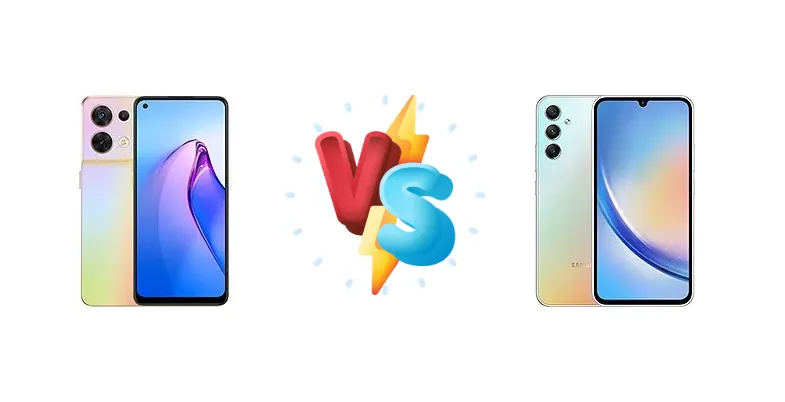
|
🏆 Quick Verdict
The Samsung Galaxy A34 takes the crown thanks to its significantly better battery life, brighter display, and faster software updates. While the Reno8 boasts faster charging, the A34's overall package offers a more well-rounded and future-proof experience.
| PHONES | ||
|---|---|---|
| Phone Names | Oppo Reno8 | Samsung Galaxy A34 |
| Network | ||
|---|---|---|
| 2G bands | GSM 850 / 900 / 1800 / 1900 | GSM 850 / 900 / 1800 / 1900 |
| 3G bands | HSDPA 800 / 850 / 900 / 1700(AWS) / 1900 / 2100 | HSDPA 850 / 900 / 1700(AWS) / 1900 / 2100 |
| 4G bands | 1, 2, 3, 4, 5, 7, 8, 12, 17, 18, 19, 20, 26, 28, 38, 39, 40, 41 | 1, 2, 3, 4, 5, 7, 8, 12, 17, 20, 26, 28, 32, 38, 40, 41, 66 |
| 5G bands | 1, 3, 5, 7, 8, 20, 28, 38, 40, 41, 77, 78 SA/NSA | 1, 3, 7, 8, 20, 28, 38, 40, 41, 77, 78 SA/NSA/Sub6 |
| Speed | HSPA, LTE, 5G | HSPA, LTE, 5G |
| Technology | GSM / HSPA / LTE / 5G | GSM / HSPA / LTE / 5G |
| Launch | ||
|---|---|---|
| Announced | 2022, July 18 | 2023, March 14 |
| Status | Available. Released 2022, July 25 | Available. Released 2023, March 24 |
| Body | ||
|---|---|---|
| Build | Glass front (Gorilla Glass 5), plastic back, plastic frame | Glass front (Gorilla Glass 5), plastic frame, plastic back |
| Dimensions | 160.6 x 73.4 x 7.7 mm (6.32 x 2.89 x 0.30 in) | 161.3 x 78.1 x 8.2 mm (6.35 x 3.07 x 0.32 in) |
| SIM | Nano-SIM + Nano-SIM | · Nano-SIM· Nano-SIM + Nano-SIM |
| Weight | 179 g (6.31 oz) | 199 g (7.02 oz) |
| - | IP67 dust/water resistant (up to 1m for 30 min) | |
| Display | ||
|---|---|---|
| Protection | Corning Gorilla Glass 5 | Corning Gorilla Glass 5 |
| Resolution | 1080 x 2400 pixels, 20:9 ratio (~411 ppi density) | 1080 x 2340 pixels, 19.5:9 ratio (~390 ppi density) |
| Size | 6.4 inches, 98.9 cm2 (~83.9% screen-to-body ratio) | 6.6 inches, 106.9 cm2 (~84.9% screen-to-body ratio) |
| Type | AMOLED, 90Hz, 430 nits (typ), 600 nits (HBM), 800 nits (peak) | Super AMOLED, 120Hz, 1000 nits (HBM) |
| Platform | ||
|---|---|---|
| CPU | Octa-core (1x3.0 GHz Cortex-A78 & 3x2.6 GHz Cortex-A78 & 4x2.0 GHz Cortex-A55) | Octa-core (2x2.6 GHz Cortex-A78 & 6x2.0 GHz Cortex-A55) |
| Chipset | Mediatek Dimensity 1300 (6 nm) | Mediatek Dimensity 1080 (6 nm) |
| GPU | Mali-G77 MC9 | Mali-G68 MC4 |
| OS | Android 12, upgradable to Android 14, ColorOS 14 | Android 13, up to 4 major Android upgrades, One UI 6.1 |
| Memory | ||
|---|---|---|
| Card slot | No | microSDXC (uses shared SIM slot) |
| Internal | 128GB 8GB RAM, 256GB 8GB RAM, 256GB 12GB RAM | 128GB 4GB RAM, 128GB 6GB RAM, 128GB 8GB RAM, 256GB 6GB RAM, 256GB 8GB RAM |
| UFS 3.1 | - | |
| Main Camera | ||
|---|---|---|
| Features | Dual-LED flash, HDR, panorama | LED flash, panorama, HDR |
| Single | 32 MP, f/2.4, 23mm (wide), 1/2.74", 0.8µm | - |
| Triple | 50 MP, f/1.8, 23mm (wide), 1/1.56", 1.0µm, multi-directional PDAF 8 MP, f/2.2, 16mm, 112˚ (ultrawide), 1/4.0", 1.12µm 2 MP (macro) | 48 MP, f/1.8, 26mm (wide), 1/2.0", 0.8µm, PDAF, OIS 8 MP, f/2.2, 123˚, (ultrawide), 1/4.0", 1.12µm 5 MP (macro) |
| Video | 4K@30fps, 1080p@30/60/120fps, gyro-EIS | 4K@30fps, 1080p@30/60fps, 720p@480fps |
| Selfie camera | ||
|---|---|---|
| Features | Panorama, HDR | - |
| Single | 32 MP, f/2.4, 23mm (wide), 1/2.74", 0.8µm | 13 MP, f/2.2, 26mm (wide), 1/3.1", 1.12µm |
| Video | 1080p@30fps, gyro-EIS | 4K@30fps, 1080p@30fps |
| Sound | ||
|---|---|---|
| 3.5mm jack | No | No |
| 35mm jack | No | No |
| Loudspeaker | Yes | Yes, with stereo speakers |
| Comms | ||
|---|---|---|
| Bluetooth | 5.3, A2DP, LE, aptX HD | 5.3, A2DP, LE |
| NFC | Yes | Yes (market/region dependent) |
| Positioning | GPS, GLONASS, BDS, GALILEO, QZSS | GPS, GLONASS, GALILEO, BDS |
| Radio | No | No |
| USB | USB Type-C 2.0, OTG | USB Type-C 2.0, OTG |
| WLAN | Wi-Fi 802.11 a/b/g/n/ac/6, dual-band, Wi-Fi Direct | Wi-Fi 802.11 a/b/g/n/ac, dual-band, Wi-Fi Direct |
| Features | ||
|---|---|---|
| Sensors | Fingerprint (under display, optical), accelerometer, gyro, proximity, compass | Fingerprint (under display, optical), accelerometer, gyro, compass |
| - | Virtual proximity sensing | |
| Battery | ||
|---|---|---|
| Charging | 80W wired, 50% in 11 min, 100% in 28 min Reverse wired | 25W wired |
| Type | Li-Po 4500 mAh | Li-Ion 5000 mAh |
| Misc | ||
|---|---|---|
| Colors | Shimmer Gold, Shimmer Black | Lime, Graphite, Violet, Silver |
| Models | CPH2359 | SM-A346E, SM-A346B, SM-A346B/DS, SM-A346B/DSN, SM-A346E/DS, SM-A346E/DSN, SM-A346M, SM-A346M/N, SM-A346M/DSN, SM-A3460 |
| Price | £ 279.99 / € 158.14 / ₹ 24,999 | € 169.99 / $ 175.00 / £ 164.99 / ₹ 23,999 |
| SAR EU | - | 0.55 W/kg (head) 1.49 W/kg (body) |
| Tests | ||
|---|---|---|
| Battery life | Endurance rating 105h | Endurance rating 133h |
| Camera | Photo / Video | Photo / Video |
| Display | Contrast ratio: Infinite (nominal) | Contrast ratio: Infinite (nominal) |
| Loudspeaker | -28.7 LUFS (Average) | -26.1 LUFS (Good) |
| Performance | AnTuTu: 619610a (v9) GeekBench: 2694 (v5.1) GFXBench: 42fps (ES 3.1 onscreen) | AnTuTu: 472126 (v9) GeekBench: 2316 (v5.5), 2518 (v6) GFXBench: 23fps (ES 3.1 onscreen) |
Oppo Reno8
- Faster Charging (80W)
- Slightly better raw performance
- Potentially more premium design
- Shorter battery life
- Lower display brightness
- Potentially less versatile camera
Samsung Galaxy A34
- Excellent battery life
- Brighter display
- Samsung's software support and updates
- Likely 120Hz refresh rate
- Slower charging (25W)
- Slightly less powerful chipset
- One UI can feel cluttered to some
Display Comparison
The Samsung Galaxy A34's display is a clear winner. It boasts a measured peak brightness of 1009 nits, significantly higher than the Reno8's 633 nits. This translates to better visibility in direct sunlight. Both have 'infinite' contrast ratios (a nominal value), but the A34's brightness advantage makes a noticeable difference in everyday use. The A34 also likely features a smoother 120Hz refresh rate (common for A-series), while the Reno8's refresh rate is likely 60Hz or 90Hz.
Camera Comparison
Camera performance is subjective, but both phones offer capable camera systems. The Reno8 is known for its portrait capabilities and video stabilization. The Galaxy A34 likely has a more versatile camera setup, potentially including a higher-resolution main sensor and a wider ultrawide lens. Both phones likely offer decent low-light performance, but Samsung's image processing tends to be more consistent.
Performance
The Oppo Reno8's Mediatek Dimensity 1300 generally offers slightly better raw performance than the Galaxy A34's Dimensity 1080. However, the difference is unlikely to be significant for most users. Both phones handle everyday tasks and moderate gaming with ease. Samsung's One UI is generally well-optimized, but Oppo's ColorOS can sometimes feel a bit more cluttered. The Dimensity 1300 has a slightly more powerful CPU configuration.
Battery Life
The Samsung Galaxy A34 absolutely dominates in the battery department. Its endurance rating of 133h significantly surpasses the Reno8's 105h. This translates to noticeably longer battery life on a single charge. While the Reno8 charges faster (80W vs 25W), the A34's larger battery capacity means it will last much longer between charges.
Buying Guide
The Oppo Reno8 is ideal for users prioritizing fast charging and a slightly more premium design. The Samsung Galaxy A34 is a better choice for those who value long battery life, a vibrant display, and the reliability of Samsung's software support.