
Google Pixel 6a vs Oppo Reno8: A Detailed Comparison of Mid-Range Champions
| Phones Images | |||||
|---|---|---|---|---|---|
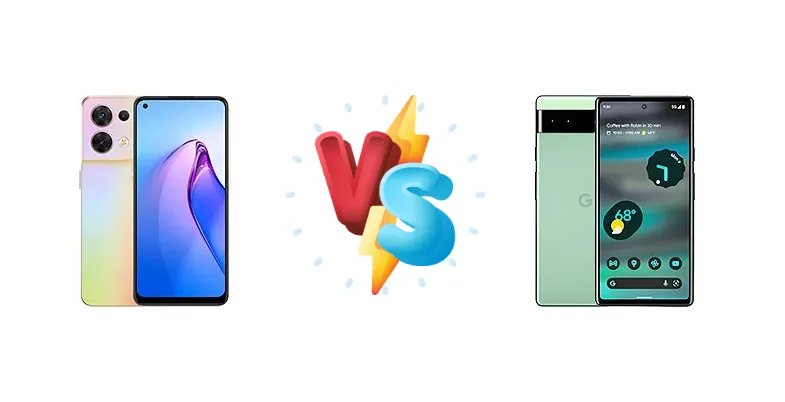
|
🏆 Quick Verdict
For the average user prioritizing camera quality and software experience, the Google Pixel 6a is the stronger choice. However, the Oppo Reno8’s significantly faster charging and brighter display make it ideal for users who demand convenience and media consumption on the go.
| PHONES | ||
|---|---|---|
| Phone Names | Oppo Reno8 | Google Pixel 6a |
| Network | ||
|---|---|---|
| 2G bands | GSM 850 / 900 / 1800 / 1900 | GSM 850 / 900 / 1800 / 1900 |
| 3G bands | HSDPA 800 / 850 / 900 / 1700(AWS) / 1900 / 2100 | HSDPA 800 / 850 / 900 / 1700(AWS) / 1900 / 2100 |
| 4G bands | 1, 2, 3, 4, 5, 7, 8, 12, 17, 18, 19, 20, 26, 28, 38, 39, 40, 41 | 1, 2, 3, 4, 5, 7, 8, 12, 13, 14, 17, 18, 19, 20, 25, 26, 28, 29, 30, 38, 39, 40, 41, 42, 48, 66, 71 - GX7AS, GB62Z (USA/Canada) |
| 5G bands | 1, 3, 5, 7, 8, 20, 28, 38, 40, 41, 77, 78 SA/NSA | 1, 2, 3, 5, 7, 8, 12, 20, 25, 28, 30, 38, 40, 41, 48, 66, 71, 77, 78 SA/NSA/Sub6 - GX7AS (USA/Canada) |
| Speed | HSPA, LTE, 5G | HSPA, LTE, 5G |
| Technology | GSM / HSPA / LTE / 5G | GSM / HSPA / LTE / 5G |
| - | 1, 2, 3, 5, 7, 8, 12, 20, 25, 28, 30, 40, 48, 66, 71, 77, 78 SA/NSA/Sub6 - G1AZG (International) | |
| Launch | ||
|---|---|---|
| Announced | 2022, July 18 | 2022, May 11 |
| Status | Available. Released 2022, July 25 | Available. Released 2022, July 21 |
| Body | ||
|---|---|---|
| Build | Glass front (Gorilla Glass 5), plastic back, plastic frame | Glass front (Gorilla Glass 3), aluminum frame, plastic back |
| Dimensions | 160.6 x 73.4 x 7.7 mm (6.32 x 2.89 x 0.30 in) | 152.2 x 71.8 x 8.9 mm (5.99 x 2.83 x 0.35 in) |
| SIM | Nano-SIM + Nano-SIM | Nano-SIM + eSIM |
| Weight | 179 g (6.31 oz) | 178 g (6.28 oz) |
| - | IP67 dust/water resistant (up to 1m for 30 min) | |
| Display | ||
|---|---|---|
| Protection | Corning Gorilla Glass 5 | Corning Gorilla Glass 3 |
| Resolution | 1080 x 2400 pixels, 20:9 ratio (~411 ppi density) | 1080 x 2400 pixels, 20:9 ratio (~429 ppi density) |
| Size | 6.4 inches, 98.9 cm2 (~83.9% screen-to-body ratio) | 6.1 inches, 90.7 cm2 (~83.0% screen-to-body ratio) |
| Type | AMOLED, 90Hz, 430 nits (typ), 600 nits (HBM), 800 nits (peak) | OLED, HDR |
| - | Always-on display | |
| Platform | ||
|---|---|---|
| CPU | Octa-core (1x3.0 GHz Cortex-A78 & 3x2.6 GHz Cortex-A78 & 4x2.0 GHz Cortex-A55) | Octa-core (2x2.80 GHz Cortex-X1 & 2x2.25 GHz Cortex-A76 & 4x1.80 GHz Cortex-A55) |
| Chipset | Mediatek Dimensity 1300 (6 nm) | Google Tensor (5 nm) |
| GPU | Mali-G77 MC9 | Mali-G78 MP20 |
| OS | Android 12, upgradable to Android 14, ColorOS 14 | Android 12, upgradable to Android 15, up to 5 major Android upgrades |
| Memory | ||
|---|---|---|
| Card slot | No | No |
| Internal | 128GB 8GB RAM, 256GB 8GB RAM, 256GB 12GB RAM | 128GB 6GB RAM |
| UFS 3.1 | UFS 3.1 | |
| Main Camera | ||
|---|---|---|
| Dual | - | 12.2 MP, f/1.7, 27mm, (wide), 1/2.55", 1.4µm, dual pixel PDAF, OIS 12 MP, f/2.2, 17mm, 114˚ (ultrawide), 1.25µm |
| Features | Dual-LED flash, HDR, panorama | Dual-LED flash, Pixel Shift, Auto-HDR, panorama |
| Single | 32 MP, f/2.4, 23mm (wide), 1/2.74", 0.8µm | 8 MP, f/2.0, 24mm (wide), 1.12µm |
| Triple | 50 MP, f/1.8, 23mm (wide), 1/1.56", 1.0µm, multi-directional PDAF 8 MP, f/2.2, 16mm, 112˚ (ultrawide), 1/4.0", 1.12µm 2 MP (macro) | - |
| Video | 4K@30fps, 1080p@30/60/120fps, gyro-EIS | 4K@30/60fps, 1080p@30/60/120/240fps; gyro-EIS, OIS |
| Selfie camera | ||
|---|---|---|
| Features | Panorama, HDR | HDR, panorama |
| Single | 32 MP, f/2.4, 23mm (wide), 1/2.74", 0.8µm | 8 MP, f/2.0, 24mm (wide), 1.12µm |
| Video | 1080p@30fps, gyro-EIS | 1080p@30fps |
| Sound | ||
|---|---|---|
| 3.5mm jack | No | No |
| 35mm jack | No | No |
| Loudspeaker | Yes | Yes, with stereo speakers |
| Comms | ||
|---|---|---|
| Bluetooth | 5.3, A2DP, LE, aptX HD | 5.2, A2DP, LE |
| NFC | Yes | Yes |
| Positioning | GPS, GLONASS, BDS, GALILEO, QZSS | GPS, GLONASS, GALILEO, QZSS |
| Radio | No | No |
| USB | USB Type-C 2.0, OTG | USB Type-C 3.1 |
| WLAN | Wi-Fi 802.11 a/b/g/n/ac/6, dual-band, Wi-Fi Direct | Wi-Fi 802.11 a/b/g/n/ac/6e, dual-band, Wi-Fi Direct |
| Features | ||
|---|---|---|
| Sensors | Fingerprint (under display, optical), accelerometer, gyro, proximity, compass | Fingerprint (under display, optical), accelerometer, gyro, proximity, compass, barometer |
| Battery | ||
|---|---|---|
| Charging | 80W wired, 50% in 11 min, 100% in 28 min Reverse wired | 18W wired, PD3.0 |
| Type | Li-Po 4500 mAh | Li-Po 4410 mAh |
| Misc | ||
|---|---|---|
| Colors | Shimmer Gold, Shimmer Black | Chalk, Charcoal, Sage |
| Models | CPH2359 | GX7AS, GB62Z, G1AZG, GB17L |
| Price | £ 279.99 / € 158.14 / ₹ 24,999 | $ 138.99 / C$ 228.74 / ₹ 23,999 |
| Tests | ||
|---|---|---|
| Battery life | Endurance rating 105h | Endurance rating 94h |
| Camera | Photo / Video | - |
| Display | Contrast ratio: Infinite (nominal) | Contrast ratio: Infinite (nominal) |
| Loudspeaker | -28.7 LUFS (Average) | - |
| Performance | AnTuTu: 619610a (v9) GeekBench: 2694 (v5.1) GFXBench: 42fps (ES 3.1 onscreen) | - |
Oppo Reno8
- Superior camera image processing
- Clean and timely software updates
- Brighter display for outdoor use
- Significantly slower charging speed
- Less powerful chipset for demanding tasks
Google Pixel 6a
- Blazing-fast 80W charging
- Powerful Mediatek Dimensity 1300 processor
- Reverse wired charging capability
- Dimmer display compared to the Pixel 6a
- Less refined software experience
Display Comparison
The Pixel 6a boasts a significantly brighter display, reaching 876 nits compared to the Reno8’s 633 nits. This translates to superior outdoor visibility, a crucial advantage for users frequently exposed to sunlight. Both displays share an infinite (nominal) contrast ratio, but the Reno8’s lower peak brightness may result in washed-out colors in bright environments. While neither phone specifies refresh rate, the Pixel 6a’s OLED panel is likely to offer better color accuracy and viewing angles, though this is not explicitly stated in the provided data.
Camera Comparison
Both devices are listed as having photo and video capabilities, but the provided data lacks specifics. However, Google’s Pixel line is renowned for its computational photography prowess, leveraging the Tensor chip to deliver exceptional image quality, particularly in challenging lighting conditions. While the Reno8 likely offers a capable camera system, it’s unlikely to match the Pixel 6a’s software-driven enhancements. Without sensor size or aperture information, it’s difficult to make a definitive judgment, but Google’s image processing algorithms are a significant advantage.
Performance
The core difference lies in the chipsets: the Google Pixel 6a utilizes Google’s in-house Tensor chip (5nm), while the Oppo Reno8 features the Mediatek Dimensity 1300 (6nm). The Tensor chip, with its Cortex-X1 prime core clocked at 2.80 GHz, is designed for AI and machine learning tasks, enhancing features like voice recognition and image processing. The Dimensity 1300, with its Cortex-A78 cores, focuses on raw processing power. The 6nm process of the Dimensity 1300 *should* offer better efficiency than the 5nm Tensor, but the Tensor’s architecture is optimized for Google’s software. Both phones feature an octa-core CPU, but the Tensor’s core configuration suggests a stronger focus on peak performance, while the Dimensity 1300 aims for sustained performance across all cores.
Battery Life
The Oppo Reno8’s 80W wired charging is a game-changer, achieving 50% charge in just 11 minutes and a full charge in 28 minutes. This drastically reduces downtime compared to the Pixel 6a’s 18W charging, which utilizes the PD3.0 standard. While the Reno8 has a slightly lower endurance rating (105h vs 94h), the significantly faster charging mitigates the impact of a potentially smaller battery capacity. The Reno8 also offers reverse wired charging, a feature absent on the Pixel 6a, adding to its convenience.
Buying Guide
Buy the Oppo Reno8 if you need incredibly fast charging – topping up from zero to full in under 30 minutes – and a display that remains easily visible in bright sunlight. Buy the Google Pixel 6a if you prioritize a clean software experience, exceptional image processing, and long-term software support directly from Google, even if it means slower charging and a less vibrant screen.