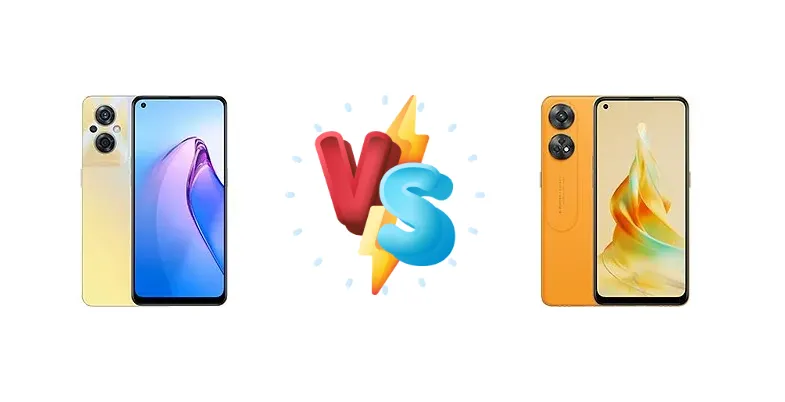
The Oppo Reno series consistently delivers stylish phones with impressive features. The Reno8 Z and Reno8 T are two compelling options, but which one reigns supreme? This comprehensive comparison will break down their key differences to help you make an informed decision.
🏆 Quick Verdict
The Oppo Reno8 T edges out the Reno8 Z thanks to its faster charging and generally stronger performance from the Helio G99 chipset. However, the Reno8 Z's Snapdragon 695 offers better 5G connectivity and potentially better efficiency. It's a close call, depending on your priorities.
| Network |
|---|
| 2G bands | GSM 850 / 900 / 1800 / 1900 | GSM 850 / 900 / 1800 / 1900 |
| 3G bands | HSDPA 800 / 850 / 900 / 1700(AWS) / 1800 / 1900 / 2100 | HSDPA 850 / 900 / 2100 |
| 4G bands | 1, 2, 3, 4, 5, 7, 8, 12, 17, 18, 19, 20, 26, 28, 38, 39, 40, 41, 66 | 1, 3, 5, 7, 8, 20, 28, 38, 40, 41 |
| 5G bands | 1, 3, 5, 7, 8, 20, 28, 38, 40, 41, 77, 78 SA/NSA | - |
| Speed | HSPA, LTE, 5G | HSPA, LTE |
| Technology | GSM / HSPA / LTE / 5G | GSM / HSPA / LTE |
| Launch |
|---|
| Announced | 2022, August 04 | 2023, February 02 |
| Status | Available. Released 2022, August 04 | Available. Released 2023, February 02 |
| Body |
|---|
| Build | Glass front, plastic frame, glass back | Glass front (Gorilla Glass 5), glass back or eco leather back, plastic frame |
| Dimensions | 159.9 x 73.2 x 7.7 mm (6.30 x 2.88 x 0.30 in) | 160.8 x 73.8 x 7.8 mm (6.33 x 2.91 x 0.31 in) |
| SIM | Nano-SIM + Nano-SIM | Nano-SIM + Nano-SIM |
| Weight | 181 g (6.38 oz) | 180 g or 183 g (6.35 oz) |
| | RGB ring lights around the cameras (notifications, charging progress) | - |
| Display |
|---|
| Protection | Schott Xensation Up | Corning Gorilla Glass 5 |
| Resolution | 1080 x 2400 pixels, 20:9 ratio (~409 ppi density) | 1080 x 2400 pixels, 20:9 ratio (~409 ppi density) |
| Size | 6.43 inches, 99.8 cm2 (~85.3% screen-to-body ratio) | 6.43 inches, 99.8 cm2 (~84.1% screen-to-body ratio) |
| Type | AMOLED, 430 nits (typ), 600 nits (HBM) | AMOLED, 90Hz, 430 nits (typ), 800 nits (peak) |
| Platform |
|---|
| CPU | Octa-core (2x2.2 GHz Kryo 660 Gold & 6x1.7 GHz Kryo 660 Silver) | Octa-core (2x2.2 GHz Cortex-A76 & 6x2.0 GHz Cortex-A55) |
| Chipset | Qualcomm SM6375 Snapdragon 695 5G (6 nm) | Mediatek Helio G99 (6 nm) |
| GPU | Adreno 619 | Mali-G57 MC2 |
| OS | Android 12, ColorOS 12.1 | Android 13, upgradable to Android 14, ColorOS 14 |
| Memory |
|---|
| Card slot | microSDXC | microSDXC |
| Internal | 128GB 8GB RAM, 256GB 8GB RAM | 128GB 8GB RAM, 256GB 8GB RAM |
| | UFS 2.2 | UFS 2.2 |
| Main Camera |
|---|
| Dual | - | 100 MP, f/1.7, 26mm (wide), AF
2 MP, f/3.3, 34mm (microscope)
Auxiliary lens |
| Features | LED flash, HDR, panorama | LED flash, HDR, panorama |
| Single | 16 MP, f/2.4, 27mm (wide), 1.0µm | 32 MP, f/2.4, 22mm (wide) |
| Triple | 64 MP, f/1.7, 26mm (wide), PDAF
2 MP (macro)
Auxiliary lens | - |
| Video | 1080p@30fps, 720p@30/120fps, EIS | 1080p@30fps |
| Selfie camera |
|---|
| Features | HDR, panorama | HDR, panorama |
| Single | 16 MP, f/2.4, 27mm (wide), 1.0µm | 32 MP, f/2.4, 22mm (wide) |
| Video | 1080p@30fps | 1080p@30fps |
| Sound |
|---|
| 3.5mm jack | Yes | Yes |
| 35mm jack | Yes | Yes |
| Loudspeaker | Yes | Yes, with stereo speakers |
| Comms |
|---|
| Bluetooth | 5.1, A2DP, LE, aptX HD | 5.3, A2DP, LE, aptX HD |
| NFC | Yes | Yes |
| Positioning | GPS, GLONASS, BDS, GALILEO, QZSS | GPS, GALILEO, GLONASS, BDS, QZSS |
| Radio | Unspecified | No |
| USB | USB Type-C 2.0, OTG | USB Type-C 2.0, OTG |
| WLAN | Wi-Fi 802.11 a/b/g/n/ac, dual-band, Wi-Fi Direct | Wi-Fi 802.11 a/b/g/n/ac, dual-band |
| Features |
|---|
| Sensors | Fingerprint (under display, optical), accelerometer, proximity, gyro, compass | Fingerprint (under display, optical), accelerometer, gyro, proximity, compass |
| Battery |
|---|
| Charging | 33W wired, PD, 31% in 15 min, 100% in 63 min
Reverse wired | 33W wired, PD, 54% in 30 min
Reverse wired |
| Type | Li-Po 4500 mAh | Li-Po 5000 mAh |
| Misc |
|---|
| Colors | Starlight Black, Dawnlight Gold | Black Starlight, Orange Sunset |
| Models | - | CPH2481 |
| Price | About 350 EUR | About 490 EUR |
Oppo Reno8 Z
- Efficient 5G modem
- Sleek design
- Reverse wired charging
- Slower charging
- Less powerful processor compared to Reno8 T
Oppo Reno8 T
- Faster charging
- More powerful processor (Helio G99)
- Potentially better camera ISP
- Potentially less efficient 5G modem
- Design may be less premium than Reno8 Z
Display Comparison
Both phones likely feature similar OLED displays, probably around 6.4-6.5 inches with a 90Hz refresh rate. Expect vibrant colors and good viewing angles. The Reno8 T might have slightly better brightness due to potential panel variations, but this is difficult to confirm without specific testing data.
Camera Comparison
Both phones likely feature a 50MP main camera, but image processing and additional lenses (ultrawide, macro) can differ. The Reno8 T might offer slightly improved image quality due to its potentially more advanced image signal processor (ISP). Expect both to capture decent photos in good lighting conditions.
Performance
The Reno8 T's MediaTek Helio G99 generally outperforms the Snapdragon 695 in raw processing power, particularly in gaming scenarios. The G99's Cortex-A76 cores provide a noticeable boost. However, the Snapdragon 695 is known for its efficient 5G modem and potentially better thermal management.
Battery Life
The Reno8 T boasts significantly faster charging (54% in 30 minutes vs. 31% in 15 minutes), making it a clear winner in this category. Battery capacity is likely similar (around 4500mAh), so the faster charging makes a big difference in real-world usage.
Buying Guide
The Oppo Reno8 Z is ideal for users prioritizing reliable 5G connectivity and a slightly more efficient processor. The Oppo Reno8 T is a better choice for those who value faster charging speeds and a more powerful processor for gaming and demanding tasks.
Frequently Asked Questions
❓ Which phone is better for gaming?
The Oppo Reno8 T is generally better for gaming due to its more powerful Helio G99 chipset.
❓ Does the Reno8 Z have 5G?
Yes, both the Reno8 Z and Reno8 T support 5G connectivity.
❓ How long does it take to fully charge each phone?
The Reno8 Z takes approximately 63 minutes to fully charge, while the Reno8 T takes less time due to its faster charging capabilities.