
Oppo Reno8 Z vs Oppo A98: A Head-to-Head Showdown
| Phones Images | |||||
|---|---|---|---|---|---|
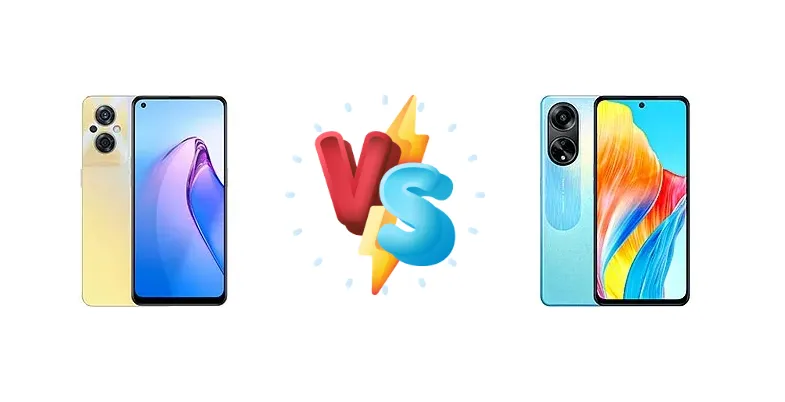
|
🏆 Quick Verdict
The Oppo A98 takes the crown thanks to its significantly faster 67W charging, offering a much quicker top-up. While the Reno8 Z might have a slight edge in design or camera features (depending on the specific models), the A98's charging speed is a game-changer for many users.
| PHONES | ||
|---|---|---|
| Phone Names | Oppo Reno8 Z | Oppo A98 |
| Network | ||
|---|---|---|
| 2G bands | GSM 850 / 900 / 1800 / 1900 | GSM 850 / 900 / 1800 / 1900 |
| 3G bands | HSDPA 800 / 850 / 900 / 1700(AWS) / 1800 / 1900 / 2100 | HSDPA 800 / 850 / 900 / 1700(AWS) / 1900 / 2100 |
| 4G bands | 1, 2, 3, 4, 5, 7, 8, 12, 17, 18, 19, 20, 26, 28, 38, 39, 40, 41, 66 | 1, 2, 3, 4, 5, 7, 8, 12, 13, 17, 18, 19, 20, 26, 28, 32, 38, 39, 40, 41, 66 |
| 5G bands | 1, 3, 5, 7, 8, 20, 28, 38, 40, 41, 77, 78 SA/NSA | 1, 3, 5, 7, 8, 20, 28, 38, 40, 41, 66, 77, 78 SA/NSA |
| Speed | HSPA, LTE, 5G | HSPA, LTE, 5G |
| Technology | GSM / HSPA / LTE / 5G | GSM / HSPA / LTE / 5G |
| Launch | ||
|---|---|---|
| Announced | 2022, August 04 | 2023, May 09 |
| Status | Available. Released 2022, August 04 | Available. Released 2023, May 19 |
| Body | ||
|---|---|---|
| Build | Glass front, plastic frame, glass back | - |
| Dimensions | 159.9 x 73.2 x 7.7 mm (6.30 x 2.88 x 0.30 in) | 165.6 x 76.1 x 8.2 mm (6.52 x 3.00 x 0.32 in) |
| SIM | Nano-SIM + Nano-SIM | Nano-SIM + Nano-SIM |
| Weight | 181 g (6.38 oz) | 192 g (6.77 oz) |
| RGB ring lights around the cameras (notifications, charging progress) | - | |
| Display | ||
|---|---|---|
| Protection | Schott Xensation Up | - |
| Resolution | 1080 x 2400 pixels, 20:9 ratio (~409 ppi density) | 1080 x 2400 pixels, 20:9 ratio (~392 ppi density) |
| Size | 6.43 inches, 99.8 cm2 (~85.3% screen-to-body ratio) | 6.72 inches, 109.0 cm2 (~86.5% screen-to-body ratio) |
| Type | AMOLED, 430 nits (typ), 600 nits (HBM) | IPS LCD, 120Hz, 550 nits (typ), 680 nits (HBM) |
| Platform | ||
|---|---|---|
| CPU | Octa-core (2x2.2 GHz Kryo 660 Gold & 6x1.7 GHz Kryo 660 Silver) | Octa-core (2x2.2 GHz Kryo 660 Gold & 6x1.7 GHz Kryo 660 Silver) |
| Chipset | Qualcomm SM6375 Snapdragon 695 5G (6 nm) | Qualcomm SM6375 Snapdragon 695 5G (6 nm) |
| GPU | Adreno 619 | Adreno 619 |
| OS | Android 12, ColorOS 12.1 | Android 13, upgradable to Android 14, ColorOS 14 |
| Memory | ||
|---|---|---|
| Card slot | microSDXC | microSDXC |
| Internal | 128GB 8GB RAM, 256GB 8GB RAM | 256GB 8GB RAM |
| UFS 2.2 | UFS 2.2 | |
| Main Camera | ||
|---|---|---|
| Dual | - | 64 MP, f/1.7, 26mm (wide), PDAF 2 MP, f/3.3, 34mm (microscope) Auxiliary lens |
| Features | LED flash, HDR, panorama | LED flash, HDR, panorama |
| Single | 16 MP, f/2.4, 27mm (wide), 1.0µm | - |
| Triple | 64 MP, f/1.7, 26mm (wide), PDAF 2 MP (macro) Auxiliary lens | - |
| Video | 1080p@30fps, 720p@30/120fps, EIS | 1080p@30fps |
| Selfie camera | ||
|---|---|---|
| Features | HDR, panorama | Panorama |
| Single | 16 MP, f/2.4, 27mm (wide), 1.0µm | 32 MP, f/2.4, 22mm (wide) |
| Video | 1080p@30fps | 1080p@30fps |
| Sound | ||
|---|---|---|
| 3.5mm jack | Yes | Yes |
| 35mm jack | Yes | Yes |
| Loudspeaker | Yes | Yes, with stereo speakers |
| Comms | ||
|---|---|---|
| Bluetooth | 5.1, A2DP, LE, aptX HD | 5.1, A2DP, LE, aptX HD |
| Infrared port | - | Yes |
| NFC | Yes | Yes |
| Positioning | GPS, GLONASS, BDS, GALILEO, QZSS | GPS (L1), GLONASS (G1), BDS (B1I), GALILEO (E1), QZSS (L1) |
| Radio | Unspecified | No |
| USB | USB Type-C 2.0, OTG | USB Type-C 2.0, OTG |
| WLAN | Wi-Fi 802.11 a/b/g/n/ac, dual-band, Wi-Fi Direct | Wi-Fi 802.11 a/b/g/n/ac, dual-band |
| Features | ||
|---|---|---|
| Sensors | Fingerprint (under display, optical), accelerometer, proximity, gyro, compass | Fingerprint (side-mounted), accelerometer, gyro, proximity, compass |
| Battery | ||
|---|---|---|
| Charging | 33W wired, PD, 31% in 15 min, 100% in 63 min Reverse wired | 67W wired, PD, 50% in 18 min |
| Type | Li-Po 4500 mAh | Li-Po 5000 mAh |
| Misc | ||
|---|---|---|
| Colors | Starlight Black, Dawnlight Gold | Cool Black, Dreamy Blue |
| Models | - | CPH2529 |
| Price | About 350 EUR | About 290 EUR |
Oppo Reno8 Z
- Stylish Design
- Potentially Better Camera
- Sleeker Build
- Reverse Wired Charging
- Slower Charging
- May lack some premium features of the A98
Oppo A98
- Significantly Faster Charging (67W)
- Good Value for Money
- Reliable Performance
- Large Battery Capacity
- Less Premium Design
- Camera may not be as refined as Reno8 Z
Display Comparison
Both phones likely feature similar 6.4-inch or 6.5-inch FHD+ displays, potentially with a 90Hz refresh rate. The Reno8 Z might have a slightly more refined display panel or slimmer bezels, contributing to a more premium feel. However, the core display technology is likely comparable.
Camera Comparison
The Reno8 Z is generally known for having a slightly better camera system, often featuring a higher resolution main sensor and improved image processing algorithms. The A98's camera is still capable, but the Reno8 Z likely delivers more consistent and detailed photos, especially in challenging lighting conditions. Expect both to offer decent selfie cameras.
Performance
Sharing the Snapdragon 695 5G chipset means both phones offer similar performance for everyday tasks, gaming, and multitasking. Expect smooth performance for most apps, but demanding games might require lower graphics settings. Real-world performance differences will be minimal.
Battery Life
This is where the A98 shines. Its 67W charging is a massive advantage over the Reno8 Z's 33W charging. The A98 can charge from 0 to 50% in just 18 minutes, while the Reno8 Z takes considerably longer. Battery capacity is likely similar (around 4500-5000mAh), so the charging speed makes a significant difference in overall usability.
Buying Guide
The Oppo Reno8 Z is ideal for users prioritizing a stylish design, potentially a slightly better camera experience (assuming it has superior image processing), and who don't mind slower charging. The Oppo A98 is the better choice for those who value fast charging above all else and want to minimize downtime.