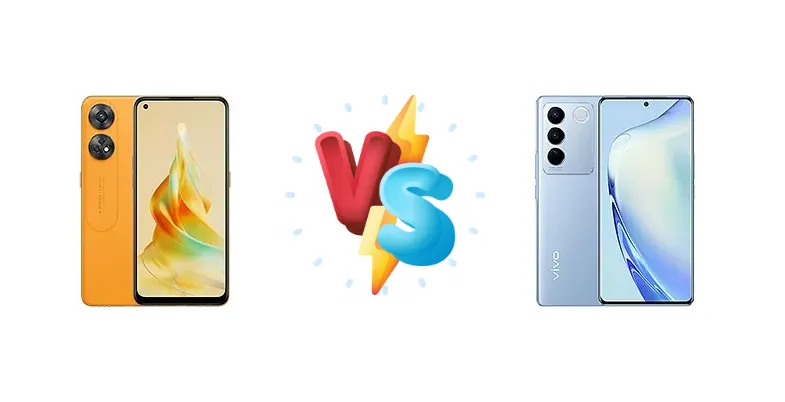
The mid-range smartphone market is fiercely competitive, and the Oppo Reno8 T and vivo V27 are two strong contenders vying for your attention. Both offer appealing features and designs, but which one truly delivers the best overall experience? Let's dive into a comprehensive comparison to help you decide.
🏆 Quick Verdict
The vivo V27 edges out the Oppo Reno8 T thanks to its significantly faster chipset (Dimensity 7200 vs Helio G99), brighter display, and faster charging. While the Reno8 T is a solid choice, the V27’s performance and display make it the more compelling option for most users.
| Network |
|---|
| 2G bands | GSM 850 / 900 / 1800 / 1900 | GSM 850 / 900 / 1800 / 1900 |
| 3G bands | HSDPA 850 / 900 / 2100 | HSDPA 850 / 900 / 1700(AWS) / 1900 / 2100 - International |
| 4G bands | 1, 3, 5, 7, 8, 20, 28, 38, 40, 41 | 1, 2, 3, 4, 5, 7, 8, 18, 19, 20, 26, 28, 38, 39, 40, 41 - International |
| 5G bands | - | 1, 3, 5, 7, 8, 20, 28, 38, 40, 41, 77, 78 SA/NSA - International |
| Speed | HSPA, LTE | HSPA, LTE, 5G |
| Technology | GSM / HSPA / LTE | GSM / HSPA / LTE / 5G |
| | - | 1, 3, 5, 8, 28, 78 SA/NSA - Asia |
| Launch |
|---|
| Announced | 2023, February 02 | 2023, March 01 |
| Status | Available. Released 2023, February 02 | Available. Released 2023, March 01 |
| Body |
|---|
| Build | Glass front (Gorilla Glass 5), glass back or eco leather back, plastic frame | Glass front, glass back |
| Dimensions | 160.8 x 73.8 x 7.8 mm (6.33 x 2.91 x 0.31 in) | 164.1 x 74.8 x 7.4 mm (6.46 x 2.94 x 0.29 in) |
| SIM | Nano-SIM + Nano-SIM | Nano-SIM + Nano-SIM |
| Weight | 180 g or 183 g (6.35 oz) | 180 g (6.35 oz) |
| | - | Color changing back panel color |
| Display |
|---|
| Protection | Corning Gorilla Glass 5 | - |
| Resolution | 1080 x 2400 pixels, 20:9 ratio (~409 ppi density) | 1080 x 2400 pixels, 20:9 ratio (~388 ppi density) |
| Size | 6.43 inches, 99.8 cm2 (~84.1% screen-to-body ratio) | 6.78 inches, 111.0 cm2 (~90.4% screen-to-body ratio) |
| Type | AMOLED, 90Hz, 430 nits (typ), 800 nits (peak) | AMOLED, 1B colors, 120Hz, HDR10+ |
| Platform |
|---|
| CPU | Octa-core (2x2.2 GHz Cortex-A76 & 6x2.0 GHz Cortex-A55) | Octa-core (2x2.8 GHz Cortex-A715 & 6x Cortex-A510) |
| Chipset | Mediatek Helio G99 (6 nm) | Mediatek Dimensity 7200 (4 nm) |
| GPU | Mali-G57 MC2 | Mali-G610 MC4 |
| OS | Android 13, upgradable to Android 14, ColorOS 14 | Android 13, Funtouch 13 |
| Memory |
|---|
| Card slot | microSDXC | No |
| Internal | 128GB 8GB RAM, 256GB 8GB RAM | 128GB 8GB RAM, 256GB 8GB RAM, 256GB 12GB RAM |
| | UFS 2.2 | - |
| Main Camera |
|---|
| Dual | 100 MP, f/1.7, 26mm (wide), AF
2 MP, f/3.3, 34mm (microscope)
Auxiliary lens | - |
| Features | LED flash, HDR, panorama | Ring-LED flash, panorama, HDR |
| Single | 32 MP, f/2.4, 22mm (wide) | 50 MP, f/2.5, (wide), AF |
| Triple | - | 50 MP, f/1.9, (wide), 1/1.56", 1.0µm, PDAF, OIS
8 MP, f/2.2, 16mm, 120˚ (ultrawide), 1/4.0", 1.12µm
2 MP (macro) |
| Video | 1080p@30fps | 4K@30/60fps, 1080p@30fps, gyro-EIS |
| Selfie camera |
|---|
| Features | HDR, panorama | Dual-LED flash, HDR |
| Single | 32 MP, f/2.4, 22mm (wide) | 50 MP, f/2.5, (wide), AF |
| Video | 1080p@30fps | 4K@30/60fps, 1080p@30fps, gyro-EIS |
| Sound |
|---|
| 3.5mm jack | Yes | No |
| 35mm jack | Yes | No |
| Loudspeaker | Yes, with stereo speakers | Yes |
| | - | 24-bit/192kHz audio |
| Comms |
|---|
| Bluetooth | 5.3, A2DP, LE, aptX HD | 5.3, A2DP, LE |
| NFC | Yes | Yes |
| Positioning | GPS, GALILEO, GLONASS, BDS, QZSS | GPS, GLONASS, GALILEO, BDS, QZSS, NavIC |
| Radio | No | No |
| USB | USB Type-C 2.0, OTG | USB Type-C 2.0, OTG |
| WLAN | Wi-Fi 802.11 a/b/g/n/ac, dual-band | Wi-Fi 802.11 a/b/g/n/ac, dual-band, Wi-Fi Direct |
| Features |
|---|
| Sensors | Fingerprint (under display, optical), accelerometer, gyro, proximity, compass | Fingerprint (under display, optical), accelerometer, gyro, proximity, compass |
| Battery |
|---|
| Charging | 33W wired, PD, 54% in 30 min
Reverse wired | 66W wired, 50% in 19 min |
| Type | Li-Po 5000 mAh | 4600 mAh |
| Misc |
|---|
| Colors | Black Starlight, Orange Sunset | Magic Blue, Noble Black, Emerald Green, Flowing Gold |
| Models | CPH2481 | V2231, V2246 |
| Price | About 490 EUR | About 380 EUR |
| Tests |
|---|
| Battery life | - |
Endurance rating 134h
|
| Camera | - |
Photo / Video |
| Display | - |
Contrast ratio: Infinite (nominal) |
| Loudspeaker | - |
-28.2 LUFS (Average)
|
| Performance | - |
AnTuTu: 613641 (v9)
GeekBench: 2400 (v5.1), 2689 (v6)
GFXBench: 34fps (ES 3.1 onscreen) |
Oppo Reno8 T
- Stylish Design
- Decent Camera
- Reliable Battery Life
- Reverse Wired Charging
- Less Powerful Chipset
- Lower Display Brightness
- Slower Charging
vivo V27
- Powerful Chipset (Dimensity 7200)
- Bright and Vibrant Display
- Fast Charging (66W)
- Excellent Battery Life
- Potentially Higher Price
- Design may not appeal to everyone
Display Comparison
The vivo V27 boasts a significant advantage with its measured 1055 nits peak brightness, offering exceptional visibility even in direct sunlight. Its 'infinite' contrast ratio (though nominal) suggests excellent image quality. The Reno8 T's display is adequate but lacks the vibrancy and brightness of the V27. Expect better color accuracy and overall visual appeal on the vivo V27.
Camera Comparison
Both phones offer capable camera systems, but detailed camera comparisons require more in-depth testing. However, the vivo V27's likely superior image processing capabilities, thanks to its more powerful chipset, suggest it may produce slightly better photos and videos, especially in challenging lighting conditions. Both likely offer good selfie cameras.
Performance
Here, the vivo V27 shines. The Dimensity 7200 chipset (4nm) is considerably more powerful than the Reno8 T's Helio G99 (6nm). Expect smoother multitasking, faster app loading times, and better gaming performance on the V27. The Cortex-A715 cores in the V27's CPU are also a significant upgrade over the Reno8 T's Cortex-A76 cores.
Battery Life
Both phones offer excellent battery life, with the vivo V27 claiming an endurance rating of 134 hours. The vivo V27 also has a faster charging speed (66W vs 33W), allowing it to reach 50% charge in just 19 minutes, significantly faster than the Reno8 T's 30 minutes.
Buying Guide
Who should buy the Oppo Reno8 T? Users prioritizing a budget-friendly option with decent performance and a reliable camera. Who should buy the vivo V27? Those seeking a smoother, faster experience, a vibrant display, and quicker charging speeds, even at a slightly higher price point.
Frequently Asked Questions
❓ Which phone is better for gaming?
The vivo V27 is significantly better for gaming due to its more powerful Dimensity 7200 chipset.
❓ Does the Oppo Reno8 T have 5G?
Yes, both the Oppo Reno8 T and vivo V27 support 5G connectivity.