
Oppo Reno8 T vs. Nothing Phone (2): A Detailed Comparison of Performance, Battery, and Value
| Phones Images | |||||
|---|---|---|---|---|---|
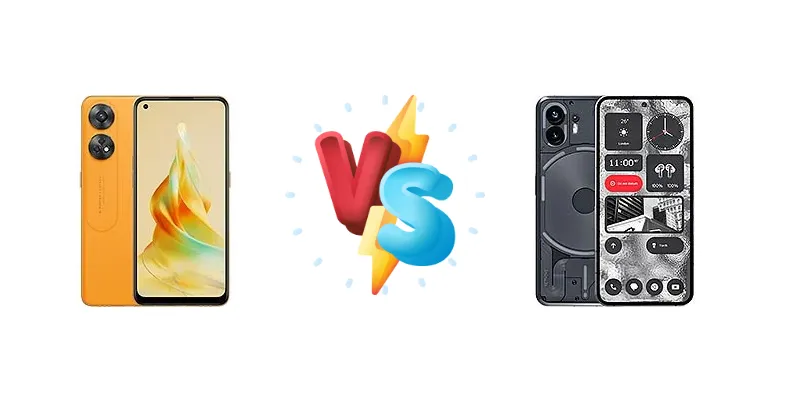
|
🏆 Quick Verdict
For the average user prioritizing raw performance and a distinctive experience, the Nothing Phone (2) is the clear winner. Its Snapdragon 8+ Gen 1 chipset and superior battery endurance justify the higher price. However, the Oppo Reno8 T provides exceptional value for gamers and those seeking a capable daily driver without breaking the bank.
| PHONES | ||
|---|---|---|
| Phone Names | Oppo Reno8 T | Nothing Phone (2) |
| Network | ||
|---|---|---|
| 2G bands | GSM 850 / 900 / 1800 / 1900 | GSM 850 / 900 / 1800 / 1900 |
| 3G bands | HSDPA 850 / 900 / 2100 | HSDPA 800 / 850 / 900 / 1700(AWS) / 1900 / 2100 |
| 4G bands | 1, 3, 5, 7, 8, 20, 28, 38, 40, 41 | 1, 2, 3, 4, 5, 7, 8, 12, 17, 18, 19, 20, 25, 26, 28, 30, 32, 34, 38, 39, 40, 41, 42, 48, 66, 71 |
| 5G bands | - | 1, 2, 3, 5, 7, 8, 12, 20, 25, 28, 30, 38, 40, 41, 66, 71, 75, 77, 78 SA/NSA |
| Speed | HSPA, LTE | HSPA, LTE, 5G |
| Technology | GSM / HSPA / LTE | GSM / HSPA / LTE / 5G |
| Launch | ||
|---|---|---|
| Announced | 2023, February 02 | 2023, July 11 |
| Status | Available. Released 2023, February 02 | Available. Released 2023, July 17 |
| Body | ||
|---|---|---|
| Build | Glass front (Gorilla Glass 5), glass back or eco leather back, plastic frame | Glass front (Gorilla Glass 5), glass back (Gorilla Glass 5), aluminum frame |
| Dimensions | 160.8 x 73.8 x 7.8 mm (6.33 x 2.91 x 0.31 in) | 162.1 x 76.4 x 8.6 mm (6.38 x 3.01 x 0.34 in) |
| SIM | Nano-SIM + Nano-SIM | Nano-SIM + Nano-SIM |
| Weight | 180 g or 183 g (6.35 oz) | 201.2 g (7.09 oz) |
| Display | ||
|---|---|---|
| Protection | Corning Gorilla Glass 5 | Corning Gorilla Glass 5 |
| Resolution | 1080 x 2400 pixels, 20:9 ratio (~409 ppi density) | 1080 x 2412 pixels, 20:9 ratio (~394 ppi density) |
| Size | 6.43 inches, 99.8 cm2 (~84.1% screen-to-body ratio) | 6.7 inches, 108.0 cm2 (~87.2% screen-to-body ratio) |
| Type | AMOLED, 90Hz, 430 nits (typ), 800 nits (peak) | LTPO OLED, 1B colors, 120Hz, 1920Hz PWM, HDR10+, 1600 nits (HBM), 1600 nits (peak) |
| Platform | ||
|---|---|---|
| CPU | Octa-core (2x2.2 GHz Cortex-A76 & 6x2.0 GHz Cortex-A55) | Octa-core (1x3.0 GHz Cortex-X2 & 3x2.5 GHz Cortex-A710 & 4x1.80 GHz Cortex-A510) |
| Chipset | Mediatek Helio G99 (6 nm) | Qualcomm SM8475 Snapdragon 8+ Gen 1 (4 nm) |
| GPU | Mali-G57 MC2 | Adreno 730 |
| OS | Android 13, upgradable to Android 14, ColorOS 14 | Android 13, upgradable to Android 15, up to 3 major Android upgrades, Nothing OS 3.0 |
| Memory | ||
|---|---|---|
| Card slot | microSDXC | No |
| Internal | 128GB 8GB RAM, 256GB 8GB RAM | 128GB 8GB RAM, 256GB 12GB RAM, 512GB 12GB RAM |
| UFS 2.2 | - | |
| Main Camera | ||
|---|---|---|
| Dual | 100 MP, f/1.7, 26mm (wide), AF 2 MP, f/3.3, 34mm (microscope) Auxiliary lens | 50 MP, f/1.9, 24mm (wide), 1/1.56", 1.0µm, PDAF, OIS 50 MP, f/2.2, 114˚ (ultrawide), 1/2.76", 0.64µm, AF |
| Features | LED flash, HDR, panorama | LED flash, panorama, HDR |
| Single | 32 MP, f/2.4, 22mm (wide) | - |
| Video | 1080p@30fps | 4K@30/60fps, 1080p@30/60fps, gyro-EIS, live HDR, OIS |
| Selfie camera | ||
|---|---|---|
| Features | HDR, panorama | HDR |
| Single | 32 MP, f/2.4, 22mm (wide) | 32 MP, f/2.5, (wide), 1/2.74", 0.8µm |
| Video | 1080p@30fps | 1080p@30fps |
| Sound | ||
|---|---|---|
| 3.5mm jack | Yes | - |
| 35mm jack | Yes | No |
| Loudspeaker | Yes, with stereo speakers | Yes, with stereo speakers |
| Comms | ||
|---|---|---|
| Bluetooth | 5.3, A2DP, LE, aptX HD | 5.3, A2DP, LE, aptX HD, aptX Adaptive |
| NFC | Yes | Yes |
| Positioning | GPS, GALILEO, GLONASS, BDS, QZSS | GPS (L1+L5), GLONASS (L1), BDS (B1I+B1c), GALILEO (E1), QZSS (L1), NavIC |
| Radio | No | No |
| USB | USB Type-C 2.0, OTG | USB Type-C 2.0, OTG |
| WLAN | Wi-Fi 802.11 a/b/g/n/ac, dual-band | Wi-Fi 802.11 a/b/g/n/ac/6, dual-band, Wi-Fi Direct |
| Features | ||
|---|---|---|
| Sensors | Fingerprint (under display, optical), accelerometer, gyro, proximity, compass | Fingerprint (under display, optical), accelerometer, proximity, gyro, compass |
| Battery | ||
|---|---|---|
| Charging | 33W wired, PD, 54% in 30 min Reverse wired | 45W wired, PD3.0, PPS, QC4, 100% in 55 min 15W wireless, 100% in 130 min 5W reverse wireless |
| Type | Li-Po 5000 mAh | Li-Ion 4700 mAh |
| Misc | ||
|---|---|---|
| Colors | Black Starlight, Orange Sunset | White, Dark Gray |
| Models | CPH2481 | A065 |
| Price | About 490 EUR | $ 379.99 / £ 370.00 |
Oppo Reno8 T
- Excellent value for money
- Efficient Helio G99 chipset for gaming
- Reverse wired charging
- Less powerful processor than the Phone (2)
- Lacks wireless charging
Nothing Phone (2)
- Flagship Snapdragon 8+ Gen 1 performance
- Exceptional battery life
- Fast wired and wireless charging
- Higher price point
- Glyph interface may not appeal to everyone
Display Comparison
The Nothing Phone (2) boasts a significantly brighter display, reaching a measured peak of 998 nits, compared to an unspecified brightness for the Reno8 T. This translates to better visibility under direct sunlight. While panel technology isn't specified for the Reno8 T, the Phone (2)'s likely OLED panel offers superior contrast. The Nothing Phone (2)'s display is also likely to have a higher refresh rate, contributing to smoother scrolling and animations, though this isn't explicitly stated in the provided data.
Camera Comparison
The provided data lacks detailed camera specifications for both devices. However, given the Nothing Phone (2)'s positioning, it's reasonable to expect a more sophisticated camera system with larger sensors and advanced image processing. The Reno8 T likely focuses on providing a competent camera experience for social media and casual photography. Without sensor size or aperture information, it's difficult to make a definitive judgment, but the Phone (2)'s flagship status suggests a superior photographic experience.
Performance
The core difference lies in the chipsets. The Nothing Phone (2)'s Snapdragon 8+ Gen 1 (4nm) is a substantial leap ahead of the Oppo Reno8 T's MediaTek Helio G99 (6nm). The Snapdragon 8+ Gen 1 features a Cortex-X2 prime core clocked at 3.0 GHz, alongside Cortex-A710 and A510 cores, offering significantly higher single-core and multi-core performance. The Helio G99, while efficient, relies on older Cortex-A76 and A55 cores. The 4nm process node of the Snapdragon 8+ Gen 1 also provides better thermal efficiency, reducing throttling during prolonged gaming sessions. The Reno8 T will be adequate for everyday tasks and less demanding games, but the Phone (2) is built for power users.
Battery Life
The Nothing Phone (2) excels in battery endurance, achieving an active use score of 14:21 hours and an endurance rating of 103 hours. While the Reno8 T's battery capacity is unknown, the Phone (2)'s larger battery and more efficient chipset contribute to its impressive longevity. Charging speeds differ significantly: the Phone (2) supports 45W wired charging (100% in 55 minutes), 15W wireless charging (100% in 130 minutes), and 5W reverse wireless charging. The Reno8 T offers 33W wired charging (54% in 30 minutes) and reverse wired charging, but lacks wireless charging capabilities. The Phone (2) provides more versatile and faster charging options.
Buying Guide
Buy the Oppo Reno8 T if you need a solid gaming experience on a budget, prioritizing sustained performance over absolute peak power, and appreciate a more conventional smartphone design. Buy the Nothing Phone (2) if you prefer a premium build, a unique aesthetic with the Glyph interface, and demand flagship-tier performance for demanding tasks like video editing or intensive gaming, and value longer battery life.