
Google Pixel 7a vs Oppo Reno8 T: A Detailed Comparison of Mid-Range Champions
| Phones Images | |||||
|---|---|---|---|---|---|
|
🏆 Quick Verdict
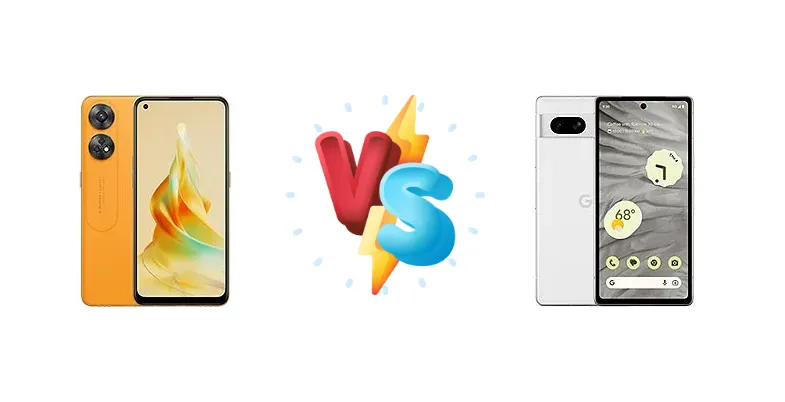
For most users, the Google Pixel 7a emerges as the stronger choice. Its superior camera system, powered by the Tensor G2, delivers consistently excellent photos and videos. While the Reno8 T offers faster charging and a slightly more efficient processor, the Pixel 7a’s overall experience and software support are more compelling.
| PHONES | ||
|---|---|---|
| Phone Names | Oppo Reno8 T | Google Pixel 7a |
| Network | ||
|---|---|---|
| 2G bands | GSM 850 / 900 / 1800 / 1900 | GSM 850 / 900 / 1800 / 1900 |
| 3G bands | HSDPA 850 / 900 / 2100 | HSDPA 800 / 850 / 900 / 1700(AWS) / 1900 / 2100 |
| 4G bands | 1, 3, 5, 7, 8, 20, 28, 38, 40, 41 | 1, 2, 3, 4, 5, 7, 8, 12, 13, 14, 17, 20, 25, 26, 28, 29, 30, 38, 40, 41, 48, 66, 71 - GWKK3, G0DZQ |
| 5G bands | - | 1, 2, 3, 5, 7, 8, 12, 14, 20, 25, 28, 30, 38, 41, 48, 66, 71, 77, 78 SA/NSA/Sub6 - GWKK3 |
| Speed | HSPA, LTE | HSPA, LTE, 5G |
| Technology | GSM / HSPA / LTE | GSM / HSPA / LTE / 5G |
| - | 1, 2, 3, 5, 7, 8, 12, 20, 25, 28, 38, 40, 41, 66, 75, 76, 77, 78, 79 SA/NSA/Sub6 - GHL1X, G82U8 | |
| Launch | ||
|---|---|---|
| Announced | 2023, February 02 | 2023, May 10 |
| Status | Available. Released 2023, February 02 | Available. Released 2023, May 10 |
| Body | ||
|---|---|---|
| Build | Glass front (Gorilla Glass 5), glass back or eco leather back, plastic frame | Glass front (Gorilla Glass 3), aluminum frame, plastic back |
| Dimensions | 160.8 x 73.8 x 7.8 mm (6.33 x 2.91 x 0.31 in) | 152 x 72.9 x 9 mm (5.98 x 2.87 x 0.35 in) |
| SIM | Nano-SIM + Nano-SIM | Nano-SIM + eSIM |
| Weight | 180 g or 183 g (6.35 oz) | 193.5 g (6.84 oz) |
| - | IP67 dust/water resistant (up to 1m for 30 min) | |
| Display | ||
|---|---|---|
| Protection | Corning Gorilla Glass 5 | Corning Gorilla Glass 3 |
| Resolution | 1080 x 2400 pixels, 20:9 ratio (~409 ppi density) | 1080 x 2400 pixels, 20:9 ratio (~429 ppi density) |
| Size | 6.43 inches, 99.8 cm2 (~84.1% screen-to-body ratio) | 6.1 inches, 90.7 cm2 (~81.8% screen-to-body ratio) |
| Type | AMOLED, 90Hz, 430 nits (typ), 800 nits (peak) | OLED, HDR, 90Hz |
| - | Always-on display | |
| Platform | ||
|---|---|---|
| CPU | Octa-core (2x2.2 GHz Cortex-A76 & 6x2.0 GHz Cortex-A55) | Octa-core (2x2.85 GHz Cortex-X1 & 2x2.35 GHz Cortex-A78 & 4x1.80 GHz Cortex-A55) |
| Chipset | Mediatek Helio G99 (6 nm) | Google Tensor G2 (5 nm) |
| GPU | Mali-G57 MC2 | Mali-G710 MP7 |
| OS | Android 13, upgradable to Android 14, ColorOS 14 | Android 13, upgradable to Android 15, up to 5 major Android upgrades |
| Memory | ||
|---|---|---|
| Card slot | microSDXC | No |
| Internal | 128GB 8GB RAM, 256GB 8GB RAM | 128GB 8GB RAM |
| UFS 2.2 | UFS 3.1 | |
| Main Camera | ||
|---|---|---|
| Dual | 100 MP, f/1.7, 26mm (wide), AF 2 MP, f/3.3, 34mm (microscope) Auxiliary lens | 64 MP, f/1.9, 26mm (wide), 1/1.73", 0.8µm, dual pixel PDAF, OIS 13 MP, f/2.2, 120˚ (ultrawide), 1.12µm |
| Features | LED flash, HDR, panorama | Dual-LED flash, Pixel Shift, Auto-HDR, panorama |
| Single | 32 MP, f/2.4, 22mm (wide) | - |
| Video | 1080p@30fps | 4K@30/60fps, 1080p@30/60/120/240fps, OIS |
| Selfie camera | ||
|---|---|---|
| Features | HDR, panorama | HDR, panorama |
| Single | 32 MP, f/2.4, 22mm (wide) | 13 MP, f/2.2, 20mm (ultrawide), 1.12µm |
| Video | 1080p@30fps | 4K@30fps, 1080p@30fps |
| Sound | ||
|---|---|---|
| 3.5mm jack | Yes | No |
| 35mm jack | Yes | No |
| Loudspeaker | Yes, with stereo speakers | Yes, with stereo speakers |
| Comms | ||
|---|---|---|
| Bluetooth | 5.3, A2DP, LE, aptX HD | 5.3, A2DP, LE |
| NFC | Yes | Yes |
| Positioning | GPS, GALILEO, GLONASS, BDS, QZSS | GPS, GLONASS, GALILEO, BDS, QZSS, NavIC |
| Radio | No | No |
| USB | USB Type-C 2.0, OTG | USB Type-C 3.2 |
| WLAN | Wi-Fi 802.11 a/b/g/n/ac, dual-band | Wi-Fi 802.11 a/b/g/n/ac/6e, tri-band |
| Features | ||
|---|---|---|
| Sensors | Fingerprint (under display, optical), accelerometer, gyro, proximity, compass | Fingerprint (under display, optical), accelerometer, gyro, proximity, compass, barometer |
| Battery | ||
|---|---|---|
| Charging | 33W wired, PD, 54% in 30 min Reverse wired | 18W wired, PD3.0 7.5W wireless |
| Type | Li-Po 5000 mAh | Li-Po 4385 mAh |
| Misc | ||
|---|---|---|
| Colors | Black Starlight, Orange Sunset | Charcoal, Snow, Sea, Coral |
| Models | CPH2481 | GWKK3, GHL1X, G0DZQ, G82U8 |
| Price | About 490 EUR | € 179.90 / $ 150.00 / £ 170.00 / ₹ 25,980 |
Oppo Reno8 T
- Superior camera performance with Google’s computational photography
- Powerful Google Tensor G2 processor for smooth performance
- Guaranteed software updates and long-term support
- Bright and vibrant display
- Slower charging speeds (18W)
- No expandable storage
Google Pixel 7a
- Faster 33W wired charging
- Efficient MediaTek Helio G99 processor
- Reverse wired charging for accessories
- Potentially more affordable price
- Less powerful processor compared to Tensor G2
- Camera performance likely inferior to Pixel 7a
Display Comparison
The Pixel 7a boasts a peak brightness of 1070 nits, measured, offering excellent visibility even in direct sunlight. While the Reno8 T’s display specifications aren’t provided, Oppo typically utilizes AMOLED panels in this segment, likely offering vibrant colors. However, the Pixel 7a’s higher peak brightness provides a tangible advantage in outdoor use. The Pixel 7a’s 90Hz refresh rate (implied by its segment) also contributes to smoother scrolling and animations compared to the Reno8 T, which is likely capped at 60Hz. The absence of LTPO technology on either device means refresh rate adjustment isn’t as dynamic as on flagship models, but the Pixel 7a’s higher peak brightness is a key differentiator.
Camera Comparison
The Pixel 7a’s camera system is its standout feature. While specific sensor details aren’t provided, Google’s computational photography prowess, powered by the Tensor G2’s image signal processor (ISP), consistently delivers exceptional image quality. The Reno8 T’s camera specifications are not detailed enough to make a direct comparison, but Oppo often focuses on high megapixel counts without necessarily prioritizing sensor size or image processing. The Pixel 7a’s video capabilities are also likely superior, benefiting from the Tensor G2’s advanced video processing algorithms. The Reno8 T may offer more camera modes and features, but the Pixel 7a’s consistent image quality and software optimizations are more valuable.
Performance
The core difference lies in the chipsets. The Google Pixel 7a’s Tensor G2, built on a 5nm process, significantly outperforms the Oppo Reno8 T’s MediaTek Helio G99 (6nm). The Tensor G2’s CPU configuration – 2x2.85 GHz Cortex-X1 & 2x2.35 GHz Cortex-A78 & 4x1.80 GHz Cortex-A55 – provides a substantial performance boost over the Reno8 T’s 2x2.2 GHz Cortex-A76 & 6x2.0 GHz Cortex-A55. This translates to faster app loading times, smoother multitasking, and improved performance in demanding applications. While the Helio G99 is efficient, the Tensor G2’s architectural advantages and dedicated AI processing capabilities give the Pixel 7a a clear edge. The Pixel 7a also benefits from potentially faster RAM (likely LPDDR5x) compared to the Reno8 T, further enhancing performance.
Battery Life
The Pixel 7a has an endurance rating of 76 hours, suggesting good battery life despite its 18W charging. The Reno8 T, with its 33W wired charging, offers significantly faster charging speeds – reaching 54% in 30 minutes. However, the Reno8 T’s battery capacity isn’t specified, so it’s difficult to assess its overall endurance. The Pixel 7a’s slower charging is offset by its efficient processor and software optimizations. The Reno8 T’s reverse wired charging is a useful feature for topping up accessories, which the Pixel 7a lacks. Ultimately, the Reno8 T wins on charging speed, but the Pixel 7a’s endurance rating suggests comparable real-world battery life.
Buying Guide
Buy the Oppo Reno8 T if you prioritize fast charging and efficient everyday performance, and frequently engage in tasks that don't heavily tax the CPU. It's ideal for users who value a responsive experience for social media, browsing, and light gaming. Buy the Google Pixel 7a if you are a photography enthusiast, value a clean and consistently updated Android experience, and want a phone that excels in image processing and computational photography. It’s the better choice for those who prioritize camera quality and long-term software support.