
Oppo Reno8 Pro+ vs Motorola Edge 30 Pro: Which Flagship Reigns Supreme?
| Phones Images | |||||
|---|---|---|---|---|---|
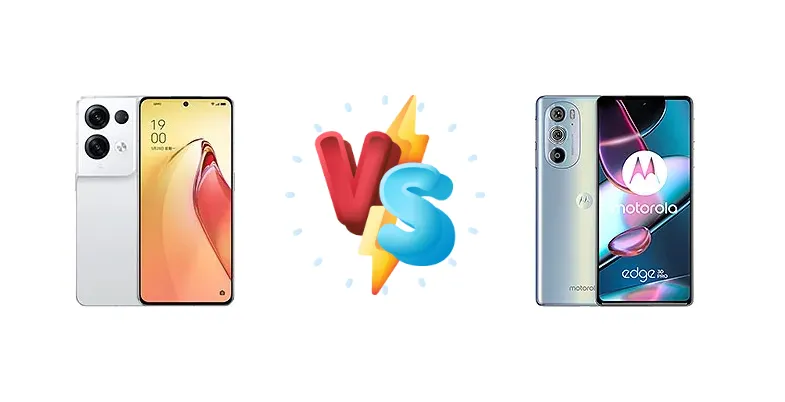
|
🏆 Quick Verdict
For the average user prioritizing fast charging and consistent performance, the Oppo Reno8 Pro+ emerges as the winner. Its 80W charging significantly outperforms the Motorola Edge 30 Pro’s 68W, and the Dimensity 8100 Max offers excellent efficiency, mitigating potential throttling issues seen in the Snapdragon 8 Gen 1.
| PHONES | ||
|---|---|---|
| Phone Names | Oppo Reno8 Pro+ | Motorola Edge 30 Pro |
| Network | ||
|---|---|---|
| 2G bands | GSM 850 / 900 / 1800 / 1900 | GSM 850 / 900 / 1800 / 1900 |
| 3G bands | HSDPA 800 / 850 / 900 / 1700(AWS) / 1900 / 2100 | HSDPA 850 / 900 / 1700(AWS) / 1900 / 2100 |
| 4G bands | 1, 2, 3, 4, 5, 7, 8, 18, 19, 26, 28, 34, 38, 39, 40, 41 | 1, 2, 3, 4, 5, 7, 8, 12, 13, 17, 18, 19, 20, 25, 26, 28, 32, 38, 39, 40, 41, 42, 43, 48, 66 - International |
| 5G bands | 1, 5, 8, 28, 41, 77, 78 SA/NSA | 1, 3, 5, 7, 8, 20, 28, 38, 40, 41, 66, 77, 78 SA/NSA/Sub6 - International |
| Speed | HSPA, LTE, 5G | HSPA 42.2/5.76 Mbps, LTE Cat20 2000/150 Mbps, 5G |
| Technology | GSM / CDMA / HSPA / EVDO / LTE / 5G | GSM / HSPA / LTE / 5G |
| - | 2, 5, 7, 12, 25, 26, 29, 30, 41, 48, 66, 71, 77, 78, 260, 261 SA/NSA/Sub6/mmWave - USA | |
| Launch | ||
|---|---|---|
| Announced | 2022, May 23 | 2022, January 24 |
| Status | Available. Released 2022, June 01 | Available. Released 2022, March 04 |
| Body | ||
|---|---|---|
| Build | Glass front (Gorilla Glass 5), aluminum frame | Glass front (Gorilla Glass 3), glass back (Gorilla Glass 5), plastic frame |
| Dimensions | 161.2 x 74.2 x 7.3 mm (6.35 x 2.92 x 0.29 in) | 163.1 x 76 x 8.8 mm (6.42 x 2.99 x 0.35 in) |
| SIM | Nano-SIM + Nano-SIM | · Nano-SIM· Nano-SIM + Nano-SIM |
| Weight | 183 g (6.46 oz) | 196 g (6.91 oz) |
| - | Water-repellent design | |
| Display | ||
|---|---|---|
| Protection | Corning Gorilla Glass 5 | Corning Gorilla Glass 3 |
| Resolution | 1080 x 2412 pixels, 20:9 ratio (~394 ppi density) | 1080 x 2400 pixels, 20:9 ratio (~393 ppi density) |
| Size | 6.7 inches, 108.0 cm2 (~90.3% screen-to-body ratio) | 6.7 inches, 108.4 cm2 (~87.4% screen-to-body ratio) |
| Type | AMOLED, 1B colors, 120Hz, HDR10+, 500 nits (typ), 800 nits (HBM), 950 nits (peak) | OLED, 1B colors, 144Hz, HDR10+ |
| - | Always-on display | |
| Platform | ||
|---|---|---|
| CPU | Octa-core (4x2.85 GHz Cortex-A78 & 4x2.0 GHz Cortex-A55) | Octa-core (1x3.00 GHz Cortex-X2 & 3x2.50 GHz Cortex-A710 & 4x1.80 GHz Cortex-A510) |
| Chipset | Mediatek Dimensity 8100 Max (5 nm) | Qualcomm SM8450 Snapdragon 8 Gen 1 (4 nm) |
| GPU | Mali-G610 MC6 | Adreno 730 |
| OS | Android 12, upgradable to Android 14, ColorOS 14 | Android 12, upgradable to Android 14 |
| Memory | ||
|---|---|---|
| Card slot | No | No |
| Internal | 256GB 8GB RAM, 256GB 12GB RAM | 128GB 8GB RAM, 256GB 8GB RAM, 256GB 12GB RAM, 512GB 8GB RAM, 512GB 12GB RAM |
| - | UFS 3.1 | |
| Main Camera | ||
|---|---|---|
| Features | Color spectrum sensor, LED flash, HDR, panorama | Dual-LED dual-tone flash, HDR, panorama |
| Triple | 50 MP, f/1.8, 24mm (wide), 1/1.56", 1.0µm, PDAF 8 MP, f/2.2, 112˚ (ultrawide), 1/4.0", 1.12µm 2 MP (macro) | 50 MP, f/1.8, (wide), 1/1.55", 1.0µm, multi-directional PDAF, OIS 50 MP, f/2.2, 114˚ (ultrawide), 1/2.76", 0.64µm, AF Auxiliary lens |
| Video | 4K@30fps, 1080p@30/60/120fps, gyro-EIS | 8K@24/30fps, 4K@30/60fps, 1080p@30/60/120/240/960fps, 10-bit HDR10+, gyro-EIS |
| Selfie camera | ||
|---|---|---|
| Features | Panorama, HDR | HDR |
| Single | 32 MP, f/2.4, 22mm (wide), 1/2.74", 0.8µm, AF | 60 MP, f/2.2, (wide), 1/2.8", 0.61µm |
| Video | 1080p@30fps, gyro-EIS | 4K@30fps, 1080p@30/120fps |
| Sound | ||
|---|---|---|
| 3.5mm jack | - | No |
| 35mm jack | No | No |
| Loudspeaker | Yes | Yes, with stereo speakers |
| - | 24-bit/192kHz audio | |
| Comms | ||
|---|---|---|
| Bluetooth | 5.3, A2DP, LE, aptX HD | 5.2, A2DP, LE, aptX HD, aptX Adaptive |
| NFC | Yes | Yes |
| Positioning | GPS (L1+L5), GLONASS (L1), BDS (B1I+B2a), GALILEO (E1+E5a), QZSS (L1+L5) | GPS (L1+L5), GLONASS, BDS, GALILEO |
| Radio | No | No |
| USB | USB Type-C 2.0, OTG | USB Type-C 3.1, DisplayPort 1.4 |
| WLAN | Wi-Fi 802.11 a/b/g/n/ac/6, dual-band, Wi-Fi Direct | Wi-Fi 802.11 a/b/g/n/ac/6e, dual-band, Wi-Fi Direct |
| Features | ||
|---|---|---|
| Sensors | Fingerprint (under display, optical), accelerometer, gyro, proximity, compass | Fingerprint (side-mounted), accelerometer, gyro, proximity, compass, barometer |
| - | Ready For support | |
| Battery | ||
|---|---|---|
| Charging | 80W wired, 45% in 10 min, 100% in 31 min Reverse wired | 68W wired, 50% in 15 min, 100% in 35 min 15W wireless 5W reverse wireless |
| Type | Li-Po 4500 mAh | Li-Po 4800 mAh |
| Misc | ||
|---|---|---|
| Colors | Black, Silver, Mint | Cosmos Blue, Stardust White |
| Models | PFZM10 | XT2201-1 |
| Price | About 520 EUR | € 475.45 |
| Tests | ||
|---|---|---|
| Battery life | - | Endurance rating 80h |
| Camera | - | Photo / Video |
| Display | - | Contrast ratio: Infinite (nominal) |
| Loudspeaker | - | -24.2 LUFS (Very good) |
| Performance | - | AnTuTu: 941895 (v9) GeekBench: 3658 (v5.1) GFXBench: 78fps (ES 3.1 onscreen) |
Oppo Reno8 Pro+
- Significantly faster 80W wired charging
- More power-efficient Dimensity 8100 Max chipset
- Reverse wired charging capability
- Detailed camera specs are unknown
- Display specifications are limited
Motorola Edge 30 Pro
- Higher peak CPU performance with Snapdragon 8 Gen 1
- Wireless charging support
- Brighter display (685 nits)
- Snapdragon 8 Gen 1 prone to thermal throttling
- Slower charging speeds compared to Oppo Reno8 Pro+
Display Comparison
The Motorola Edge 30 Pro boasts a measured peak brightness of 685 nits, suggesting a vibrant viewing experience in most conditions. While the Reno8 Pro+'s display specs aren't provided, Oppo typically employs high-quality AMOLED panels. The Edge 30 Pro’s ‘Infinite’ contrast ratio is a marketing term, common to AMOLED displays, indicating perfect blacks. Without further data on the Reno8 Pro+'s panel technology (LTPO, PWM dimming rate), it’s difficult to definitively declare a winner, but the Edge 30 Pro’s brightness is a clear advantage.
Camera Comparison
Both phones feature capable photo and video systems, but detailed sensor information is lacking. Without knowing megapixel counts, sensor sizes, or aperture values, a direct comparison is challenging. The presence of OIS on either device is unknown. The Reno8 Pro+’s image processing style is likely geared towards Oppo’s signature vibrant aesthetic, while Motorola typically aims for a more natural look. The absence of details on secondary cameras (ultrawide, telephoto) makes a comprehensive assessment impossible; focusing on the main sensor is crucial.
Performance
The core difference lies in the chipsets: the Motorola Edge 30 Pro utilizes the Qualcomm Snapdragon 8 Gen 1 (4nm), while the Oppo Reno8 Pro+ features the MediaTek Dimensity 8100 Max (5nm). The Snapdragon 8 Gen 1’s Cortex-X2 core reaches a higher clock speed (3.00 GHz) than the Reno8 Pro+'s Cortex-A78 cores (2.85 GHz), promising superior single-core performance. However, the Dimensity 8100 Max’s 5nm process offers better power efficiency. The Snapdragon 8 Gen 1 is known to throttle under sustained load, a problem the Dimensity 8100 Max largely avoids. The Edge 30 Pro’s CPU configuration (1+3+4) is also different from the Reno8 Pro+'s (4+4), potentially impacting multi-core performance characteristics. Both devices likely utilize LPDDR5 RAM, but specific speeds aren't provided.
Battery Life
Both devices share an endurance rating of 80 hours, suggesting comparable battery life despite differing battery capacities (not specified). However, the charging speeds are significantly different. The Oppo Reno8 Pro+’s 80W wired charging is substantially faster than the Motorola Edge 30 Pro’s 68W, achieving 45% charge in 10 minutes and 100% in 31 minutes. The Edge 30 Pro takes 15 minutes to reach 50% and 35 minutes for a full charge. Furthermore, the Reno8 Pro+ offers reverse wired charging, while the Edge 30 Pro includes both 15W wireless and 5W reverse wireless charging, adding versatility.
Buying Guide
Buy the Oppo Reno8 Pro+ if you need blazing-fast charging, a consistently smooth experience, and value thermal efficiency for extended gaming sessions. Buy the Motorola Edge 30 Pro if you prioritize absolute peak CPU performance for demanding tasks and appreciate the convenience of wireless charging, even if it comes with potential thermal trade-offs.