
Oppo Reno8 Pro+ vs Xiaomi 12 Pro (Dimensity): A Deep Dive into Mediatek Flagships
| Phones Images | |||||
|---|---|---|---|---|---|
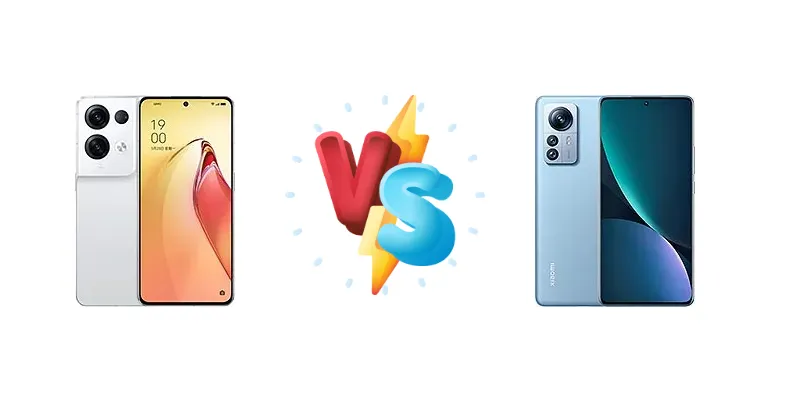
|
🏆 Quick Verdict
For the average user prioritizing all-around performance and incredibly fast charging, the Oppo Reno8 Pro+ emerges as the winner. Its 80W charging significantly reduces downtime, and the Dimensity 8100-Max provides more than enough power for demanding tasks, all while potentially offering better thermal management due to its 5nm process.
| PHONES | ||
|---|---|---|
| Phone Names | Oppo Reno8 Pro+ | Xiaomi 12 Pro (Dimensity) |
| Network | ||
|---|---|---|
| 2G bands | GSM 850 / 900 / 1800 / 1900 - SIM 1 & SIM 2 | GSM 850 / 900 / 1800 / 1900 |
| 3G bands | HSDPA 800 / 850 / 900 / 1700(AWS) / 1900 / 2100 | HSDPA 800 / 850 / 900 / 1700(AWS) / 1900 / 2100 |
| 4G bands | 1, 2, 3, 4, 5, 7, 8, 18, 19, 26, 28, 34, 38, 39, 40, 41 | 1, 2, 3, 4, 5, 7, 8, 18, 19, 26, 34, 38, 39, 40, 41, 42 |
| 5G bands | 1, 5, 8, 28, 41, 77, 78 SA/NSA | 1, 3, 5, 8, 28, 38, 40, 41, 77, 78 SA/NSA |
| Speed | HSPA, LTE-A (CA), 5G | HSPA, LTE, 5G |
| Technology | GSM / CDMA / HSPA / EVDO / LTE / 5G | GSM / CDMA / HSPA / EVDO / LTE / 5G |
| CDMA2000 1xEV-DO | CDMA2000 1xEV-DO | |
| Launch | ||
|---|---|---|
| Announced | 2022, May 23 | 2022, July 04 |
| Status | Available. Released 2022, June 01 | Available. Released 2022, July 13 |
| Body | ||
|---|---|---|
| Build | Glass front (Gorilla Glass 5), aluminum frame | - |
| Dimensions | 161.2 x 74.2 x 7.3 mm (6.35 x 2.92 x 0.29 in) | 163.6 x 74.6 x 8.2 mm (6.44 x 2.94 x 0.32 in) |
| SIM | Dual SIM (Nano-SIM, dual stand-by) | Nano-SIM + Nano-SIM |
| Weight | 183 g (6.46 oz) | 201 g (7.09 oz) |
| Display | ||
|---|---|---|
| Protection | Corning Gorilla Glass 5 | Corning Gorilla Glass Victus |
| Resolution | 1080 x 2412 pixels, 20:9 ratio (~394 ppi density) | 1440 x 3200 pixels, 20:9 ratio (~521 ppi density) |
| Size | 6.7 inches, 108.0 cm2 (~90.3% screen-to-body ratio) | 6.73 inches, 109.4 cm2 (~89.6% screen-to-body ratio) |
| Type | AMOLED, 1B colors, 120Hz, HDR10+, 500 nits (typ), 800 nits (HBM), 950 nits (peak) | LTPO2 AMOLED, 1B colors, 120Hz, Dolby Vision, HDR10+, 1000 nits (HBM), 1500 nits (peak) |
| Platform | ||
|---|---|---|
| CPU | Octa-core (4x2.85 GHz Cortex-A78 & 4x2.0 GHz Cortex-A55) | Octa-core (1x3.20 GHz Cortex-X2 & 3x2.85 GHz Cortex-A710 & 4x1.80 GHz Cortex-A510) |
| Chipset | Mediatek Dimensity 8100-Max (5 nm) | Mediatek Dimensity 9000+ (4 nm) |
| GPU | Mali-G610 MC6 | Mali-G710 MC10 |
| OS | Android 12, ColorOS 12.1 | Android 12, MIUI 13 |
| Memory | ||
|---|---|---|
| Card slot | No | No |
| Internal | 256GB 8GB RAM, 256GB 12GB RAM | 128GB 8GB RAM, 256GB 12GB RAM |
| UFS 3.1 | UFS 3.1 | |
| Main Camera | ||
|---|---|---|
| Features | LED flash, HDR, panorama | Color spectrum sensor, Dual-LED dual-tone flash, HDR, panorama |
| Single | 32 MP, f/2.4, 22mm (wide), 1/2.74", 0.8µm, AF | 32 MP, f/2.5, 26mm (wide), 0.7µm |
| Triple | 50 MP, f/1.8, 24mm (wide), 1/1.56", 1.0µm, PDAF 8 MP, f/2.2, 112˚ (ultrawide), 1/4.0", 1.12µm 2 MP, f/2.4, (macro) | 50 MP, f/1.9, 24mm (wide), 1/1.28", 1.22µm, dual pixel PDAF, OIS 13 MP, f/2.4, 15mm, 123˚ (ultrawide), 1/3.06", 1.12µm 5 MP, f/2.4, 50mm (telephoto macro), AF |
| Video | 4K@30fps, 1080p@30/60/120fps, gyro-EIS | 4K@30/60fps, 1080p@30/60/120fps, gyro-EIS |
| Selfie camera | ||
|---|---|---|
| Features | Panorama, HDR | HDR, panorama |
| Single | 32 MP, f/2.4, 22mm (wide), 1/2.74", 0.8µm, AF | 32 MP, f/2.5, 26mm (wide), 0.7µm |
| Video | 1080p@30fps, gyro-EIS | 1080p@30/60fps, 720p@120fps |
| Sound | ||
|---|---|---|
| 3.5mm jack | No | No |
| 35mm jack | - | No |
| Loudspeaker | Yes | Yes, with stereo speakers |
| - | 24-bit/192kHz audio Tuned by Harman Kardon | |
| Comms | ||
|---|---|---|
| Bluetooth | 5.3, A2DP, LE, aptX HD | 5.3, A2DP, LE |
| Infrared port | - | Yes |
| NFC | Yes | Yes |
| Positioning | GPS (L1+L5), GLONASS (L1), BDS (B1I+B2a), GALILEO (E1+E5a), QZSS (L1+L5) | GPS (L1+L5), GLONASS (L1), BDS (B1I+B1c+B2a), GALILEO (E1+E5a), QZSS (L1+L5), NavIC (L5) |
| Radio | No | No |
| USB | USB Type-C 2.0, OTG | USB Type-C 2.0, OTG |
| WLAN | Wi-Fi 802.11 a/b/g/n/ac/6, dual-band, Wi-Fi Direct | Wi-Fi 802.11 a/b/g/n/ac/6, dual-band, Wi-Fi Direct |
| Features | ||
|---|---|---|
| Sensors | Fingerprint (under display, optical), accelerometer, gyro, proximity, compass, color spectrum | Fingerprint (under display, optical), accelerometer, gyro, proximity, compass |
| Battery | ||
|---|---|---|
| Charging | 80W wired, 1-45% in 10 min, 1-100% in 31 min (advertised) Reverse wired | 67W wired, PD3.0, QC4 |
| Type | Li-Po 4500 mAh, non-removable | Li-Po 5160 mAh |
| Misc | ||
|---|---|---|
| Colors | Black, Silver, Mint | Gray, Blue |
| Models | PFZM10 | 2207122MC |
| Price | About 520 EUR | About 570 EUR |
Oppo Reno8 Pro+
- Significantly faster 80W charging
- Potentially better thermal management due to 5nm process
- Reverse wired charging capability
- Slightly less powerful CPU compared to the Dimensity 9000+
- Camera specs are less known, potentially lagging behind Xiaomi
Xiaomi 12 Pro (Dimensity)
- More powerful Dimensity 9000+ chipset
- Likely superior display calibration and peak brightness
- Potentially larger main camera sensor
- Slower 67W charging
- May experience more thermal throttling under heavy load
Display Comparison
Neither device specifies display details beyond the chipset, so a direct comparison is limited. However, both are expected to feature high-refresh-rate AMOLED panels typical of flagship devices. The Xiaomi 12 Pro, given its higher price point at launch, likely benefits from slightly better color calibration and potentially higher peak brightness. The Reno8 Pro+ may compensate with a more efficient panel design, contributing to overall battery life. Bezels are expected to be minimal on both.
Camera Comparison
Without detailed camera specs, a definitive comparison is difficult. Both phones likely feature multi-camera systems with a primary sensor, ultrawide, and potentially a telephoto lens. The Xiaomi 12 Pro, being a higher-tier device, may feature a larger primary sensor, resulting in better low-light performance and dynamic range. Image processing philosophies will also differ; Oppo typically favors vibrant, social media-ready images, while Xiaomi often aims for a more natural look. The presence of Optical Image Stabilization (OIS) on the main sensor of both devices is highly probable, improving image stability and video recording.
Performance
The Xiaomi 12 Pro (Dimensity) holds a clear advantage on paper with the Dimensity 9000+. Its Cortex-X2 prime core, clocked at 3.20 GHz, offers a significant performance boost over the Reno8 Pro+'s 2.85 GHz Cortex-A78 cores. The 9000+ is also fabricated on a 4nm process, theoretically improving efficiency. However, the Reno8 Pro+'s Dimensity 8100-Max, while using a 5nm process, is a highly optimized chip. Real-world differences may be less pronounced than the raw specs suggest, especially in everyday tasks. The Xiaomi 12 Pro’s LPDDR5X RAM will contribute to faster data transfer speeds, potentially aiding in multitasking and gaming. Thermal management will be crucial; the 4nm node of the 9000+ *should* offer better efficiency, but the higher peak performance could still lead to throttling under sustained load.
Battery Life
The Reno8 Pro+’s 80W wired charging is a standout feature, promising a 1-100% charge in just 31 minutes (advertised). This is significantly faster than the Xiaomi 12 Pro’s 67W charging, which supports PD3.0 and QC4 standards. While the Xiaomi 12 Pro may have a slightly larger battery capacity (speculation based on typical Xiaomi flagship sizing), the Reno8 Pro+'s faster charging effectively mitigates any capacity disadvantage. The Reno8 Pro+ also offers reverse wired charging, a convenient feature for topping up accessories.
Buying Guide
Buy the Oppo Reno8 Pro+ if you need blazing-fast charging, a consistently smooth user experience, and value efficient power consumption. It’s ideal for users who frequently top up their phones and demand reliable performance throughout the day. Buy the Xiaomi 12 Pro (Dimensity) if you prioritize absolute peak CPU performance for demanding applications like video editing or emulation, and are willing to trade some charging speed and potentially deal with slightly higher thermal output.