
Oppo Reno8 Pro+ vs Samsung Galaxy S22+: A Detailed Comparison of Flagship Androids
| Phones Images | |||||
|---|---|---|---|---|---|
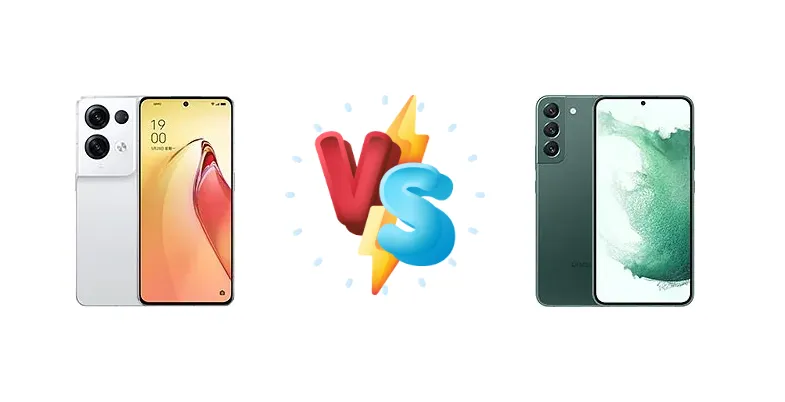
|
🏆 Quick Verdict
For most users, the Oppo Reno8 Pro+ offers a compelling package with its significantly faster 80W charging and strong performance from the Dimensity 8100-Max. While the Galaxy S22+ boasts a brighter display and a more refined software experience, the Reno8 Pro+'s value proposition is hard to ignore.
| PHONES | ||
|---|---|---|
| Phone Names | Oppo Reno8 Pro+ | Samsung Galaxy S22+ 5G |
| Network | ||
|---|---|---|
| 2G bands | GSM 850 / 900 / 1800 / 1900 - SIM 1 & SIM 2 | GSM 850 / 900 / 1800 / 1900 |
| 3G bands | HSDPA 800 / 850 / 900 / 1700(AWS) / 1900 / 2100 | HSDPA 850 / 900 / 1700(AWS) / 1900 / 2100 |
| 4G bands | 1, 2, 3, 4, 5, 7, 8, 18, 19, 26, 28, 34, 38, 39, 40, 41 | 1, 2, 3, 4, 5, 7, 8, 12, 13, 17, 18, 19, 20, 25, 26, 28, 32, 38, 39, 40, 41, 66 - International |
| 5G bands | 1, 5, 8, 28, 41, 77, 78 SA/NSA | 1, 2, 3, 5, 7, 8, 12, 20, 25, 28, 38, 40, 41, 66, 75, 77, 78 SA/NSA/Sub6 - International |
| Speed | HSPA, LTE-A (CA), 5G | HSPA 42.2/5.76 Mbps, LTE (7CA) Cat20 2000/200 Mbps, 5G (5+ Gbps DL) |
| Technology | GSM / CDMA / HSPA / EVDO / LTE / 5G | GSM / CDMA / HSPA / EVDO / LTE / 5G |
| CDMA2000 1xEV-DO | 1, 3, 5, 7, 8, 20, 28, 38, 41, 66, 71, 260, 261 SA/NSA/Sub6/mmWave - USA | |
| Launch | ||
|---|---|---|
| Announced | 2022, May 23 | 2022, February 09 |
| Status | Available. Released 2022, June 01 | Available. Released 2022, February 25 |
| Body | ||
|---|---|---|
| Build | Glass front (Gorilla Glass 5), aluminum frame | Glass front (Gorilla Glass Victus+), glass back (Gorilla Glass Victus+), aluminum frame |
| Dimensions | 161.2 x 74.2 x 7.3 mm (6.35 x 2.92 x 0.29 in) | 157.4 x 75.8 x 7.6 mm (6.20 x 2.98 x 0.30 in) |
| SIM | Dual SIM (Nano-SIM, dual stand-by) | · Nano-SIM + eSIM· Nano-SIM + Nano-SIM + eSIM (max 2 at a time) |
| Weight | 183 g (6.46 oz) | 195 g / 196 g (mmWave) (6.88 oz) |
| - | IP68 dust/water resistant (up to 1.5m for 30 min) Armor aluminum frame with tougher drop and scratch resistance (advertised) | |
| Display | ||
|---|---|---|
| Protection | Corning Gorilla Glass 5 | Corning Gorilla Glass Victus+ |
| Resolution | 1080 x 2412 pixels, 20:9 ratio (~394 ppi density) | 1080 x 2340 pixels, 19.5:9 ratio (~393 ppi density) |
| Size | 6.7 inches, 108.0 cm2 (~90.3% screen-to-body ratio) | 6.6 inches, 105.3 cm2 (~88.3% screen-to-body ratio) |
| Type | AMOLED, 1B colors, 120Hz, HDR10+, 500 nits (typ), 800 nits (HBM), 950 nits (peak) | Dynamic AMOLED 2X, 120Hz, HDR10+, 1750 nits (peak) |
| - | Always-on display | |
| Platform | ||
|---|---|---|
| CPU | Octa-core (4x2.85 GHz Cortex-A78 & 4x2.0 GHz Cortex-A55) | Octa-core (1x2.8 GHz Cortex-X2 & 3x2.50 GHz Cortex-A710 & 4x1.8 GHz Cortex-A510) - EuropeOcta-core (1x3.00 GHz Cortex-X2 & 3x2.50 GHz Cortex-A710 & 4x1.80 GHz Cortex-A510) - ROW |
| Chipset | Mediatek Dimensity 8100-Max (5 nm) | Exynos 2200 (4 nm) - EuropeQualcomm SM8450 Snapdragon 8 Gen 1 (4 nm) - ROW |
| GPU | Mali-G610 MC6 | Xclipse 920 - EuropeAdreno 730 - ROW |
| OS | Android 12, ColorOS 12.1 | Android 12, up to 4 major Android upgrades, One UI 6.1.1 |
| Memory | ||
|---|---|---|
| Card slot | No | No |
| Internal | 256GB 8GB RAM, 256GB 12GB RAM | 128GB 8GB RAM, 256GB 8GB RAM |
| UFS 3.1 | UFS 3.1 | |
| Main Camera | ||
|---|---|---|
| Features | LED flash, HDR, panorama | LED flash, auto-HDR, panorama |
| Single | 32 MP, f/2.4, 22mm (wide), 1/2.74", 0.8µm, AF | - |
| Triple | 50 MP, f/1.8, 24mm (wide), 1/1.56", 1.0µm, PDAF 8 MP, f/2.2, 112˚ (ultrawide), 1/4.0", 1.12µm 2 MP, f/2.4, (macro) | 50 MP, f/1.8, 23mm (wide), 1/1.56", 1.0µm, dual pixel PDAF, OIS 10 MP, f/2.4, 70mm (telephoto), 1/3.94", 1.0µm, PDAF, OIS, 3x optical zoom 12 MP, f/2.2, 13mm, 120˚ (ultrawide), 1/2.55" 1.4µm, Super Steady video |
| Video | 4K@30fps, 1080p@30/60/120fps, gyro-EIS | 8K@24fps, 4K@30/60fps, 1080p@30/60/120/240fps, HDR10+, stereo sound rec., gyro-EIS |
| Selfie camera | ||
|---|---|---|
| Features | Panorama, HDR | HDR |
| Single | 32 MP, f/2.4, 22mm (wide), 1/2.74", 0.8µm, AF | 10 MP, f/2.2, 26mm (wide), 1/3.24", 1.22µm, dual pixel PDAF |
| Video | 1080p@30fps, gyro-EIS | 4K@30/60fps, 1080p@30fps |
| Sound | ||
|---|---|---|
| 3.5mm jack | No | No |
| 35mm jack | - | No |
| Loudspeaker | Yes | Yes, with stereo speakers |
| - | 32-bit/384kHz audio Tuned by AKG | |
| Comms | ||
|---|---|---|
| Bluetooth | 5.3, A2DP, LE, aptX HD | 5.2, A2DP, LE |
| NFC | Yes | Yes |
| Positioning | GPS (L1+L5), GLONASS (L1), BDS (B1I+B2a), GALILEO (E1+E5a), QZSS (L1+L5) | GPS, GLONASS, BDS, GALILEO |
| Radio | No | No |
| USB | USB Type-C 2.0, OTG | USB Type-C 3.2, OTG |
| WLAN | Wi-Fi 802.11 a/b/g/n/ac/6, dual-band, Wi-Fi Direct | Wi-Fi 802.11 a/b/g/n/ac/6e, dual-band, Wi-Fi Direct |
| Features | ||
|---|---|---|
| Sensors | Fingerprint (under display, optical), accelerometer, gyro, proximity, compass, color spectrum | Fingerprint (under display, ultrasonic), accelerometer, gyro, proximity, compass, barometer |
| - | Samsung DeX, Samsung Wireless DeX (desktop experience support) Bixby natural language commands and dictation Samsung Pay (Visa, MasterCard certified) Ultra Wideband (UWB) support | |
| Battery | ||
|---|---|---|
| Charging | 80W wired, 1-45% in 10 min, 1-100% in 31 min (advertised) Reverse wired | 45W wired, PD3.0 15W wireless (Qi) 4.5W reverse wireless |
| Type | Li-Po 4500 mAh, non-removable | Li-Ion 4500 mAh |
| Misc | ||
|---|---|---|
| Colors | Black, Silver, Mint | Phantom Black, White, Pink Gold, Green, Graphite, Sky Blue, Violet, Cream, Bora Purple |
| Models | PFZM10 | SM-S906B, SM-S906B/DS, SM-S906U, SM-S906U1, SM-S906W, SM-S906N, SM-S9060, SM-S906E, SM-S906E/DS, SM-S906L |
| Price | About 520 EUR | € 236.99 / $ 194.37 / £ 349.00 |
| SAR | - | 1.19 W/kg (head) 1.08 W/kg (body) |
| SAR EU | - | 0.57 W/kg (head) 1.40 W/kg (body) |
| Tests | ||
|---|---|---|
| Battery life | - | Endurance rating 97h |
| Camera | - | Photo / Video |
| Display | - | Contrast ratio: Infinite (nominal) |
| Loudspeaker | - | -26.0 LUFS (Very good) |
| Performance | - | AnTuTu: 722495 (v8), 886916 (v9) GeekBench: 3528 (v5.1) GFXBench: 68fps (ES 3.1 onscreen) |
Oppo Reno8 Pro+
- Significantly faster 80W charging
- Potentially better thermal management with Dimensity 8100-Max
- Competitive price point
- Less established brand recognition
- Software experience may not be as refined as Samsung's
Samsung Galaxy S22+ 5G
- Brighter, higher-quality display
- More polished and feature-rich software
- Stronger ecosystem integration (Samsung)
- Slower 45W charging
- Potential for throttling with Exynos 2200 variant
- Higher price
Display Comparison
The Samsung Galaxy S22+ holds a clear advantage in display brightness, achieving a measured peak of 1214 nits. This translates to superior visibility under direct sunlight. While the Reno8 Pro+'s display specs aren't provided, Samsung’s Dynamic AMOLED 2X panel is known for its vibrant colors and excellent contrast, boasting an infinite (nominal) contrast ratio. The S22+’s display is likely to offer a more refined viewing experience, though the Reno8 Pro+ may compensate with a higher refresh rate (spec not provided).
Camera Comparison
Both phones feature capable camera systems, but detailed sensor information is limited for the Reno8 Pro+. The Galaxy S22+’s camera prowess is well-documented, offering excellent photo and video quality. The Reno8 Pro+ likely focuses on computational photography to enhance image quality. Without specific sensor size details, it’s difficult to definitively declare a winner. However, the S22+'s established image processing algorithms and potentially larger main sensor (based on Samsung’s flagship history) give it an edge. The presence of OIS (Optical Image Stabilization) on both devices is crucial for stable video recording and low-light photography.
Performance
The chipset choice is a key differentiator. The Oppo Reno8 Pro+ utilizes the Mediatek Dimensity 8100-Max, a 5nm chip with a focus on efficiency and performance. Its octa-core configuration (4x2.85 GHz Cortex-A78 & 4x2.0 GHz Cortex-A55) is geared towards sustained performance. The Galaxy S22+ comes in two variants: the Exynos 2200 (4nm, Europe) and the Snapdragon 8 Gen 1 (4nm, ROW). While the Snapdragon 8 Gen 1 generally offers better sustained performance and thermal management, the Exynos 2200 has historically faced criticism for throttling under heavy load. The Dimensity 8100-Max’s 5nm process gives it a potential edge in efficiency compared to the 4nm Snapdragon/Exynos, potentially leading to less throttling during extended gaming sessions. Both phones utilize octa-core CPUs, but the Cortex-X2 core in the S22+’s processors offers a theoretical peak performance advantage, though real-world gains may be minimal.
Battery Life
The Galaxy S22+ boasts an endurance rating of 97 hours, indicating solid battery life. However, the Reno8 Pro+’s 80W wired charging is a game-changer. Advertised figures claim a 1-45% charge in just 10 minutes and a full charge in 31 minutes. This drastically reduces downtime compared to the S22+'s 45W charging. While the S22+ offers 15W wireless and 4.5W reverse wireless charging, the Reno8 Pro+ also includes reverse wired charging, offering more versatility. The Reno8 Pro+'s faster charging effectively mitigates any potential disadvantage from a smaller battery capacity (spec not provided).
Buying Guide
Buy the Oppo Reno8 Pro+ if you prioritize incredibly fast charging, need a phone that can top up quickly during short breaks, and want excellent performance for the price. Buy the Samsung Galaxy S22+ 5G if you value a more polished software experience, a brighter display for outdoor visibility, and integration within the Samsung ecosystem, and are willing to trade off charging speed.