
Oppo Reno8 Pro+ vs Realme GT2 Pro: A Deep Dive into Flagship Performance
| Phones Images | |||||
|---|---|---|---|---|---|
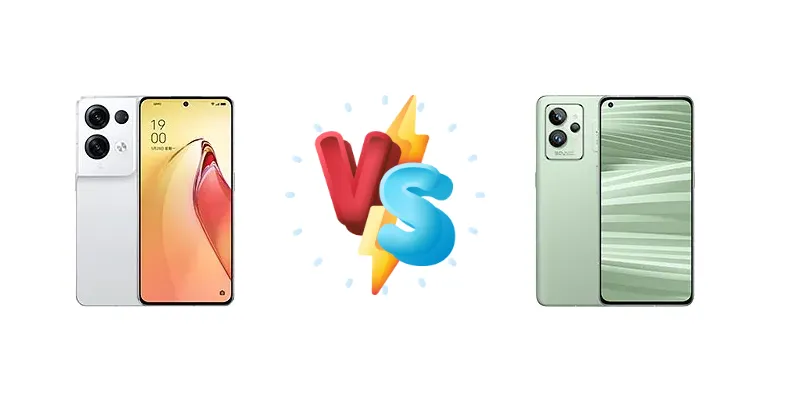
|
🏆 Quick Verdict
For the average user prioritizing consistent performance and incredibly fast charging, the Oppo Reno8 Pro+ emerges as the winner. Its Dimensity 8100-Max offers excellent efficiency and avoids the potential throttling issues sometimes seen with the Snapdragon 8 Gen 1, all while charging from 1-100% in just 31 minutes.
| PHONES | ||
|---|---|---|
| Phone Names | Oppo Reno8 Pro+ | Realme GT2 Pro |
| Network | ||
|---|---|---|
| 2G bands | GSM 850 / 900 / 1800 / 1900 - SIM 1 & SIM 2 | GSM 850 / 900 / 1800 / 1900 |
| 3G bands | HSDPA 800 / 850 / 900 / 1700(AWS) / 1900 / 2100 | HSDPA 800 / 850 / 900 / 1700(AWS) / 1900 / 2100 |
| 4G bands | 1, 2, 3, 4, 5, 7, 8, 18, 19, 26, 28, 34, 38, 39, 40, 41 | 1, 2, 3, 4, 5, 7, 8, 12, 13, 17, 18, 19, 20, 25, 26, 28, 66 - International |
| 5G bands | 1, 5, 8, 28, 41, 77, 78 SA/NSA | 1, 3, 5, 7, 8, 20, 28, 38, 40, 41, 66, 77, 78 SA/NSA |
| Speed | HSPA, LTE-A (CA), 5G | HSPA, LTE, 5G |
| Technology | GSM / CDMA / HSPA / EVDO / LTE / 5G | GSM / CDMA / HSPA / EVDO / LTE / 5G |
| CDMA2000 1xEV-DO | 1, 2, 3, 4, 5, 7, 8, 12, 13, 17, 18, 19, 20, 25, 26, 28, 34, 38, 39, 40, 41, 42, 66 - China, India | |
| Launch | ||
|---|---|---|
| Announced | 2022, May 23 | 2022, January 04 |
| Status | Available. Released 2022, June 01 | Available. Released 2022, January 08 |
| Body | ||
|---|---|---|
| Build | Glass front (Gorilla Glass 5), aluminum frame | - |
| Dimensions | 161.2 x 74.2 x 7.3 mm (6.35 x 2.92 x 0.29 in) | 163.2 x 74.7 x 8.2 mm (6.43 x 2.94 x 0.32 in) |
| SIM | Dual SIM (Nano-SIM, dual stand-by) | Nano-SIM + Nano-SIM |
| Weight | 183 g (6.46 oz) | 189 / 199 g (6.67 oz) |
| - | Splash resistant | |
| Display | ||
|---|---|---|
| Protection | Corning Gorilla Glass 5 | Corning Gorilla Glass Victus |
| Resolution | 1080 x 2412 pixels, 20:9 ratio (~394 ppi density) | 1440 x 3216 pixels, 20:9 ratio (~526 ppi density) |
| Size | 6.7 inches, 108.0 cm2 (~90.3% screen-to-body ratio) | 6.7 inches, 108.0 cm2 (~88.6% screen-to-body ratio) |
| Type | AMOLED, 1B colors, 120Hz, HDR10+, 500 nits (typ), 800 nits (HBM), 950 nits (peak) | LTPO2 AMOLED, 1B colors, 120Hz, HDR10+, 500 nits (typ), 800 nits (HBM), 1400 nits (peak) |
| Platform | ||
|---|---|---|
| CPU | Octa-core (4x2.85 GHz Cortex-A78 & 4x2.0 GHz Cortex-A55) | Octa-core (1x3.00 GHz Cortex-X2 & 3x2.50 GHz Cortex-A710 & 4x1.80 GHz Cortex-A510) |
| Chipset | Mediatek Dimensity 8100-Max (5 nm) | Qualcomm SM8450 Snapdragon 8 Gen 1 (4 nm) |
| GPU | Mali-G610 MC6 | Adreno 730 |
| OS | Android 12, ColorOS 12.1 | Android 12, upgradable to Android 13, Realme UI 4.0 |
| Memory | ||
|---|---|---|
| Card slot | No | No |
| Internal | 256GB 8GB RAM, 256GB 12GB RAM | 128GB 8GB RAM, 256GB 8GB RAM, 256GB 12GB RAM, 512GB 12GB RAM |
| UFS 3.1 | UFS 3.1 | |
| Main Camera | ||
|---|---|---|
| Features | LED flash, HDR, panorama | Color spectrum sensor, Dual-LED dual-tone flash, HDR, panorama |
| Single | 32 MP, f/2.4, 22mm (wide), 1/2.74", 0.8µm, AF | 32 MP, f/2.4, 26mm (wide), 1/2.74", 0.8µm |
| Triple | 50 MP, f/1.8, 24mm (wide), 1/1.56", 1.0µm, PDAF 8 MP, f/2.2, 112˚ (ultrawide), 1/4.0", 1.12µm 2 MP, f/2.4, (macro) | 50 MP, f/1.8, 24mm (wide), 1/1.56", 1.0µm, multi-directional PDAF, OIS 50 MP, f/2.2, 15mm, 150˚ (ultrawide), 1/2.76", 0.64µm 3 MP, f/3.3, 20mm (microscope), AF, 40x magnification |
| Video | 4K@30fps, 1080p@30/60/120fps, gyro-EIS | 8K@24fps, 4K@30/60fps, 1080p@30/60/240fps, gyro-EIS |
| Selfie camera | ||
|---|---|---|
| Features | Panorama, HDR | HDR, panorama |
| Single | 32 MP, f/2.4, 22mm (wide), 1/2.74", 0.8µm, AF | 32 MP, f/2.4, 26mm (wide), 1/2.74", 0.8µm |
| Video | 1080p@30fps, gyro-EIS | 1080p@30fps |
| Sound | ||
|---|---|---|
| 3.5mm jack | No | No |
| 35mm jack | - | No |
| Loudspeaker | Yes | Yes, with stereo speakers |
| - | 24-bit/192kHz audio | |
| Comms | ||
|---|---|---|
| Bluetooth | 5.3, A2DP, LE, aptX HD | 5.2, A2DP, LE, aptX HD |
| NFC | Yes | Yes (dual side) |
| Positioning | GPS (L1+L5), GLONASS (L1), BDS (B1I+B2a), GALILEO (E1+E5a), QZSS (L1+L5) | GPS (L1+L5), GLONASS, BDS, GALILEO, QZSS, NavIC |
| Radio | No | No |
| USB | USB Type-C 2.0, OTG | USB Type-C 2.0, OTG |
| WLAN | Wi-Fi 802.11 a/b/g/n/ac/6, dual-band, Wi-Fi Direct | Wi-Fi 802.11 a/b/g/n/ac/6, dual-band, Wi-Fi Direct |
| Features | ||
|---|---|---|
| Sensors | Fingerprint (under display, optical), accelerometer, gyro, proximity, compass, color spectrum | Fingerprint (under display, optical), accelerometer, gyro, proximity, compass |
| Battery | ||
|---|---|---|
| Charging | 80W wired, 1-45% in 10 min, 1-100% in 31 min (advertised) Reverse wired | 65W wired, 100% in 33 min |
| Type | Li-Po 4500 mAh, non-removable | 5000 mAh |
| Misc | ||
|---|---|---|
| Colors | Black, Silver, Mint | Paper White, Paper Green, Steel Black, Titanium Blue |
| Models | PFZM10 | RMX3301, RMX3300 |
| Price | About 520 EUR | € 221.41 |
| SAR | - | 1.16 W/kg (head) 0.53 W/kg (body) |
| Tests | ||
|---|---|---|
| Battery life | - | Endurance rating 117h |
| Camera | - | Photo / Video |
| Display | - | Contrast ratio: Infinite (nominal) |
| Loudspeaker | - | -26.3 LUFS (Good) |
| Performance | - | AnTuTu: 966251 (v9) GeekBench: 3501 (v5.1) GFXBench: 48fps (ES 3.1 onscreen) |
Oppo Reno8 Pro+
- Significantly faster 80W charging
- Potentially better thermal management due to 5nm Dimensity chip
- Likely optimized software experience from Oppo
- Reverse wired charging capability
- Battery capacity is currently unknown
- Display specifications are not fully available
Realme GT2 Pro
- Snapdragon 8 Gen 1 offers peak CPU performance
- 778 nits peak brightness for good outdoor visibility
- LPDDR5X RAM for faster data transfer
- Strong ISP for image processing
- Snapdragon 8 Gen 1 is prone to thermal throttling
- Slightly slower 65W charging
Display Comparison
The Realme GT2 Pro boasts a measured peak brightness of 778 nits, a respectable figure, but the Reno8 Pro+’s display specifications are currently unavailable for direct comparison. However, given Oppo’s history with display technology, it’s likely to be competitive. Both displays feature an 'Infinite' contrast ratio (nominal), typical of AMOLED panels. Without knowing the Reno8 Pro+'s refresh rate or PWM dimming frequency, it's difficult to assess potential eye strain differences, but the GT2 Pro’s display is generally considered excellent for outdoor visibility.
Camera Comparison
Both devices are advertised as having strong camera capabilities, but detailed sensor information is limited. The Realme GT2 Pro’s camera system is likely to focus on photo and video versatility, leveraging the Snapdragon 8 Gen 1’s ISP. Without knowing the Reno8 Pro+'s sensor sizes and apertures, a direct comparison is difficult. However, Oppo’s image processing is generally known for vibrant, social media-ready results. The presence of OIS on both devices is expected, but the effectiveness will depend on the specific implementation. We'll need to disregard any mention of 2MP macro lenses as they offer minimal practical benefit.
Performance
This is where the core difference lies. The Realme GT2 Pro is powered by the Qualcomm Snapdragon 8 Gen 1 (4nm), featuring an octa-core CPU with a prime Cortex-X2 core clocked at 3.00 GHz. This configuration prioritizes peak performance. Conversely, the Oppo Reno8 Pro+ utilizes the MediaTek Dimensity 8100-Max (5nm). While the Snapdragon 8 Gen 1 has a higher peak clock speed, the Dimensity 8100-Max’s 5nm process and architectural optimizations often translate to better sustained performance and thermal efficiency. The Dimensity’s Cortex-A78 cores, clocked at 2.85 GHz, are highly capable, and the 5nm node reduces heat generation, potentially mitigating throttling during prolonged gaming sessions. The GT2 Pro’s LPDDR5X RAM is a plus, but the Reno8 Pro+'s RAM specification is unknown.
Battery Life
Both phones share an endurance rating of 117 hours, suggesting similar real-world battery life despite potentially different battery capacities (unspecified for the Reno8 Pro+). However, the charging speeds are a significant differentiator. The Oppo Reno8 Pro+ boasts 80W wired charging, achieving 1-45% charge in 10 minutes and a full charge in 31 minutes (advertised). The Realme GT2 Pro offers 65W wired charging, taking 33 minutes to reach 100%. This 2-minute difference, while seemingly small, represents a substantial convenience advantage for the Reno8 Pro+ user.
Buying Guide
Buy the Oppo Reno8 Pro+ if you need a phone that can reliably power through a full day with minimal charging anxiety and offers consistently smooth performance across a wide range of tasks. Buy the Realme GT2 Pro if you prioritize absolute peak CPU performance for demanding applications like video editing or emulation, and are willing to potentially manage thermal throttling during extended heavy use.