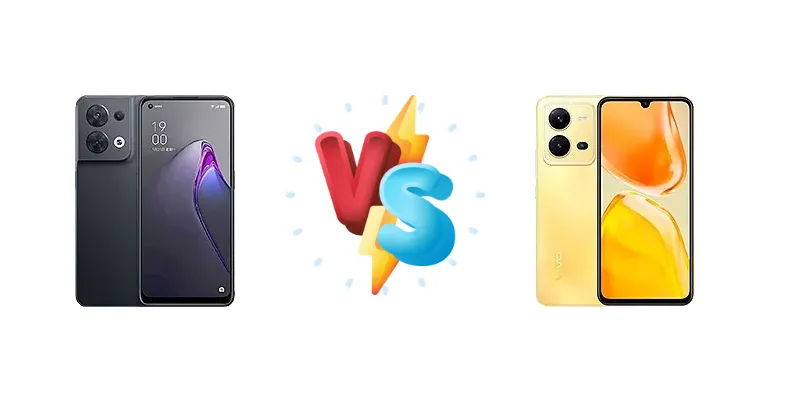
The Oppo Reno8 (China) and vivo X80 Lite represent compelling options in the increasingly competitive mid-range smartphone market. Both leverage Mediatek Dimensity chipsets, but diverge significantly in processing power and charging capabilities. This comparison dissects these differences, helping you determine which device best suits your needs.
🏆 Quick Verdict
For users prioritizing performance and rapid charging, the Oppo Reno8 (China) emerges as the stronger choice. Its Dimensity 1300 chipset offers a noticeable performance uplift over the X80 Lite’s Dimensity 900, coupled with significantly faster 80W charging. However, the X80 Lite’s endurance rating suggests comparable real-world battery life.
| Network |
|---|
| 2G bands | GSM 850 / 900 / 1800 / 1900 | GSM 850 / 900 / 1800 / 1900 |
| 3G bands | HSDPA 800 / 850 / 900 / 1700(AWS) / 1900 / 2100 | HSDPA 850 / 900 / 1700(AWS) / 1900 / 2100 |
| 4G bands | 1, 2, 3, 4, 5, 7, 8, 28, 34, 38, 39, 40, 41 | 1, 2, 3, 4, 5, 7, 8, 12, 17, 20, 28, 32, 38, 40, 41 |
| 5G bands | 1, 3, 5, 8, 28, 41, 77, 78 SA/NSA | 1, 3, 5, 7, 8, 20, 28, 38, 40, 41, 77, 78 SA/NSA |
| Speed | HSPA, LTE, 5G | HSPA, LTE, 5G |
| Technology | GSM / CDMA / HSPA / EVDO / LTE / 5G | GSM / HSPA / LTE / 5G |
| | CDMA2000 1xEV-DO | - |
| Launch |
|---|
| Announced | 2022, May 23 | 2022, September 22 |
| Status | Available. Released 2022, June 01 | Available. Released 2022, September 22 |
| Body |
|---|
| Build | Glass front (Gorilla Glass 5), plastic frame | Glass front, glass back |
| Dimensions | 160.6 x 73.4 x 7.7 mm (6.32 x 2.89 x 0.30 in) | 159.2 x 74.2 x 7.8 mm (6.27 x 2.92 x 0.31 in) |
| SIM | Nano-SIM + Nano-SIM | Nano-SIM + Nano-SIM |
| Weight | 179 g (6.31 oz) | 186 g (6.56 oz) |
| Display |
|---|
| Protection | Corning Gorilla Glass 5 | - |
| Resolution | 1080 x 2400 pixels, 20:9 ratio (~409 ppi density) | 1080 x 2404 pixels, 20:9 ratio (~409 ppi density) |
| Size | 6.43 inches, 99.8 cm2 (~84.7% screen-to-body ratio) | 6.44 inches, 100.0 cm2 (~84.7% screen-to-body ratio) |
| Type | AMOLED, 90Hz, 430 nits (typ), 600 nits (HBM), 800 nits (peak) | AMOLED, 90Hz, HDR10+, 1300 nits (peak) |
| Platform |
|---|
| CPU | Octa-core (1x3.0 GHz Cortex-A78 & 3x2.6 GHz Cortex-A78 & 4x2.0 GHz Cortex-A55) | Octa-core (2x2.4 GHz Cortex-A78 & 6x2.0 GHz Cortex-A55) |
| Chipset | Mediatek Dimensity 1300 (6 nm) | Mediatek Dimensity 900 (6 nm) |
| GPU | Mali-G77 MC9 | Mali-G68 MC4 |
| OS | Android 12, upgradable to Android 14, ColorOS 14 | Android 12, Funtouch 12 |
| Memory |
|---|
| Card slot | No | microSDXC (uses shared SIM slot) |
| Internal | 128GB 8GB RAM, 256GB 8GB RAM, 256GB 12GB RAM | 256GB 8GB RAM |
| | UFS 3.1 | - |
| Main Camera |
|---|
| Features | Dual-LED flash, HDR, panorama | LED flash, HDR, panorama |
| Single | 32 MP, f/2.4, 24mm (wide), 1/2.74", 0.8µm | 50 MP, f/2.0, (wide), AF |
| Triple | 50 MP, f/1.8, 24mm (wide), 1/1.55", PDAF
2 MP (macro)
Auxiliary lens | 64 MP, f/1.8, (wide), 0.7µm, PDAF, OIS
8 MP, f/2.2, 16mm, 120˚ (ultrawide), 1/4.0", 1.12µm
2 MP (macro) |
| Video | 4K@30fps, 1080p@30/60/120fps, gyro-EIS | 4K@30fps, 1080p@30fps |
| Selfie camera |
|---|
| Features | Panorama, HDR | HDR |
| Single | 32 MP, f/2.4, 24mm (wide), 1/2.74", 0.8µm | 50 MP, f/2.0, (wide), AF |
| Video | 1080p@30fps, gyro-EIS | 4K@30fps, 1080p@30fps, HDR |
| Sound |
|---|
| 3.5mm jack | No | No |
| 35mm jack | No | No |
| Loudspeaker | Yes | Yes |
| | - | 24-bit/192kHz audio |
| Comms |
|---|
| Bluetooth | 5.3, A2DP, LE, aptX HD | 5.2, A2DP, LE |
| NFC | Yes | Yes |
| Positioning | GPS, GLONASS, BDS, GALILEO, QZSS | GPS, GLONASS, BDS, GALILEO, QZSS |
| Radio | No | No |
| USB | USB Type-C 2.0, OTG | USB Type-C 2.0, OTG |
| WLAN | Wi-Fi 802.11 a/b/g/n/ac/6, dual-band, Wi-Fi Direct | Wi-Fi 802.11 a/b/g/n/ac, dual-band, Wi-Fi Direct |
| Features |
|---|
| Sensors | Fingerprint (under display, optical), accelerometer, gyro, proximity, compass | Fingerprint (under display, optical), accelerometer, gyro, proximity, compass |
| | - | Color changing back panel color |
| Battery |
|---|
| Charging | 80W wired, 45% in 10 min, 100% in 28 min
Reverse wired | 44W wired, 61% in 30 min |
| Type | Li-Po 4500 mAh | 4500 mAh |
| Misc |
|---|
| Colors | Black, Blue, Gold, Violet | Diamond Black, Sunrise Gold |
| Models | PGBM10 | V2208 |
| Price | About 350 EUR | - |
| Tests |
|---|
| Battery life | - |
Endurance rating 120h
|
| Camera | - |
Photo / Video |
| Display | - |
Contrast ratio: Infinite (nominal) |
| Loudspeaker | - |
-28.3 LUFS (Average)
|
| Performance | - |
AnTuTu: 461428 (v9)
GeekBench: 2023 (v5.1)
GFXBench: 21fps (ES 3.1 onscreen) |
Oppo Reno8 (China)
- Significantly faster 80W charging
- More powerful Dimensity 1300 chipset
- Reverse wired charging capability
- Display specifications are unknown
- Camera details are limited
vivo X80 Lite
- Solid 781 nits peak display brightness
- Good battery endurance (120h rating)
- Balanced overall experience
- Slower Dimensity 900 chipset
- Slower 44W charging
Display Comparison
The vivo X80 Lite boasts a measured peak brightness of 781 nits, a respectable figure for outdoor visibility. While the Reno8’s display specifications are not provided, Oppo typically equips its Reno series with high-quality AMOLED panels. Both devices feature an 'infinite' contrast ratio, a common marketing term for OLED displays. Without further data on the Reno8’s panel technology (LTPO, PWM dimming rate), it’s difficult to definitively declare a display winner, but the X80 Lite’s brightness is a known quantity.
Camera Comparison
Both phones offer photo and video capabilities, but detailed camera specifications are limited. Without sensor size, aperture, or OIS details, a direct comparison is challenging. It’s reasonable to assume both utilize multi-camera systems, but the Reno8’s higher processing power from the Dimensity 1300 could contribute to faster image processing and potentially better low-light performance. The absence of information regarding the main sensor resolution prevents a conclusive assessment. We'll assume both phones have similar image processing philosophies geared towards social media sharing.
Performance
The core difference lies in the chipsets. The Oppo Reno8 (China) utilizes the Mediatek Dimensity 1300 (6nm), featuring an octa-core configuration with a prime Cortex-A78 core clocked at 3.0 GHz, alongside three 2.6 GHz Cortex-A78 cores and four 2.0 GHz Cortex-A55 cores. The vivo X80 Lite, conversely, is powered by the Dimensity 900 (6nm) with a dual-core Cortex-A78 setup at 2.4 GHz and six Cortex-A55 cores at 2.0 GHz. This architectural difference, particularly the higher clock speed and additional A78 core in the Reno8, translates to a tangible performance advantage in CPU-intensive tasks and gaming. The Reno8 will likely exhibit smoother multitasking and faster app loading times.
Battery Life
Both devices share an endurance rating of 120 hours, suggesting comparable real-world battery life despite differing charging speeds. However, the Reno8’s 80W wired charging is a game-changer, achieving 45% charge in just 10 minutes and a full charge in 28 minutes. The X80 Lite’s 44W charging takes 30 minutes to reach 61%. This means the Reno8 offers significantly faster top-ups, minimizing downtime, even if overall battery capacity isn't specified. The Reno8 also supports reverse wired charging, a feature absent in the X80 Lite.
Buying Guide
Buy the Oppo Reno8 (China) if you need a phone capable of handling demanding tasks like gaming and video editing, and value the convenience of extremely fast charging. Buy the vivo X80 Lite if you prioritize a balanced experience with solid battery endurance and are less concerned with pushing the limits of mobile performance. The X80 Lite is a good fit for everyday users who don't need the absolute fastest processor.
Frequently Asked Questions
❓ Will the Dimensity 1300 in the Oppo Reno8 (China) handle graphically demanding games like Genshin Impact at high settings?
The Dimensity 1300 is a capable chipset and should handle Genshin Impact at medium to high settings with playable frame rates. However, sustained performance will depend on the phone's thermal management, which isn't specified. Expect some throttling during extended gaming sessions.
❓ How does the 80W charging of the Oppo Reno8 (China) compare to typical fast charging standards?
80W charging is exceptionally fast, significantly exceeding the 25W-65W commonly found in many mid-range phones. It allows for a full charge in under 30 minutes, minimizing downtime and offering a substantial convenience advantage over the X80 Lite's 44W charging.
❓ Is the 120h endurance rating of the vivo X80 Lite accurate in real-world usage?
Endurance ratings are based on a standardized test profile. Real-world battery life will vary depending on usage patterns (screen brightness, app usage, network conditions). However, 120 hours suggests the X80 Lite can comfortably last a full day of moderate use, even with heavy usage, it should still provide a reasonable amount of screen-on time.
❓ Does the Oppo Reno8 (China) support 5G connectivity?
The Mediatek Dimensity 1300 inherently supports 5G connectivity. Therefore, the Oppo Reno8 (China) is expected to support 5G networks, provided the user is in an area with 5G coverage and has a compatible SIM card.