
Oppo Reno8 (China) vs. Huawei P50 Pro: A Detailed Comparison of Flagship Features
| Phones Images | |||||
|---|---|---|---|---|---|
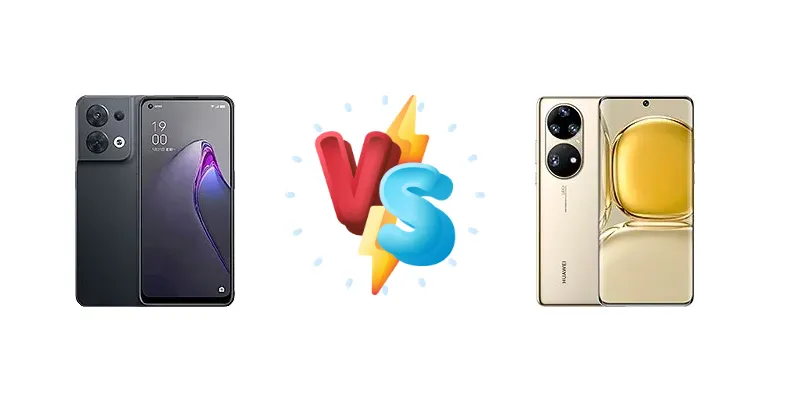
|
🏆 Quick Verdict
For most users, the Oppo Reno8 (China) offers a more compelling package. Its Dimensity 1300 chipset provides strong performance, coupled with blazing-fast 80W charging. While the P50 Pro boasts a fantastic camera, its Kirin 9000/Snapdragon 888 4G chipset and slower charging speeds make it less competitive in 2024.
| PHONES | ||
|---|---|---|
| Phone Names | Oppo Reno8 (China) | Huawei P50 Pro |
| Network | ||
|---|---|---|
| 2G bands | GSM 850 / 900 / 1800 / 1900 | GSM 850 / 900 / 1800 / 1900 |
| 3G bands | HSDPA 800 / 850 / 900 / 1700(AWS) / 1900 / 2100 | HSDPA 800 / 850 / 900 / 1700(AWS) / 1900 / 2100 |
| 4G bands | 1, 2, 3, 4, 5, 7, 8, 28, 34, 38, 39, 40, 41 | 1, 2, 3, 4, 5, 6, 7, 8, 9, 12, 17, 18, 19, 20, 26, 28, 34, 38, 39, 40, 41 - China |
| 5G bands | 1, 3, 5, 8, 28, 41, 77, 78 SA/NSA | - |
| Speed | HSPA, LTE, 5G | HSPA, LTE |
| Technology | GSM / CDMA / HSPA / EVDO / LTE / 5G | GSM / CDMA / HSPA / CDMA2000 / LTE |
| CDMA2000 1xEV-DO | 1, 2, 3, 4, 5, 7, 8, 12, 17, 18, 19, 20, 26, 28, 32, 34, 38, 39, 40, 41, 66 - International | |
| Launch | ||
|---|---|---|
| Announced | 2022, May 23 | 2021, July 29 |
| Status | Available. Released 2022, June 01 | Available. Released 2021, August 12 |
| Body | ||
|---|---|---|
| Build | Glass front (Gorilla Glass 5), plastic frame | Glass front, glass back, aluminum frame |
| Dimensions | 160.6 x 73.4 x 7.7 mm (6.32 x 2.89 x 0.30 in) | 158.8 x 72.8 x 8.5 mm (6.25 x 2.87 x 0.33 in) |
| SIM | Nano-SIM + Nano-SIM | · Nano-SIM· Nano-SIM + Nano-SIM |
| Weight | 179 g (6.31 oz) | 195 g (6.88 oz) |
| - | IP68 dust/water resistant (up to 1.5m for 30 min) | |
| Display | ||
|---|---|---|
| Protection | Corning Gorilla Glass 5 | - |
| Resolution | 1080 x 2400 pixels, 20:9 ratio (~409 ppi density) | 1228 x 2700 pixels (~450 ppi density) |
| Size | 6.43 inches, 99.8 cm2 (~84.7% screen-to-body ratio) | 6.6 inches, 105.4 cm2 (~91.2% screen-to-body ratio) |
| Type | AMOLED, 90Hz, 430 nits (typ), 600 nits (HBM), 800 nits (peak) | OLED, 1B colors, 120Hz |
| Platform | ||
|---|---|---|
| CPU | Octa-core (1x3.0 GHz Cortex-A78 & 3x2.6 GHz Cortex-A78 & 4x2.0 GHz Cortex-A55) | Octa-core (1x3.13 GHz Cortex-A77 & 3x2.54 GHz Cortex-A77 & 4x2.05 GHz Cortex-A55)Octa-core (1x2.84 GHz Cortex-X1 & 3x2.42 GHz Cortex-A78 & 4x1.80 GHz Cortex-A55) |
| Chipset | Mediatek Dimensity 1300 (6 nm) | Kirin 9000 (5 nm)Qualcomm SM8350 Snapdragon 888 4G (5 nm) |
| GPU | Mali-G77 MC9 | Mali-G78 MP24Adreno 660 |
| OS | Android 12, upgradable to Android 14, ColorOS 14 | HarmonyOS 2.0 (China), EMUI 14.2 (Europe), no Google Play Services |
| Memory | ||
|---|---|---|
| Card slot | No | Nano Memory (uses shared SIM slot) |
| Internal | 128GB 8GB RAM, 256GB 8GB RAM, 256GB 12GB RAM | 128GB 8GB RAM, 256GB 8GB RAM, 512GB 8GB RAM, 512GB 12GB RAM |
| UFS 3.1 | - | |
| Main Camera | ||
|---|---|---|
| Features | Dual-LED flash, HDR, panorama | Laser AF, color spectrum sensor, Leica optics, dual-LED flash, panorama, HDR |
| Quad | - | 50 MP, f/1.8, 23mm (wide), PDAF, OIS 64 MP, f/3.5, 90mm (periscope telephoto), PDAF, OIS, 3.5x optical zoom, 7x lossless zoom 13 MP, f/2.2, 13mm (ultrawide), AF 40 MP, f/1.6, 23mm (B/W), AF |
| Single | 32 MP, f/2.4, 24mm (wide), 1/2.74", 0.8µm | 13 MP, f/2.4, (wide), AF |
| Triple | 50 MP, f/1.8, 24mm (wide), 1/1.55", PDAF 2 MP (macro) Auxiliary lens | - |
| Video | 4K@30fps, 1080p@30/60/120fps, gyro-EIS | 4K@30/60fps, 1080p@30/60fps, 1080p@960fps; gyro-EIS |
| Selfie camera | ||
|---|---|---|
| Features | Panorama, HDR | Panorama, HDR |
| Single | 32 MP, f/2.4, 24mm (wide), 1/2.74", 0.8µm | 13 MP, f/2.4, (wide), AF |
| Video | 1080p@30fps, gyro-EIS | 4K@30fps, 1080p@30/60/240fps |
| Sound | ||
|---|---|---|
| 3.5mm jack | No | No |
| 35mm jack | No | No |
| Loudspeaker | Yes | Yes, with stereo speakers |
| Comms | ||
|---|---|---|
| Bluetooth | 5.3, A2DP, LE, aptX HD | 5.2, A2DP, LE |
| Infrared port | - | Yes |
| NFC | Yes | Yes |
| Positioning | GPS, GLONASS, BDS, GALILEO, QZSS | GPS (L1+L5), GLONASS (L1), BDS (B1I+B1c+B2a+B2b), GALILEO (E1+E5a+E5b), QZSS (L1+L5), NavIC |
| Radio | No | No |
| USB | USB Type-C 2.0, OTG | USB Type-C 3.1, OTG |
| WLAN | Wi-Fi 802.11 a/b/g/n/ac/6, dual-band, Wi-Fi Direct | Wi-Fi 802.11 a/b/g/n/ac/6, dual-band, Wi-Fi Direct |
| Features | ||
|---|---|---|
| Sensors | Fingerprint (under display, optical), accelerometer, gyro, proximity, compass | Fingerprint (under display, optical), accelerometer, gyro, proximity, compass, barometer |
| Battery | ||
|---|---|---|
| Charging | 80W wired, 45% in 10 min, 100% in 28 min Reverse wired | 66W wired 50W wireless Reverse wireless charging |
| Type | Li-Po 4500 mAh | Li-Po 4360 mAh |
| Misc | ||
|---|---|---|
| Colors | Black, Blue, Gold, Violet | Golden Black, Cocoa Gold, Pearl White, Charm Pink |
| Models | PGBM10 | JAD-AL50, JAD-LX9, JAD-AL00 |
| Price | About 350 EUR | $ 196.62 / £ 329.00 / € 473.13 |
| Tests | ||
|---|---|---|
| Battery life | - | Endurance rating 76h |
| Camera | - | Photo / Video |
| Display | - | Contrast ratio: Infinite (nominal) |
| Loudspeaker | - | -27.3 LUFS (Good) |
| Performance | - | AnTuTu: 793876 (v8), 786215 (v9) GeekBench: 3145 (v5.1) GFXBench: 44fps (ES 3.1 onscreen) |
Oppo Reno8 (China)
- Significantly faster 80W charging
- Potentially better thermal management with Dimensity 1300
- Reverse wired charging capability
- Limited to 4G connectivity
- Camera specs are less detailed than the P50 Pro
Huawei P50 Pro
- Excellent camera system with advanced image processing
- High display brightness for outdoor visibility
- Established brand reputation for camera quality
- Slower charging speeds (66W wired, 50W wireless)
- Limited to 4G connectivity
- Potentially higher price point
Display Comparison
The Huawei P50 Pro’s display achieves a measured peak brightness of 754 nits, providing good visibility outdoors. While the Reno8’s display specs aren’t explicitly stated, Oppo typically employs high-quality AMOLED panels. The P50 Pro’s ‘Infinite’ contrast ratio suggests a true black level, common in OLED technology. However, without knowing the Reno8’s panel technology (LTPO or standard AMOLED) or PWM dimming rate, a definitive display quality assessment is difficult. The P50 Pro’s established brightness level gives it a slight edge for outdoor usability.
Camera Comparison
Both phones are marketed for their camera capabilities, but approach it differently. The P50 Pro’s camera system is renowned for its image processing and color science. While specific sensor details are missing, Huawei’s history suggests a focus on large sensors and advanced computational photography. The Reno8’s camera specs are not detailed enough to make a direct comparison. The P50 Pro’s strength lies in its consistent image quality across various lighting conditions and its sophisticated video recording features. The Reno8 will likely offer a competitive camera experience, but without detailed specs, it’s difficult to assess its capabilities against the P50 Pro’s established reputation.
Performance
The core difference lies in the chipsets. The Oppo Reno8 utilizes the Mediatek Dimensity 1300 (6nm), featuring a Cortex-A78 prime core clocked at 3.0 GHz. The Huawei P50 Pro comes with either the Kirin 9000 (5nm) or the Snapdragon 888 4G (5nm). While the Kirin 9000 and Snapdragon 888 4G offer comparable CPU performance to the Dimensity 1300, the 5nm process node used in both Huawei options *should* translate to better thermal efficiency and sustained performance under heavy load. However, the Reno8’s newer architecture and potentially more efficient thermal design could mitigate this advantage. The P50 Pro’s 4G limitation is a significant drawback for users in areas with robust 5G infrastructure.
Battery Life
Both devices boast an endurance rating of 76 hours, suggesting similar real-world battery life. However, the charging speeds are drastically different. The Oppo Reno8’s 80W wired charging can replenish the battery to 45% in 10 minutes and 100% in 28 minutes – a significant advantage. The P50 Pro offers 66W wired charging and 50W wireless charging, but these are considerably slower. The Reno8 also supports reverse wired charging, a feature absent in the P50 Pro’s specifications. The Reno8’s charging speed is a major differentiator, minimizing downtime and maximizing usability.
Buying Guide
Buy the Oppo Reno8 (China) if you prioritize fast charging, strong all-around performance for gaming and daily tasks, and don't require 5G connectivity. Buy the Huawei P50 Pro if camera quality is your absolute top priority, you value a polished software experience, and are willing to compromise on charging speed and network capabilities.