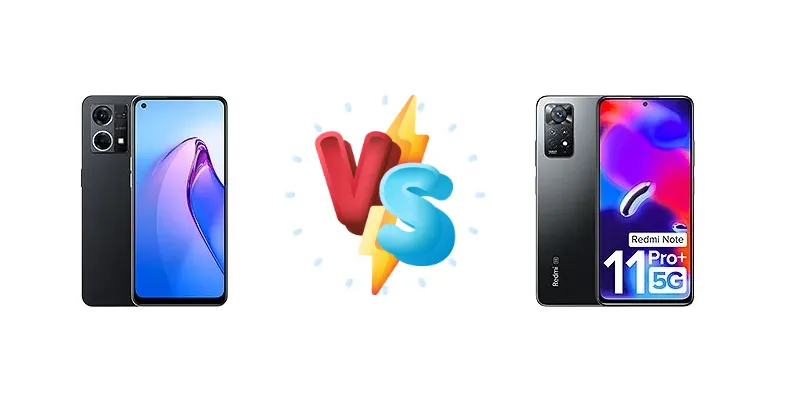
The Oppo Reno8 4G and Xiaomi Redmi Note 11 Pro+ 5G (India) represent compelling options in the increasingly competitive mid-range smartphone market. While both aim to deliver a balanced experience, they diverge significantly in chipset choice and charging capabilities, creating a clear distinction for potential buyers. This comparison dissects these differences to determine which device offers the best value.
🏆 Quick Verdict
For the average user prioritizing fast charging and future-proofing with 5G connectivity, the Xiaomi Redmi Note 11 Pro+ 5G (India) is the better choice. Its 67W charging significantly reduces downtime, and the Snapdragon 695 offers a performance edge and 5G support, despite the Reno8's slightly more efficient processor.
| Network |
|---|
| 2G bands | GSM 850 / 900 / 1800 / 1900 | GSM 850 / 900 / 1800 / 1900 |
| 3G bands | HSDPA 850 / 900 / 2100 | HSDPA 850 / 900 / 1900 / 2100 |
| 4G bands | 1, 3, 5, 8, 40 | 1, 3, 5, 8, 40, 41 |
| 5G bands | - | 1, 3, 5, 8, 28, 40, 78 SA/NSA |
| Speed | HSPA, LTE | HSPA, LTE, 5G |
| Technology | GSM / HSPA / LTE | GSM / HSPA / LTE / 5G |
| Launch |
|---|
| Announced | 2022, August 17 | 2022, March 09 |
| Status | Available. Released 2022, August 26 | Available. Released 2022, March 15 |
| Body |
|---|
| Build | - | Glass front (Gorilla Glass 5), glass back |
| Dimensions | 159.9 x 73.2 x 7.7 mm (6.30 x 2.88 x 0.30 in) | 164.2 x 76.1 x 8.1 mm (6.46 x 3.00 x 0.32 in) |
| SIM | Nano-SIM + Nano-SIM | Nano-SIM + Nano-SIM |
| Weight | 182 g (6.42 oz) | 202 g (7.13 oz) |
| | IPX4 water resistant
RGB ring light around the camera (notifications, charging progress) | - |
| Display |
|---|
| Protection | Panda Glass | Corning Gorilla Glass 5 |
| Resolution | 1080 x 2400 pixels, 20:9 ratio (~409 ppi density) | 1080 x 2400 pixels, 20:9 ratio (~395 ppi density) |
| Size | 6.43 inches, 99.8 cm2 (~85.3% screen-to-body ratio) | 6.67 inches, 107.4 cm2 (~86.0% screen-to-body ratio) |
| Type | AMOLED, 90Hz, 430 nits (typ), 600 nits (HBM), 800 nits (peak) | Super AMOLED, 120Hz, 700 nits, 1200 nits (peak) |
| Platform |
|---|
| CPU | Octa-core (4x2.4 GHz Kryo 265 Gold & 4x1.9 GHz Kryo 265 Silver) | Octa-core (2x2.2 GHz Kryo 660 Gold & 6x1.7 GHz Kryo 660 Silver) |
| Chipset | Qualcomm SM6225 Snapdragon 680 4G (6 nm) | Qualcomm SM6375 Snapdragon 695 5G (6 nm) |
| GPU | Adreno 610 | Adreno 619 |
| OS | Android 12, ColorOS 12.1 | Android 11, MIUI 13 |
| Memory |
|---|
| Card slot | microSDXC | microSDXC (uses shared SIM slot) |
| Internal | 256GB 8GB RAM | 64GB 6GB RAM, 128GB 6GB RAM, 128GB 8GB RAM, 256GB 8GB RAM |
| | UFS 2.2 | - |
| Main Camera |
|---|
| Features | LED flash, HDR, panorama | LED flash, HDR, panorama |
| Single | 32 MP, f/2.4, 24mm (wide), 1/2.74", 0.8µm | - |
| Triple | 64 MP, f/1.7, 26mm (wide), 1/2.0", 0.7µm, PDAF
2 MP, f/3.3, (microscope)
Auxiliary lens | 108 MP, f/1.9, 26mm (wide), 1/1.52", 0.7µm, PDAF
8 MP, f/2.2, 118˚ (ultrawide)
2 MP (macro) |
| Video | 1080p@30fps, gyro-EIS | 1080p@30fps |
| Selfie camera |
|---|
| Features | Panorama, HDR | - |
| Single | 32 MP, f/2.4, 24mm (wide), 1/2.74", 0.8µm | 16 MP, f/2.5, (wide), 1/3.06" 1.0µm |
| Video | 1080p@30fps, gyro-EIS | 1080p@30fps |
| Sound |
|---|
| 3.5mm jack | Yes | - |
| 35mm jack | Yes | Yes |
| Loudspeaker | Yes | Yes, with stereo speakers |
| Comms |
|---|
| Bluetooth | 5.1, A2DP, LE, aptX HD | 5.1, A2DP, LE |
| Infrared port | - | Yes |
| NFC | Yes (market/region dependent) | No |
| Positioning | GPS, GLONASS, BDS, GALILEO, QZSS | GPS, GLONASS, BDS, GALILEO |
| Radio | No | Unspecified |
| USB | USB Type-C 2.0, OTG | USB Type-C 2.0, OTG |
| WLAN | Wi-Fi 802.11 a/b/g/n/ac, dual-band, Wi-Fi Direct | Wi-Fi 802.11 a/b/g/n/ac, dual-band, Wi-Fi Direct |
| Features |
|---|
| Sensors | Fingerprint (under display, optical), accelerometer, gyro, proximity, compass | Fingerprint (side-mounted), accelerometer, gyro, proximity, compass |
| Battery |
|---|
| Charging | 33W wired
5W reverse wired | 67W wired, PD3.0, QC3, 50% in 15 min, 100% in 42 min |
| Type | Li-Po 4500 mAh | Li-Po 5000 mAh |
| Misc |
|---|
| Colors | Dawnlight Gold, Starlight Black | Mirage Blue, Phantom White, Stealth Black |
| Models | CPH2457 | 2201116SI |
| Price | About 330 EUR | About 250 EUR |
Oppo Reno8 4G
- Potentially more efficient processor for basic tasks.
- Sleek design (assumed based on Oppo's brand image).
- Reverse wired charging for accessories.
- Limited to 4G connectivity.
- Slower 33W charging.
- Less powerful GPU for gaming.
Xiaomi Redmi Note 11 Pro+ 5G (India)
- Significantly faster 67W charging.
- 5G connectivity for future-proofing.
- More powerful GPU for gaming and demanding apps.
- Potentially slightly lower battery efficiency.
- Larger size and weight (likely, based on charging tech).
- Xiaomi's MIUI software can be polarizing.
Display Comparison
Neither device boasts a standout display. Both likely utilize AMOLED panels, common in this price bracket, but specific details like peak brightness and color gamut coverage are absent. The focus here isn't on display quality, but on the underlying processing power to drive it. Bezels are likely comparable, and without specific data, it's difficult to declare a winner based on visual experience.
Camera Comparison
Without detailed camera specs beyond the chipsets, a direct comparison is limited. Both phones likely feature multi-camera setups, but the image signal processor (ISP) within the Snapdragon 695 offers more advanced features and processing capabilities. The Redmi Note 11 Pro+ 5G likely benefits from better noise reduction and dynamic range. The absence of information regarding sensor sizes and optical image stabilization (OIS) makes a definitive judgment impossible, but the 695’s ISP gives it an edge.
Performance
The core difference lies in the chipsets. The Xiaomi Redmi Note 11 Pro+ 5G utilizes the Qualcomm Snapdragon 695 5G (6nm), featuring a dual-core Kryo 660 Gold configuration clocked at 2.2 GHz paired with six Kryo 660 Silver cores at 1.7 GHz. This contrasts with the Oppo Reno8 4G’s Snapdragon 680 (6nm) with its quad-core Kryo 265 Gold at 2.4 GHz and quad-core Kryo 265 Silver at 1.9 GHz. While the Reno8’s Gold cores have a higher clock speed, the 695’s architecture and 5G modem provide a broader performance advantage, particularly in sustained workloads and network connectivity. The 695 also benefits from a newer Adreno GPU, offering better graphics performance. The Redmi Note 11 Pro+ 5G is the clear winner for users who anticipate needing 5G or engaging in more demanding mobile gaming.
Battery Life
The Redmi Note 11 Pro+ 5G’s 67W wired charging is a game-changer. Xiaomi claims a 50% charge in 15 minutes and 100% in 42 minutes. This drastically reduces downtime compared to the Oppo Reno8 4G’s 33W charging. While battery capacity isn’t specified, the faster charging speed of the Redmi Note 11 Pro+ 5G effectively mitigates any potential disadvantage from a slightly smaller battery. The inclusion of PD3.0 and QC3 support further enhances charging versatility.
Buying Guide
Buy the Oppo Reno8 4G if you prioritize a potentially more efficient processor for everyday tasks and are content with 4G connectivity. Buy the Xiaomi Redmi Note 11 Pro+ 5G (India) if you value significantly faster charging speeds, 5G support for future network compatibility, and a slight performance boost for gaming and demanding applications.
Frequently Asked Questions
❓ Will the Snapdragon 695 in the Redmi Note 11 Pro+ 5G handle demanding games like PUBG Mobile at high settings?
The Snapdragon 695 is capable of running PUBG Mobile at high settings, though you may need to adjust graphics settings for consistently smooth frame rates. It's a noticeable step up from the Snapdragon 680 in terms of GPU performance, offering a better gaming experience overall.
❓ How much faster is the 67W charging on the Redmi Note 11 Pro+ 5G compared to the 33W charging on the Oppo Reno8 4G in real-world use?
The 67W charging on the Redmi Note 11 Pro+ 5G can fully charge the phone in approximately 42 minutes, while the Oppo Reno8 4G's 33W charging will take considerably longer – likely over an hour and a half. This difference is significant for users who frequently need to top up their battery quickly.
❓ Does the Redmi Note 11 Pro+ 5G support carrier aggregation for improved 5G speeds?
While specific carrier aggregation support varies by region and carrier, the Snapdragon 695 generally supports carrier aggregation, allowing for faster and more stable 5G connections where available. Check with your carrier for specific compatibility details.