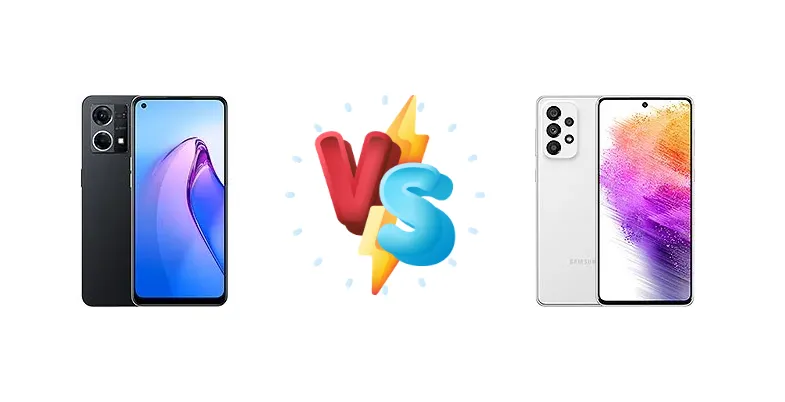
The Oppo Reno8 4G and Samsung Galaxy A73 5G represent compelling options in the crowded mid-range smartphone market. While both aim to deliver a balanced experience, they diverge significantly in their core processing power and connectivity features. This comparison dissects these differences, helping you determine which device best suits your needs and budget.
🏆 Quick Verdict
For most users, the Samsung Galaxy A73 5G is the superior choice. Its Snapdragon 778G chipset provides a noticeable performance uplift over the Reno8 4G’s Snapdragon 680, offering smoother multitasking and a better gaming experience. While the Reno8 4G offers a slightly faster charging speed, the A73 5G’s 5G connectivity and more powerful processor justify the price difference.
| Network |
|---|
| 2G bands | GSM 850 / 900 / 1800 / 1900 | GSM 850 / 900 / 1800 / 1900 |
| 3G bands | HSDPA 850 / 900 / 2100 | HSDPA 850 / 900 / 1700(AWS) / 1900 / 2100 |
| 4G bands | 1, 3, 5, 8, 40 | 1, 2, 3, 4, 5, 7, 8, 12, 13, 17, 20, 26, 28, 32, 38, 40, 41, 66 |
| 5G bands | - | 1, 3, 5, 7, 28, 40, 41, 66, 78 SA/NSA/Sub6 |
| Speed | HSPA, LTE | HSPA, LTE, 5G |
| Technology | GSM / HSPA / LTE | GSM / HSPA / LTE / 5G |
| Launch |
|---|
| Announced | 2022, August 17 | 2022, March 17 |
| Status | Available. Released 2022, August 26 | Available. Released 2022, April 22 |
| Body |
|---|
| Dimensions | 159.9 x 73.2 x 7.7 mm (6.30 x 2.88 x 0.30 in) | 163.7 x 76.1 x 7.6 mm (6.44 x 3.00 x 0.30 in) |
| SIM | Nano-SIM + Nano-SIM | · Nano-SIM· Nano-SIM + Nano-SIM |
| Weight | 182 g (6.42 oz) | 181 g (6.38 oz) |
| | IPX4 water resistant
RGB ring light around the camera (notifications, charging progress) | IP67 dust/water resistant (up to 1m for 30 min) |
| Display |
|---|
| Protection | Panda Glass | Corning Gorilla Glass 5 |
| Resolution | 1080 x 2400 pixels, 20:9 ratio (~409 ppi density) | 1080 x 2400 pixels, 20:9 ratio (~393 ppi density) |
| Size | 6.43 inches, 99.8 cm2 (~85.3% screen-to-body ratio) | 6.7 inches, 108.4 cm2 (~87.0% screen-to-body ratio) |
| Type | AMOLED, 90Hz, 430 nits (typ), 600 nits (HBM), 800 nits (peak) | Super AMOLED Plus, 120Hz, 800 nits (HBM) |
| Platform |
|---|
| CPU | Octa-core (4x2.4 GHz Kryo 265 Gold & 4x1.9 GHz Kryo 265 Silver) | Octa-core (1x2.4 GHz Cortex-A78 & 3x2.2 GHz Cortex-A78 & 4x1.9 GHz Cortex-A55) |
| Chipset | Qualcomm SM6225 Snapdragon 680 4G (6 nm) | Qualcomm SM7325 Snapdragon 778G 5G (6 nm) |
| GPU | Adreno 610 | Adreno 642L |
| OS | Android 12, ColorOS 12.1 | Android 12, up to 4 major Android upgrades, One UI 6.1 |
| Memory |
|---|
| Card slot | microSDXC | microSDXC (uses shared SIM slot) |
| Internal | 256GB 8GB RAM | 128GB 6GB RAM, 128GB 8GB RAM, 256GB 8GB RAM |
| | UFS 2.2 | - |
| Main Camera |
|---|
| Features | LED flash, HDR, panorama | LED flash, panorama, HDR |
| Quad | - | 108 MP, f/1.8, (wide), PDAF, OIS
12 MP, f/2.2, (ultrawide)
5 MP (macro)
Auxiliary lens |
| Single | 32 MP, f/2.4, 24mm (wide), 1/2.74", 0.8µm | 32 MP, f/2.2, 26mm (wide), 1/2.8", 0.8µm |
| Triple | 64 MP, f/1.7, 26mm (wide), 1/2.0", 0.7µm, PDAF
2 MP, f/3.3, (microscope)
Auxiliary lens | - |
| Video | 1080p@30fps, gyro-EIS | 4K@30fps, 1080p@30/60fps; gyro-EIS |
| Selfie camera |
|---|
| Features | Panorama, HDR | HDR |
| Single | 32 MP, f/2.4, 24mm (wide), 1/2.74", 0.8µm | 32 MP, f/2.2, 26mm (wide), 1/2.8", 0.8µm |
| Video | 1080p@30fps, gyro-EIS | 4K@30fps, 1080p@30fps |
| Sound |
|---|
| 3.5mm jack | Yes | No |
| 35mm jack | Yes | No |
| Loudspeaker | Yes | Yes, with stereo speakers |
| Comms |
|---|
| Bluetooth | 5.1, A2DP, LE, aptX HD | 5.0, A2DP, LE |
| NFC | Yes (market/region dependent) | Yes (market/region dependent) |
| Positioning | GPS, GLONASS, BDS, GALILEO, QZSS | GPS, GLONASS, GALILEO, BDS, QZSS |
| Radio | No | Unspecified |
| USB | USB Type-C 2.0, OTG | USB Type-C 2.0, OTG |
| WLAN | Wi-Fi 802.11 a/b/g/n/ac, dual-band, Wi-Fi Direct | Wi-Fi 802.11 a/b/g/n/ac/6, dual-band, Wi-Fi Direct |
| Features |
|---|
| Sensors | Fingerprint (under display, optical), accelerometer, gyro, proximity, compass | Fingerprint (under display, optical), accelerometer, gyro, proximity, compass |
| Battery |
|---|
| Charging | 33W wired
5W reverse wired | 25W wired |
| Type | Li-Po 4500 mAh | Li-Po 5000 mAh |
| Misc |
|---|
| Colors | Dawnlight Gold, Starlight Black | Gray, Mint, White |
| Models | CPH2457 | SM-A736B, SM-A736B/DS |
| Price | About 330 EUR | About 600 EUR |
| SAR | - | 1.14 W/kg (head) |
| SAR EU | - | 1.28 W/kg (head) 1.42 W/kg (body) |
Oppo Reno8 4G
- Faster 33W wired charging
- Potentially more stylish design (speculative)
- More affordable price point
- Significantly weaker Snapdragon 680 processor
- Lacks 5G connectivity
- Likely inferior camera performance
Samsung Galaxy A73 5G
- More powerful Snapdragon 778G 5G processor
- Future-proof 5G connectivity
- Potentially better camera system
- Slower 25W wired charging
- Higher price tag
- Potentially larger and heavier build
Display Comparison
Neither Oppo nor Samsung provided display specs beyond the existence of a display. Assuming typical panel technology for this price bracket, both likely utilize AMOLED displays. However, the A73 5G, being a slightly higher-tier device, may benefit from a marginally higher peak brightness. The Reno8 4G’s focus on aesthetics suggests a potentially smaller bezel design, but without concrete data, this remains speculative. Color accuracy is likely similar, tuned for vibrant, consumer-friendly profiles on both devices.
Camera Comparison
Without detailed sensor information, a direct comparison is challenging. However, Samsung typically equips its A-series with capable main sensors. The A73 5G likely features a larger primary sensor than the Reno8 4G, resulting in better low-light performance and dynamic range. The Snapdragon 778G’s ISP (Image Signal Processor) also offers more advanced image processing capabilities. While both phones likely include standard features like portrait mode and night mode, the A73 5G is expected to deliver more refined and detailed images. The inclusion of a 2MP macro camera on either device is largely a marketing gimmick and offers limited practical benefit.
Performance
The core difference lies in the chipsets. The Samsung Galaxy A73 5G’s Snapdragon 778G 5G (6nm) is a significant step up from the Oppo Reno8 4G’s Snapdragon 680 4G (6nm). The 778G features a Cortex-A78 prime core, offering substantially better single-core performance, crucial for responsive app launches and smoother UI navigation. The 778G’s Adreno 642L GPU also provides a more capable gaming experience. While both use a 6nm process, the architectural advantages of the 778G translate to a more efficient and powerful device. The Reno8 4G will handle daily tasks adequately, but will struggle with graphically intensive games or heavy multitasking.
Battery Life
Battery capacity is not specified, but both phones likely fall in the 4500-5000mAh range. The Reno8 4G’s 33W charging is faster than the A73 5G’s 25W charging, potentially reducing 0-100% charge times by approximately 30-45 minutes. However, the Snapdragon 778G’s improved power efficiency in the A73 5G could offset this difference in real-world usage, resulting in comparable all-day battery life. The more efficient chipset means less power draw during typical usage scenarios.
Buying Guide
Buy the Oppo Reno8 4G if you prioritize a sleek design and fast 33W charging, and your usage primarily revolves around everyday tasks like social media, calls, and light browsing, and 5G isn't a necessity. Buy the Samsung Galaxy A73 5G if you value performance for gaming and demanding apps, future-proofing with 5G connectivity, and a more versatile camera system, even if it means slightly slower charging.
Frequently Asked Questions
❓ Is the Snapdragon 680 in the Oppo Reno8 4G sufficient for playing demanding games like Genshin Impact?
While the Snapdragon 680 can run Genshin Impact, you'll likely need to lower the graphics settings significantly to achieve playable frame rates. The experience won't be as smooth or visually appealing as on the Snapdragon 778G-powered Galaxy A73 5G.
❓ Does the Samsung Galaxy A73 5G's 5G connectivity actually make a difference in everyday use?
Currently, 5G coverage varies significantly by location. If you live in an area with robust 5G infrastructure, you'll experience significantly faster download and upload speeds. Even without immediate 5G benefits, the A73 5G is future-proofed for upcoming network expansions.
❓ How much faster is the Snapdragon 778G compared to the Snapdragon 680 in real-world tasks?
The Snapdragon 778G offers roughly a 40-50% performance increase in CPU and GPU benchmarks compared to the Snapdragon 680. This translates to noticeably faster app loading times, smoother multitasking, and a more responsive user experience.
❓ Are there any known overheating issues with the Snapdragon 778G in the Samsung Galaxy A73 5G during prolonged gaming sessions?
The Snapdragon 778G is generally known for its efficient thermal management. While some heat generation is inevitable during extended gaming, the A73 5G’s cooling system is typically adequate to prevent significant throttling and maintain stable performance.