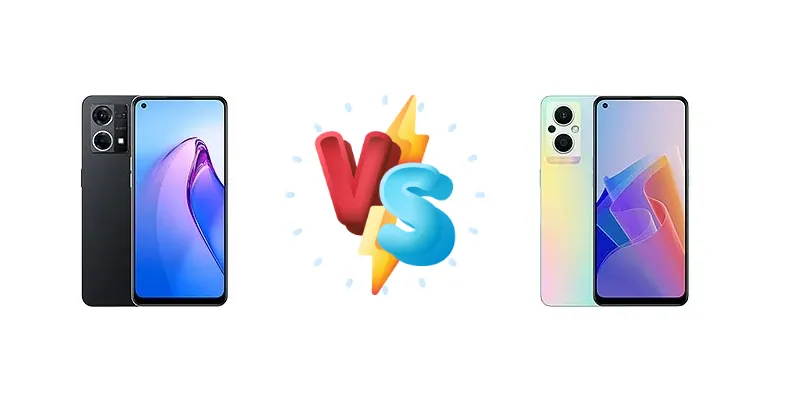
Choosing between the Oppo Reno8 4G and Reno7 Lite can be tricky. Both offer stylish designs and competitive features, but cater to slightly different needs. This comprehensive comparison will dissect their strengths and weaknesses to help you make the right decision.
🏆 Quick Verdict
The Oppo Reno7 Lite edges out the Reno8 4G thanks to its superior Snapdragon 695 5G chipset, offering better performance and 5G connectivity. While both have good battery life, the Reno7 Lite's slightly faster charging and overall processing power make it the winner.
| Network |
|---|
| 2G bands | GSM 850 / 900 / 1800 / 1900 | GSM 850 / 900 / 1800 / 1900 |
| 3G bands | HSDPA 850 / 900 / 2100 | HSDPA 800 / 850 / 900 / 1900 / 2100 |
| 4G bands | 1, 3, 5, 8, 40 | 1, 3, 5, 7, 8, 28, 34, 38, 39, 40, 41 |
| 5G bands | - | 1, 8, 28, 41, 77, 78 SA/NSA |
| Speed | HSPA, LTE | HSPA, LTE, 5G |
| Technology | GSM / HSPA / LTE | GSM / HSPA / LTE / 5G |
| Launch |
|---|
| Announced | 2022, August 17 | 2022, April 14 |
| Status | Available. Released 2022, August 26 | Available. Released 2022, June |
| Body |
|---|
| Build | - | Glass front, plastic frame, glass back |
| Dimensions | 159.9 x 73.2 x 7.7 mm (6.30 x 2.88 x 0.30 in) | 159.9 x 73.2 x 7.5 mm (6.30 x 2.88 x 0.30 in) |
| SIM | Nano-SIM + Nano-SIM | Nano-SIM + Nano-SIM |
| Weight | 182 g (6.42 oz) | 173 g (6.10 oz) |
| | IPX4 water resistant
RGB ring light around the camera (notifications, charging progress) | IPX4, dust and water resistant
RGB ring lights around the cameras (notifications, charging progress) |
| Display |
|---|
| Protection | Panda Glass | - |
| Resolution | 1080 x 2400 pixels, 20:9 ratio (~409 ppi density) | 1080 x 2400 pixels, 20:9 ratio (~409 ppi density) |
| Size | 6.43 inches, 99.8 cm2 (~85.3% screen-to-body ratio) | 6.43 inches, 99.8 cm2 (~85.3% screen-to-body ratio) |
| Type | AMOLED, 90Hz, 430 nits (typ), 600 nits (HBM), 800 nits (peak) | AMOLED, 430 nits (typ), 600 nits (HBM) |
| Platform |
|---|
| CPU | Octa-core (4x2.4 GHz Kryo 265 Gold & 4x1.9 GHz Kryo 265 Silver) | Octa-core (2x2.2 GHz Kryo 660 Gold & 6x1.7 GHz Kryo 660 Silver) |
| Chipset | Qualcomm SM6225 Snapdragon 680 4G (6 nm) | Qualcomm SM6375 Snapdragon 695 5G (6 nm) |
| GPU | Adreno 610 | Adreno 619 |
| OS | Android 12, ColorOS 12.1 | Android 11, ColorOS 12 |
| Memory |
|---|
| Card slot | microSDXC | microSDXC |
| Internal | 256GB 8GB RAM | 128GB 8GB RAM, 256GB 8GB RAM |
| | UFS 2.2 | UFS 2.2 |
| Main Camera |
|---|
| Features | LED flash, HDR, panorama | LED flash, HDR, panorama |
| Single | 32 MP, f/2.4, 24mm (wide), 1/2.74", 0.8µm | 16 MP, f/2.4, 27mm (wide), 1.0µm |
| Triple | 64 MP, f/1.7, 26mm (wide), 1/2.0", 0.7µm, PDAF
2 MP, f/3.3, (microscope)
Auxiliary lens | 64 MP, f/1.7, 26mm (wide), PDAF
2 MP (macro)
Auxiliary lens |
| Video | 1080p@30fps, gyro-EIS | 1080p@30fps |
| Selfie camera |
|---|
| Features | Panorama, HDR | HDR, panorama |
| Single | 32 MP, f/2.4, 24mm (wide), 1/2.74", 0.8µm | 16 MP, f/2.4, 27mm (wide), 1.0µm |
| Video | 1080p@30fps, gyro-EIS | 1080p@30fps |
| Sound |
|---|
| 3.5mm jack | Yes | Yes |
| 35mm jack | Yes | Yes |
| Loudspeaker | Yes | Yes |
| Comms |
|---|
| Bluetooth | 5.1, A2DP, LE, aptX HD | 5.1, A2DP, LE, aptX HD |
| NFC | Yes (market/region dependent) | Yes |
| Positioning | GPS, GLONASS, BDS, GALILEO, QZSS | GPS, GLONASS, BDS, GALILEO, QZSS |
| Radio | No | No |
| USB | USB Type-C 2.0, OTG | USB Type-C 2.0, OTG |
| WLAN | Wi-Fi 802.11 a/b/g/n/ac, dual-band, Wi-Fi Direct | Wi-Fi 802.11 a/b/g/n/ac, dual-band, Wi-Fi Direct |
| Features |
|---|
| Sensors | Fingerprint (under display, optical), accelerometer, gyro, proximity, compass | Fingerprint (under display, optical), accelerometer, proximity, gyro, compass |
| Battery |
|---|
| Charging | 33W wired
5W reverse wired | 33W wired, PD, 31% in 15 min, 100% in 63 min
Reverse wired |
| Type | Li-Po 4500 mAh | Li-Po 4500 mAh |
| Misc |
|---|
| Colors | Dawnlight Gold, Starlight Black | Cosmic Black, Champagne Silver |
| Models | CPH2457 | CPH2343 |
| Price | About 330 EUR | About 350 EUR |
| Tests |
|---|
| Battery life | - |
Endurance rating 125h
|
| Camera | - |
Photo / Video |
| Display | - |
Contrast ratio: Infinite (nominal) |
| Loudspeaker | - |
-28.5 LUFS (Average)
|
| Performance | - |
AnTuTu: 315250 (v8), 376819 (v9)
GeekBench: 1996 (v5.1)
GFXBench: 17fps (ES 3.1 onscreen) |
Oppo Reno8 4G
- More affordable
- Stylish design
- Decent battery life
- Less powerful chipset
- No 5G connectivity
- Slower charging
Oppo Reno7 Lite
- Faster performance (Snapdragon 695 5G)
- 5G connectivity
- Faster charging
- Brighter display
- Slightly more expensive
- Infinite contrast ratio claim is nominal
Display Comparison
Both phones feature vibrant displays, but the Reno7 Lite boasts a measured peak brightness of 657 nits, offering better visibility in direct sunlight. The Reno7 Lite's 'infinite' contrast ratio (nominal) suggests excellent blacks and vibrant colors, though this is a marketing term and real-world performance may vary. The Reno8 4G's display is likely good, but lacks the quantifiable brightness advantage of the Reno7 Lite.
Camera Comparison
Both phones offer capable camera systems, but detailed camera comparisons require more in-depth testing. The Reno7 Lite likely benefits from the more powerful image signal processor (ISP) within the Snapdragon 695, potentially leading to slightly better image quality and video recording. Both are expected to deliver good results in well-lit conditions.
Performance
The Reno7 Lite's Snapdragon 695 5G chipset is a significant upgrade over the Reno8 4G's Snapdragon 680. The 695 offers noticeably better CPU and GPU performance, resulting in smoother multitasking, faster app loading times, and improved gaming. The Reno8 4G is adequate for everyday tasks, but will struggle with more demanding applications.
Battery Life
Both phones share a similar battery capacity and offer 33W wired charging. The Reno7 Lite's charging speeds are slightly faster (31% in 15 min, 100% in 63 min) compared to the Reno8 4G. Both phones boast an endurance rating of 125h, suggesting excellent battery life for typical usage.
Buying Guide
The Oppo Reno8 4G is ideal for users prioritizing a budget-friendly option and don't need 5G. The Oppo Reno7 Lite is a better choice for those seeking a smoother experience, faster charging, and future-proof 5G capabilities.
Frequently Asked Questions
❓ Is the Oppo Reno8 4G worth buying in 2024?
If you're on a tight budget and don't need 5G, the Reno8 4G can still be a decent option. However, the Reno7 Lite offers better value overall.
❓ Which phone has better gaming performance?
The Oppo Reno7 Lite, thanks to its Snapdragon 695 5G chipset, provides significantly better gaming performance than the Reno8 4G.