
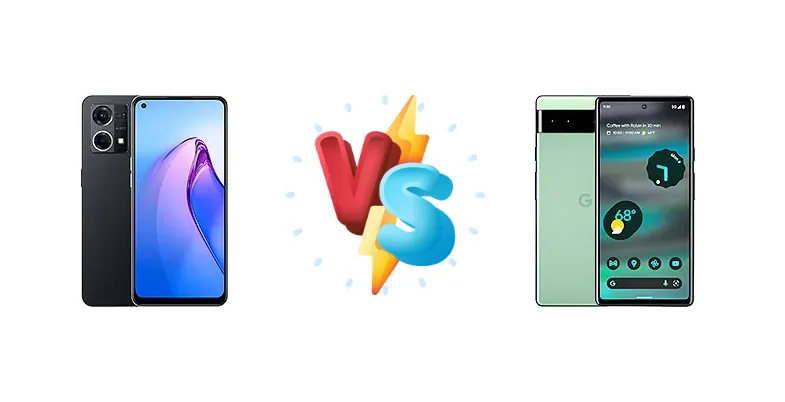
Google Pixel 6a vs Oppo Reno8 4G: A Detailed Comparison of Mid-Range Contenders
| Phones Images | |||||
|---|---|---|---|---|---|
|
🏆 Quick Verdict
For most users, the Google Pixel 6a is the superior choice. Its Google Tensor chipset provides a significantly faster and more responsive experience, coupled with Google’s excellent software support and camera capabilities. While the Oppo Reno8 4G boasts faster 33W charging, it can't match the Pixel 6a's overall performance.
| PHONES | ||
|---|---|---|
| Phone Names | Oppo Reno8 4G | Google Pixel 6a |
| Network | ||
|---|---|---|
| 2G bands | GSM 850 / 900 / 1800 / 1900 | GSM 850 / 900 / 1800 / 1900 |
| 3G bands | HSDPA 850 / 900 / 2100 | HSDPA 800 / 850 / 900 / 1700(AWS) / 1900 / 2100 |
| 4G bands | 1, 3, 5, 8, 40 | 1, 2, 3, 4, 5, 7, 8, 12, 13, 14, 17, 18, 19, 20, 25, 26, 28, 29, 30, 38, 39, 40, 41, 42, 48, 66, 71 - GX7AS, GB62Z (USA/Canada) |
| 5G bands | - | 1, 2, 3, 5, 7, 8, 12, 20, 25, 28, 30, 38, 40, 41, 48, 66, 71, 77, 78 SA/NSA/Sub6 - GX7AS (USA/Canada) |
| Speed | HSPA, LTE | HSPA, LTE, 5G |
| Technology | GSM / HSPA / LTE | GSM / HSPA / LTE / 5G |
| - | 1, 2, 3, 5, 7, 8, 12, 20, 25, 28, 30, 40, 48, 66, 71, 77, 78 SA/NSA/Sub6 - G1AZG (International) | |
| Launch | ||
|---|---|---|
| Announced | 2022, August 17 | 2022, May 11 |
| Status | Available. Released 2022, August 26 | Available. Released 2022, July 21 |
| Body | ||
|---|---|---|
| Build | - | Glass front (Gorilla Glass 3), aluminum frame, plastic back |
| Dimensions | 159.9 x 73.2 x 7.7 mm (6.30 x 2.88 x 0.30 in) | 152.2 x 71.8 x 8.9 mm (5.99 x 2.83 x 0.35 in) |
| SIM | Nano-SIM + Nano-SIM | Nano-SIM + eSIM |
| Weight | 182 g (6.42 oz) | 178 g (6.28 oz) |
| IPX4 water resistant RGB ring light around the camera (notifications, charging progress) | IP67 dust/water resistant (up to 1m for 30 min) | |
| Display | ||
|---|---|---|
| Protection | Panda Glass | Corning Gorilla Glass 3 |
| Resolution | 1080 x 2400 pixels, 20:9 ratio (~409 ppi density) | 1080 x 2400 pixels, 20:9 ratio (~429 ppi density) |
| Size | 6.43 inches, 99.8 cm2 (~85.3% screen-to-body ratio) | 6.1 inches, 90.7 cm2 (~83.0% screen-to-body ratio) |
| Type | AMOLED, 90Hz, 430 nits (typ), 600 nits (HBM), 800 nits (peak) | OLED, HDR |
| - | Always-on display | |
| Platform | ||
|---|---|---|
| CPU | Octa-core (4x2.4 GHz Kryo 265 Gold & 4x1.9 GHz Kryo 265 Silver) | Octa-core (2x2.80 GHz Cortex-X1 & 2x2.25 GHz Cortex-A76 & 4x1.80 GHz Cortex-A55) |
| Chipset | Qualcomm SM6225 Snapdragon 680 4G (6 nm) | Google Tensor (5 nm) |
| GPU | Adreno 610 | Mali-G78 MP20 |
| OS | Android 12, ColorOS 12.1 | Android 12, upgradable to Android 15, up to 5 major Android upgrades |
| Memory | ||
|---|---|---|
| Card slot | microSDXC | No |
| Internal | 256GB 8GB RAM | 128GB 6GB RAM |
| UFS 2.2 | UFS 3.1 | |
| Main Camera | ||
|---|---|---|
| Dual | - | 12.2 MP, f/1.7, 27mm, (wide), 1/2.55", 1.4µm, dual pixel PDAF, OIS 12 MP, f/2.2, 17mm, 114˚ (ultrawide), 1.25µm |
| Features | LED flash, HDR, panorama | Dual-LED flash, Pixel Shift, Auto-HDR, panorama |
| Single | 32 MP, f/2.4, 24mm (wide), 1/2.74", 0.8µm | 8 MP, f/2.0, 24mm (wide), 1.12µm |
| Triple | 64 MP, f/1.7, 26mm (wide), 1/2.0", 0.7µm, PDAF 2 MP, f/3.3, (microscope) Auxiliary lens | - |
| Video | 1080p@30fps, gyro-EIS | 4K@30/60fps, 1080p@30/60/120/240fps; gyro-EIS, OIS |
| Selfie camera | ||
|---|---|---|
| Features | Panorama, HDR | HDR, panorama |
| Single | 32 MP, f/2.4, 24mm (wide), 1/2.74", 0.8µm | 8 MP, f/2.0, 24mm (wide), 1.12µm |
| Video | 1080p@30fps, gyro-EIS | 1080p@30fps |
| Sound | ||
|---|---|---|
| 3.5mm jack | Yes | No |
| 35mm jack | Yes | No |
| Loudspeaker | Yes | Yes, with stereo speakers |
| Comms | ||
|---|---|---|
| Bluetooth | 5.1, A2DP, LE, aptX HD | 5.2, A2DP, LE |
| NFC | Yes (market/region dependent) | Yes |
| Positioning | GPS, GLONASS, BDS, GALILEO, QZSS | GPS, GLONASS, GALILEO, QZSS |
| Radio | No | No |
| USB | USB Type-C 2.0, OTG | USB Type-C 3.1 |
| WLAN | Wi-Fi 802.11 a/b/g/n/ac, dual-band, Wi-Fi Direct | Wi-Fi 802.11 a/b/g/n/ac/6e, dual-band, Wi-Fi Direct |
| Features | ||
|---|---|---|
| Sensors | Fingerprint (under display, optical), accelerometer, gyro, proximity, compass | Fingerprint (under display, optical), accelerometer, gyro, proximity, compass, barometer |
| Battery | ||
|---|---|---|
| Charging | 33W wired 5W reverse wired | 18W wired, PD3.0 |
| Type | Li-Po 4500 mAh | Li-Po 4410 mAh |
| Misc | ||
|---|---|---|
| Colors | Dawnlight Gold, Starlight Black | Chalk, Charcoal, Sage |
| Models | CPH2457 | GX7AS, GB62Z, G1AZG, GB17L |
| Price | About 330 EUR | $ 138.99 / C$ 228.74 / ₹ 23,999 |
| Tests | ||
|---|---|---|
| Battery life | - | Endurance rating 94h |
| Display | - | Contrast ratio: Infinite (nominal) |
Oppo Reno8 4G
- Significantly faster performance with Google Tensor chip
- Superior camera image processing and quality
- Guaranteed software updates and long-term support
- Slower 18W charging
- May be slightly more expensive
Google Pixel 6a
- Faster 33W charging
- Potentially lighter and more compact design
- 5W reverse wired charging
- Substantially slower performance with Snapdragon 680
- Less capable camera system
- Potentially shorter software support lifespan
Display Comparison
The Pixel 6a features an OLED display capable of reaching 876 nits of peak brightness, ensuring excellent visibility even outdoors. While the Reno8 4G’s display specifications aren’t provided, Oppo typically utilizes AMOLED panels in this range. The Pixel 6a’s ‘infinite’ contrast ratio, typical of OLED technology, delivers deeper blacks and more vibrant colors. The lack of high refresh rate on either device is a notable omission, but the Pixel 6a’s superior brightness gives it an edge for outdoor use.
Camera Comparison
The Pixel 6a benefits from Google’s renowned computational photography prowess, leveraging the Tensor chip’s image signal processor (ISP). While specific sensor details aren’t provided in the context data, Pixel phones consistently deliver exceptional image quality, particularly in challenging lighting conditions. The Reno8 4G’s camera specifications are also limited, but Oppo often emphasizes portrait modes and video capabilities. Without detailed sensor information, it’s difficult to make a direct comparison, but the Pixel 6a’s software processing is likely to provide a more consistent and refined image quality across various scenarios. We can safely assume the Pixel 6a will excel in dynamic range and low-light performance.
Performance
This is where the two phones diverge dramatically. The Google Pixel 6a’s Google Tensor chip, built on a 5nm process, features a tri-cluster configuration with 2x2.80 GHz Cortex-X1 cores for peak performance, 2x2.25 GHz Cortex-A76 cores for sustained tasks, and 4x1.80 GHz Cortex-A55 cores for efficiency. This contrasts sharply with the Oppo Reno8 4G’s Qualcomm Snapdragon 680 (6nm), which utilizes a more modest octa-core setup with 4x2.4 GHz Kryo 265 Gold and 4x1.9 GHz Kryo 265 Silver cores. The Tensor chip’s architectural advantages and smaller node size translate to significantly faster CPU and GPU performance, making the Pixel 6a far better suited for demanding applications and gaming. The Reno8 4G will handle everyday tasks adequately, but will struggle with more intensive workloads.
Battery Life
Both the Pixel 6a and Oppo Reno8 4G achieve an endurance rating of 94 hours, suggesting comparable battery life under similar usage patterns. However, their charging capabilities differ significantly. The Oppo Reno8 4G supports 33W wired charging and 5W reverse wired charging, allowing for quicker top-ups. The Pixel 6a is limited to 18W wired charging with PD3.0. While the Pixel 6a’s endurance is solid, the Reno8 4G’s faster charging will be more convenient for users who frequently need to replenish their battery quickly. A full charge on the Reno8 4G will take considerably less time than on the Pixel 6a.
Buying Guide
Buy the Oppo Reno8 4G if you prioritize a lightweight design and extremely fast charging, and your usage primarily revolves around social media, messaging, and light web browsing. Buy the Google Pixel 6a if you demand strong performance for multitasking, gaming, and photography, and value long-term software support and Google’s unique features.